
Production and Manufacturer History
Designed by the Waco Aircraft Company of Troy, Ohio, the CG-4 (designated as the CG-4A Hadrian by the USAAF) was mass-produced to meet the urgent demands of World War II. Production began in 1942 and continued through mid-1945, with the National Museum of the USAF noting an example accepted as late as July 1945. To achieve the necessary scale, 15 different U.S. manufacturers produced the glider under license. While Waco built 1,074 units, other firms such as the Gibson Refrigerator Company of Greenville, Michigan, also contributed to the effort. Total production figures vary by source, with estimates ranging from over 12,000 to nearly 14,000 units, produced at an average cost of $18,800 per aircraft.
Design and Technical Specifications
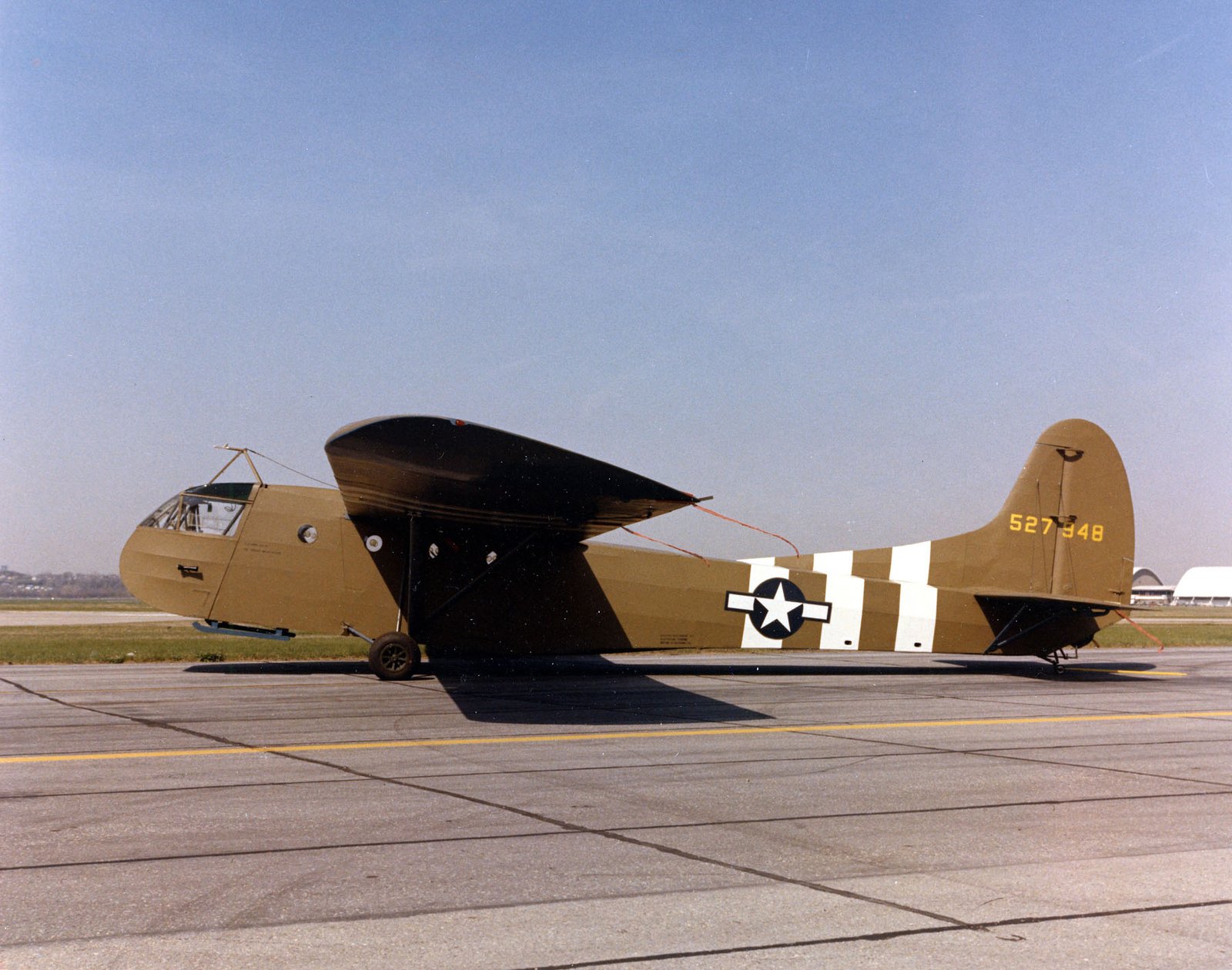
As a pure glider, the CG-4A had no engine and relied on tow aircraft, primarily the C-47 Skytrain and C-46 Commando, for deployment. The aircraft featured a fabric-covered wood and metal framework with a wingspan of 83 feet 8 inches, a length of 48 feet 4 inches, and a height of 12 feet 7 inches. A defining design feature was the up-hinged nose section, which included the cockpit; this allowed for the direct loading of heavy equipment. The glider could transport 13 fully equipped troops or a variety of cargo, including a jeep with a four-man crew, a 75 mm pack howitzer, a light anti-tank gun, or a CA-1 Clark airborne bulldozer. The crew consisted of a pilot and a copilot, and the aircraft could reach a maximum towed speed of 150 mph.
Military Service
The CG-4A was the most widely used U.S. troop and cargo glider of World War II, operated primarily by the United States Army Air Forces. It saw extensive action across multiple theaters, beginning with the invasion of Sicily in July 1943. In the European Theater, it played a vital role during the D-Day assaults in Normandy on June 6, 1944, supporting the 101st and 82nd Airborne Divisions. It was further utilized during the invasion of Southern France in August 1944—where 405 gliders delivered nearly 3,000 men—as well as Operation Market Garden in the Netherlands and Operation Varsity during the Rhine crossing in 1945. In the China-Burma-India theater, the 1st Air Commando used the glider for operations in Burma, including a March 1944 mission that landed forces 150 miles behind Japanese lines.
Legacy
Because they were constructed from humble materials and intended to be expendable, most CG-4As were abandoned or destroyed after their first combat landing. Following the war, the aircraft quickly became obsolete, and glider training in the U.S. ended by 1953. However, the USAF utilized the type into the early 1950s to support scientific research in the Arctic. Today, examples are preserved in museums, including the Air Mobility Command Museum at Dover AFB and the National Museum of the United States Air Force, which displays serial number 45-27948.