
Production and Manufacturer History
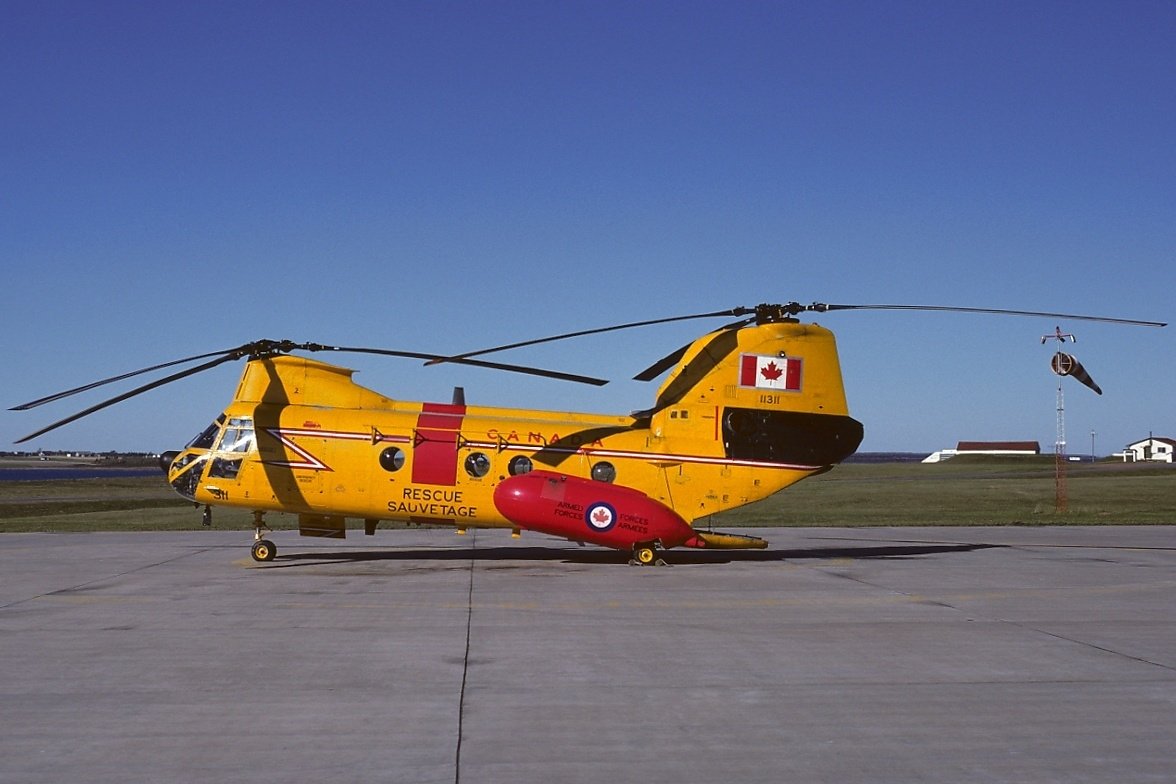
The Boeing Vertol CH-113 Labrador was a Canadian variant of the Boeing Vertol Model 107/CH-46 Sea Knight family. The aircraft were manufactured at the Boeing Vertol facility in Philadelphia, Pennsylvania. The manufacturer, Boeing Vertol, emerged after Boeing acquired the Vertol Aircraft Corporation in 1960, which had previously evolved from the Piasecki Helicopter Corporation. While a precise production window for the CH-113 is not explicitly documented, the parent CH-46 type was produced between 1962 and 1971, and the first Labrador entered service with the Royal Canadian Air Force (RCAF) on October 11, 1963.
Canada procured a total of 18 airframes to the CH-113/113A specification. This included six CH-113 Labradors dedicated to search-and-rescue (SAR) and twelve CH-113A Voyageurs intended for medium-lift assault and utility transport for the Canadian Army. Following the acquisition of the CH-147 Chinook in the mid-1970s, the Army's Voyageurs were refurbished to the Labrador SAR standard and re-designated as CH-113A Labradors. This conversion process resulted in a total of 15 Labradors in active service.
Design and Technical Details
As a derivative of the Model 107, the CH-113 featured a twin-engine, tandem-rotor layout. This design eliminated the need for a tail rotor and provided superior lift and center-of-gravity flexibility, which was essential for transporting cargo, troops, and rescue equipment. The Labrador configuration was specifically optimized for long-range SAR, incorporating rescue hoists, extended fuel capacity, and specialized avionics for poor-weather operations. The aircraft utilized two General Electric T58 series turboshaft engines, a powerplant common to the mature Model 107 and CH-46 variants, providing the reliability necessary for over-water missions.
Service History and Legacy
The CH-113 served primarily in peacetime roles within the Canadian Forces. The CH-113A Voyageur initially performed tactical troop and cargo transport for the Canadian Army, while the CH-113 Labrador focused on strategic domestic SAR. Over its service life, the aircraft became a cornerstone of Canadian rescue operations, responding to emergencies in harsh northern terrains and maritime environments. The fleet remained in operation until the final CH-113 was retired in 2004.
Today, the legacy of the Labrador is preserved through static displays. A Boeing Vertol CH-113 is held at the Canada Aviation and Space Museum, and other examples, such as airframe 11301, have been documented in preserved condition in locations such as Arnprior, Ontario.