
Service History
The CH-300 Tri-Zénith carved out a distinctive niche in the homebuilt aircraft market during its 22-year production run from 1977 to 1999. More than 400 sets of plans had been sold by 1982, with several hundred complete kits distributed globally before the final deliveries around 1992. The aircraft found particular favor among Canadian builders, with at least 20 to 30 examples appearing on Canadian registers between the late 1970s and 1995, and approximately 45 remaining operational as of 2011.
The type's most celebrated achievement came just one year after its maiden flight when Robin "Red" Morris, assisted by Gerry Boudreau and Doug Holtby, completed assembly of C-GOVK in May 1978. On July 1-2, 1978, Morris piloted this aircraft on a remarkable non-stop trans-Canada flight from Vancouver International Airport to Halifax International Airport, covering 4,440 to 4,500 kilometers in 22 hours and 43 to 44 minutes despite facing headwinds, generator failure, and challenging mountain terrain over the Rockies. This flight established three FAI Class C-1c speed records and demonstrated the aircraft's exceptional long-range capabilities.
The Manufacturer
Zenair Ltd. emerged from humble beginnings in 1974 when French aeronautical engineer Christophe "Chris" Heintz established the company in a two-car garage in Richmond, Ontario. Despite its modest origins, Zenair rapidly expanded to serve global markets, developing eight distinct light aircraft designs throughout its operational period. The company's breakthrough came in the late 1970s when both the CH-200 and CH-300 designs earned awards for efficiency and quality, with the aircraft featured prominently at the 1977 EAA Annual Convention and Fly-In.
Zenair entered the ultralight market in 1983, broadening its product portfolio beyond traditional homebuilt aircraft. The company continued operations through at least 1999, eventually evolving into or being acquired by entities that maintained the Zenair brand. Today, Zenair Ltd. remains active in aircraft manufacturing, producing modern designs such as the CH 640 Zodiac while maintaining the engineering philosophy established by Chris Heintz.
Design Philosophy and Technical Innovation
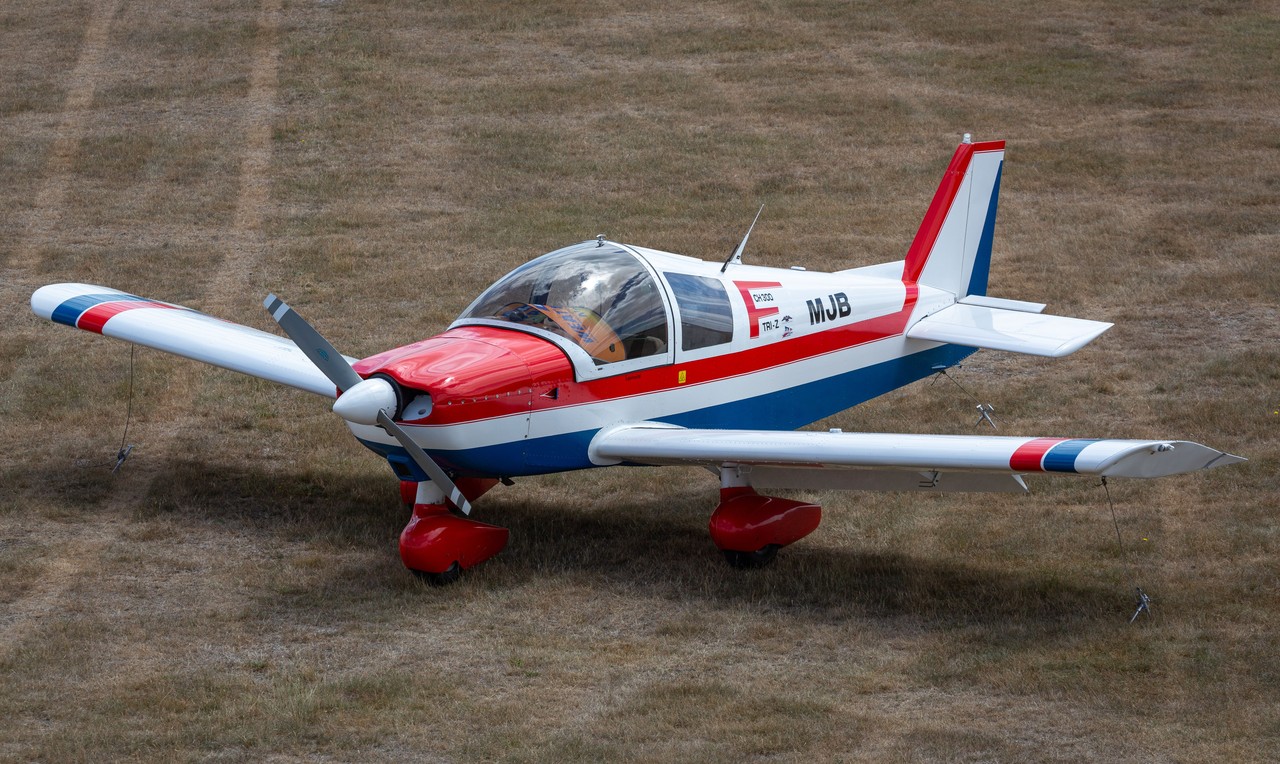
Chris Heintz conceived the CH-300 as an enlarged three-seat derivative of his successful Zenair CH-200 design. The primary objective was creating a capable cross-country aircraft for homebuilders that could accommodate three adults or include two children on the rear bench seat. The all-metal construction philosophy departed from the wood-and-fabric approach common among homebuilts of the era, offering greater durability and a more professional appearance.
The aircraft featured a forward-sliding canopy that provided excellent visibility and ease of entry, while the low-wing configuration delivered superior performance compared to high-wing alternatives. Builders could choose between two landing gear configurations: the standard CH-300 with fixed tricycle gear, or the CH-300 TD variant equipped with conventional taildragger landing gear.
The powerplant flexibility represented another key design strength, with the airframe engineered to accept inline piston engines producing between 125 and 180 horsepower. This range allowed builders to select engines based on their performance requirements and budget constraints, from modest touring configurations to high-performance cross-country machines.
Record-Setting Performance
The trans-Canada flight of C-GOVK required extensive modifications to achieve its record-breaking range. Morris and his team installed a custom fuel system holding 773 liters (170 imperial gallons) compared to the standard 127 liters (28 imperial gallons), nearly quintupling the aircraft's fuel capacity. Additional equipment included specialized instruments and an autopilot system essential for the lengthy solo flight across the Canadian wilderness.
This achievement validated Heintz's design objectives, proving that a homebuilt aircraft could deliver airline-level reliability and performance. The flight covered some of the world's most challenging terrain, from coastal mountains to prairie expanses, demonstrating the CH-300's versatility across diverse operating conditions.
Production Legacy and Modern Survival
Zenair's partial pre-construction kit approach simplified the building process for amateur constructors while maintaining the educational and cost benefits of homebuilt aircraft. The CH-300's success directly influenced subsequent designs, serving as the foundation for the later CH-2000, which achieved first flight in 1993 as a factory-built variant, and contributing to the development of the AMD Alarus.
Today, the CH-300's legacy lives on through surviving airframes and museum preservation. The record-setting C-GOVK, built in 1978 with kit number 1984.0194, found permanent preservation at the Canada Aviation and Space Museum Reserve Hangar in Ottawa after acquisition in 1984, ensuring future generations can study this pioneering homebuilt design.
The CH-300 Tri-Zénith stands as a testament to innovative engineering emerging from modest beginnings, proving that exceptional aircraft design transcends corporate size or manufacturing capacity. Its combination of practical utility, construction simplicity, and record-setting capability established new benchmarks for the homebuilt aviation community that continue to influence aircraft design today.