
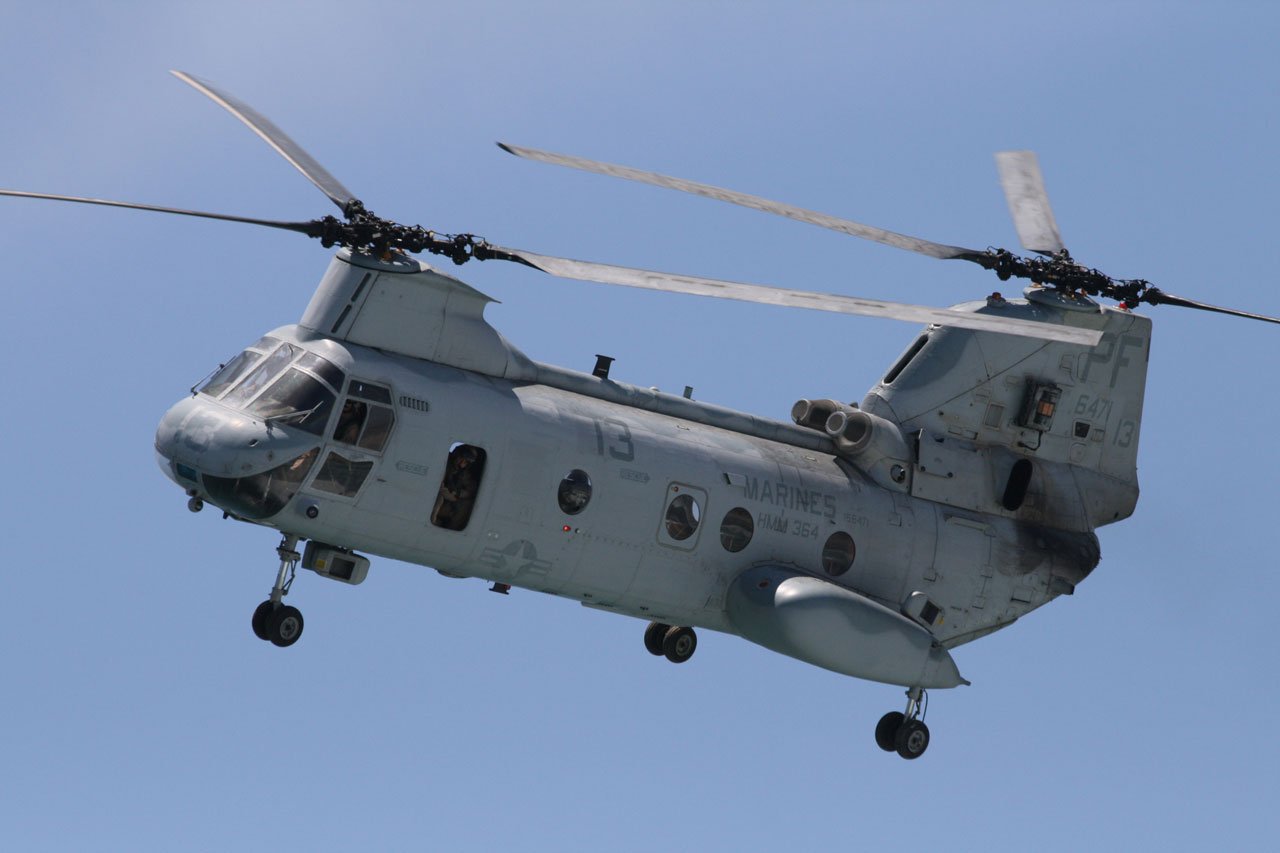
The Boeing Vertol CH-46 Sea Knight is a medium-lift, tandem-rotor transport helicopter that served as the cornerstone of U.S. Marine Corps assault operations from the mid-1960s until 2015. The aircraft is the military derivative of the Boeing-Vertol Model 107, a design developed by the Vertol Aircraft Corporation in the 1950s. Following Boeing's acquisition of Vertol in 1960, the company became Boeing Vertol, operating out of a plant in Morton, Pennsylvania. While the original V-107 prototype first flew on April 22, 1958, the military CH-46A variant made its first flight in August 1962.
Designed to meet specific Marine Corps requirements, the Sea Knight was the service's first turbine-powered assault helicopter. It was engineered to transport 17 fully equipped troops or 4,000 pounds of cargo, achieving a combat radius of 115 miles at speeds of 150 mph. Production of the series occurred between 1962 and 1971, with the final CH-46F rolling out of the Morton plant on February 2, 1971. Production numbers vary by source, with some citing 524 airframes, while others, including USNI and Boeing, indicate over 600 units were delivered.
In military service, the CH-46 performed a wide array of missions, including casualty evacuation (CASEVAC), search and rescue (SAR), and shipboard vertical replenishment (VERTREP). The aircraft entered combat in Vietnam in March 1966, with Marine Medium Helicopter Squadron 164 (HMM-164 "Knight Riders") being the first to deploy the CH-46A. Throughout the Vietnam War, 106 Sea Knights were lost in combat. Later variants, such as the CH-46D, increased capacity to 25 troops or 3.5 tons of cargo. The aircraft remained vital through the Cold War and saw intense combat during deployments to Afghanistan in 2004 and Iraq between 2007 and 2009.
Beyond the U.S. military, the Sea Knight was operated by Canada (as the CH-113), Japan, Sweden, Saudi Arabia, and Thailand. A commercial version, the 107-II, was also produced for airlines. The U.S. Marine Corps retired the CH-46E in August 2015, followed by the U.S. Navy's retirement of the HH-46E on September 29, 2015. Today, the "Phrog" is preserved in museums such as the Smithsonian National Air and Space Museum and the Pima Air & Space Museum, while some retired airframes continue to serve in firefighting roles with agencies like the Santa Barbara County Fire Department.