
Development Origins
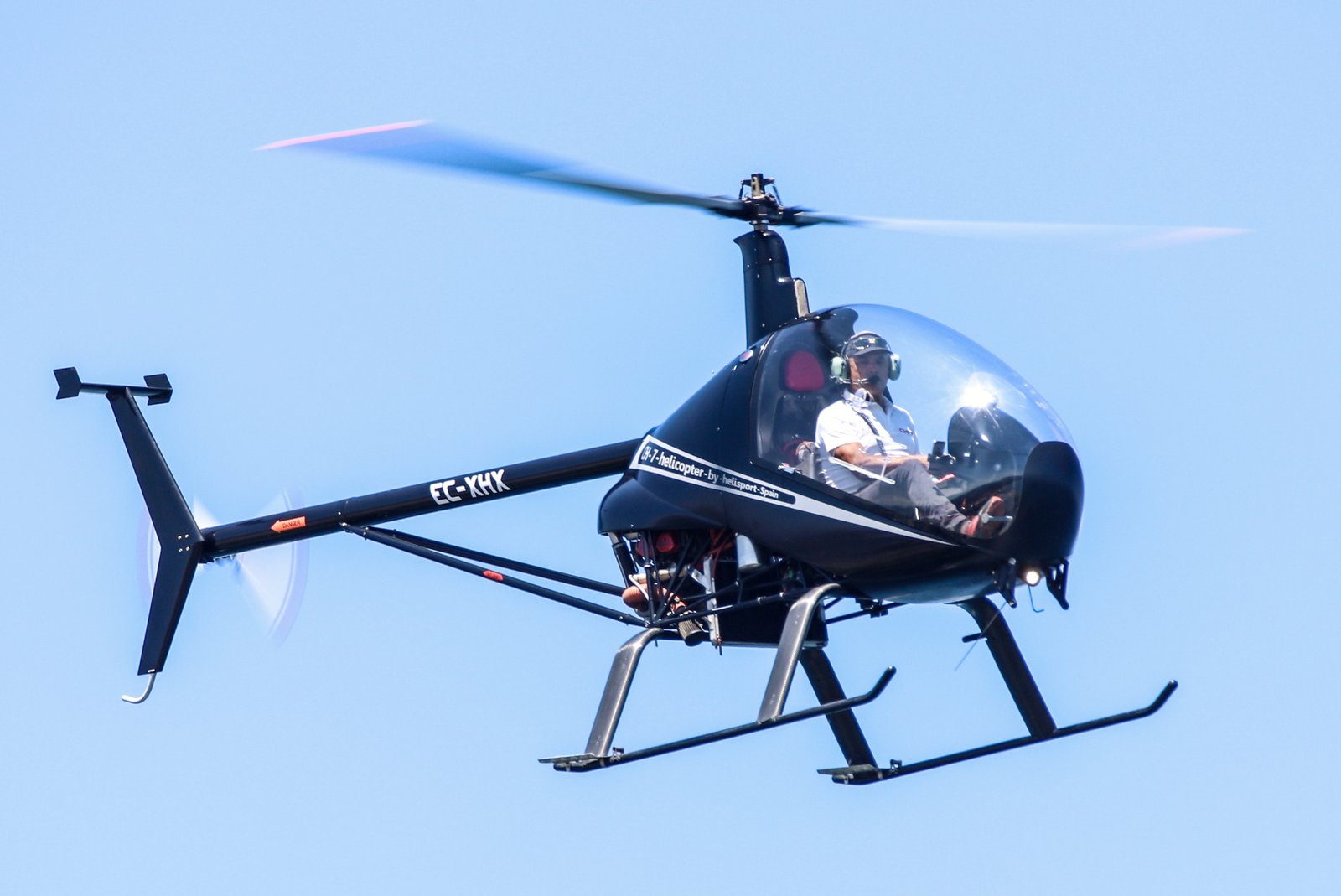
The CH-7 Kompress emerged from Italian manufacturer Heli-Sport's ambitious expansion of Argentine designer Augusto Cicaré's original helicopter concepts. Brothers Josi and Claudio Barbero acquired rights to Cicaré's CH-6 design in 1989, establishing their Turin-based operation in a converted villa that housed assembly lines for gearboxes and rotor components. By 1996, the Barberos recognized the market potential for a two-seat training variant of their successful single-seat CH-7 Angel, leading to the Kompress development program.
Italian automotive designer Marcello Gandini, renowned for his work on Lamborghini supercars, contributed the enclosed cabin design that distinguished the CH-7 series from conventional open-cockpit ultralights. The Kompress stretched Gandini's original Angel fuselage to accommodate tandem seating, creating what would become one of the most successful kit helicopters of the late 1990s.
Technical Innovation
The Kompress incorporated several advanced features uncommon in ultralight helicopters. Its semi-rigid teetering main rotor system utilized composite construction with six degrees of twist and NACA 8-H-12 airfoil sections, providing exceptional performance characteristics. The aluminum tail rotor complemented a fiberglass pod-and-boom fuselage mounted on a steel tube framework, achieving an optimal balance of strength and weight.
Powering the Kompress was the Austrian-built Rotax 914 turbocharged four-stroke engine, delivering 84.6 kilowatts through a belt-driven transmission system. This powerplant enabled cruise speeds of 160 kilometers per hour with a never-exceed velocity of 192 kilometers per hour—performance figures that rivaled conventional certificated helicopters. The main rotor system operated at a maximum 520 revolutions per minute while the tail rotor spun at 2,808 revolutions per minute, with both components designed for 10,000-hour operational lives.
Production Success
Heli-Sport achieved remarkable commercial success with the CH-7 series, producing 215 Kompress and improved Kompress Charlie variants between 1996 and 2009. This followed 120 Angel helicopters manufactured from 1992 to 1997, establishing a total CH-7 family production exceeding 335 aircraft. The company maintained dealerships across Europe, including operations in the Czech Republic, France, Italy, and Poland.
By 2009, Kompress helicopters operated in fifteen countries spanning four continents, from Australia and Taiwan to South Africa and the United States. The growing fleet accumulated over 30,000 flight hours by mid-2009, demonstrating the design's reliability and operator satisfaction. Registration records indicate widespread international adoption, with aircraft like OK-OHA 38 and ZU-SEP representing the type's global reach.
Competitive Achievement
The Kompress proved its capabilities beyond recreational flying, achieving notable success in helicopter competitions. A Kompress won the 2007 Italian Helicopter Championships, while another secured third place at the 2009 World Air Games. These victories validated the design's performance potential and enhanced its reputation among sport helicopter pilots.
The tandem seating configuration made the Kompress particularly suitable for flight training applications, where instructor and student could communicate effectively while maintaining proper control access. Standard fuel capacity of 40 liters, expandable to 59 liters with optional tanks, provided three-hour endurance for extended training flights.
Variants and Evolution
Heli-Sport developed several Kompress variants to meet diverse market requirements. The 2005 Kompress Charlie incorporated refinements addressing vibration, speed, and altitude performance while adding carbon fiber airfoil skid legs. The CH-7 Mariner variant featured inflatable floats adding 15 kilograms to empty weight, expanding operational capabilities to water-based operations.
One experimental installation in 2001 demonstrated the airframe's adaptability when a United States operator fitted a 95-horsepower Solar T622A1 turbine engine, though this configuration remained a one-off modification rather than a production variant.
Manufacturing Legacy
Production rights for CH-7 variants eventually returned to Argentina's Cicaré SA, which developed the CH-7B Spirit in 2011 and CH-7T Spirit Tandem in 2015. These later variants incorporated Rotax 912S and 914 engines while maintaining the fundamental design philosophy established by the original Kompress.
Heli-Sport's post-2009 status remains unclear, though their contribution to affordable rotorcraft aviation proved substantial. The company's kit approach enabled builders to complete a Kompress in 200 hours of assembly time, or 85 hours with fast-build options, making helicopter ownership accessible to recreational pilots previously limited to fixed-wing aircraft.
Today, surviving Kompress helicopters continue operating worldwide, with examples like I-6344 photographed in Poland as recently as 2021. The type's enduring presence in international registers reflects both its robust design and the dedicated community of kit helicopter enthusiasts who recognized the CH-7 Kompress as a breakthrough achievement in ultralight rotorcraft development.