
Service History
The 7GCBC Citabria carved out a distinctive niche in general aviation by democratizing aerobatic training and tailwheel proficiency. Unlike expensive military surplus warbirds or complex aerobatic machines, the Citabria offered civilian pilots accessible spin training, loops, and rolls at operating costs comparable to standard training aircraft. Flight schools across the United States adopted the type for advanced instruction, while bush pilots embraced its rugged construction for backcountry operations. American Champion today supports approximately 14,000 airframes across the Champion 7-series and 8-series lineage, demonstrating the aircraft's enduring operational relevance.
The Manufacturer
The aircraft's lineage traces back to Aeronca Aircraft Corporation, founded in 1928 in Cincinnati, Ohio, which produced over 17,000 aircraft before ceasing production in 1951. Robert Brown established Champion Aircraft Corporation in 1954 after purchasing Aeronca's 7EC type certificate, relocating operations to Osceola, Wisconsin. Champion introduced the aerobatic Citabria variants in the 1960s, with the reversed spelling of "aircraft" highlighting the design's aerobatic capabilities.
Bellanca Aircraft Corporation acquired Champion in 1970, continuing production until a factory fire and economic downturn in the late 1970s forced suspension of operations. The company passed through several hands, including a brief stint in Tomball, Texas, before Jerry Mehlhaff Sr. purchased the assets in 1988. He established American Champion Aircraft Corporation in Rochester, Wisconsin, modernizing production with laser cutting equipment and MIG welding techniques. The company peaked at 112 employees in 2006 but downsized to 34 during the 2009 recession while maintaining production capabilities.
Engine & Technical Details
The 7GCBC typically employs Lycoming O-360 series engines, specifically the IO-360 or AEIO-360 variants rated at 180 horsepower. These air-cooled, horizontally-opposed four-cylinder engines provide reliable power for both aerobatic maneuvers and utility operations. Recent variants have upgraded to the Lycoming IO-390 producing 210 horsepower, introduced around 2011 for enhanced performance at high density altitudes.
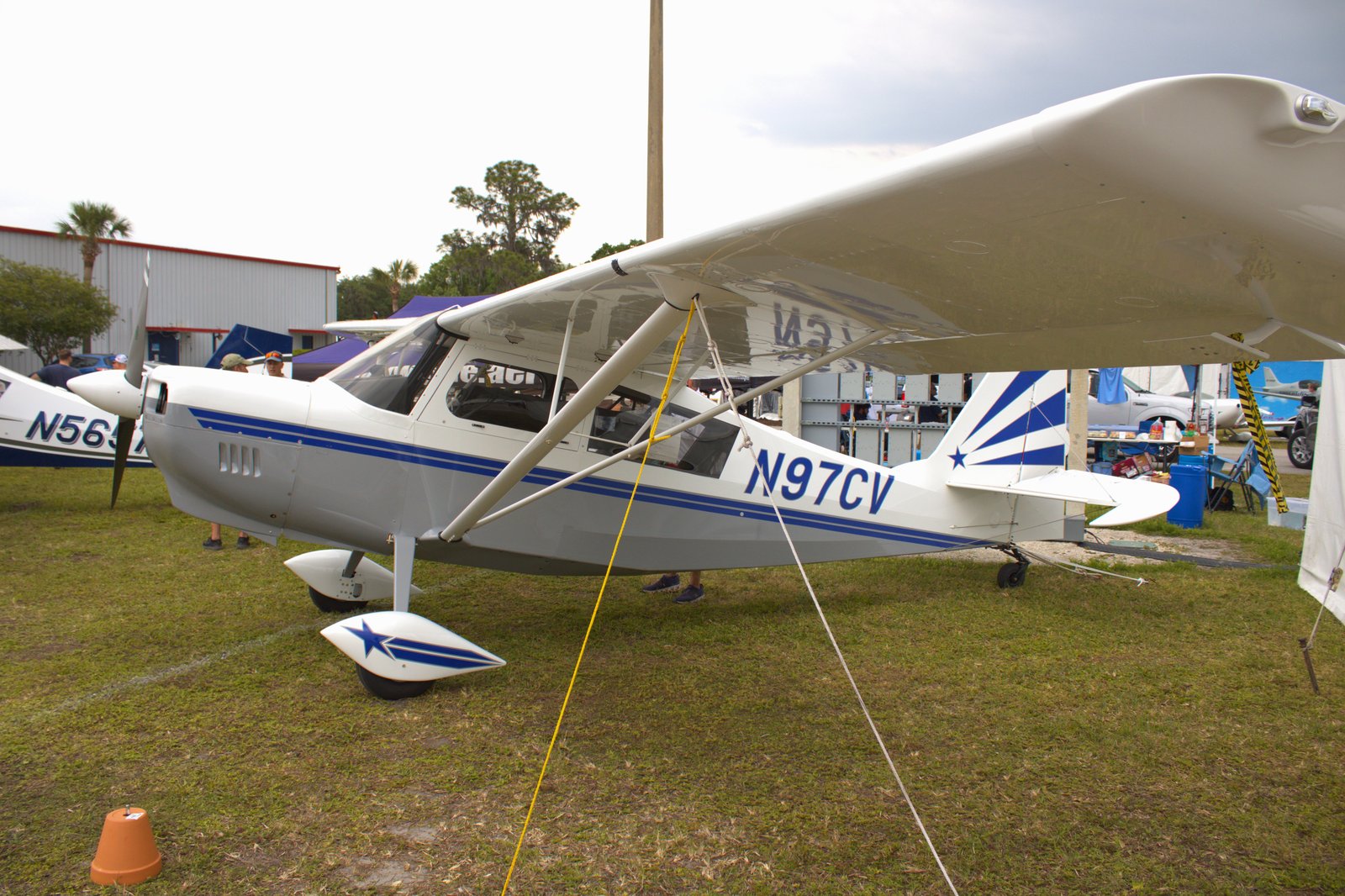
The aircraft features conventional landing gear with a steerable tailwheel, fabric-covered control surfaces, and American Champion's modern all-metal wing construction that replaced earlier wood spar designs. The tandem seating arrangement places the instructor or pilot-in-command in the rear seat, providing optimal weight distribution and visibility during aerobatic sequences.
Pilot Perspective
Pilots appreciate the Citabria's honest flying characteristics and forgiving nature during aerobatic training. The aircraft's relatively low wing loading and responsive controls make it suitable for teaching fundamental aerobatic maneuvers without the intimidation factor of higher-performance machines. Its conventional gear configuration provides essential tailwheel experience increasingly rare in modern training fleets.
Performance specifications include a cruise speed of approximately 135 miles per hour, service ceiling near 14,000 feet, and range of 450 miles with standard fuel capacity. The climb rate of roughly 850 feet per minute enables efficient pattern work and aerobatic positioning. These modest but adequate performance figures reflect the aircraft's training mission rather than speed or payload priorities.
Design Evolution
The "High Country Explorer" designation emphasizes the variant's suitability for operations at elevated airports and challenging terrain. Modifications for high-altitude performance include engine optimization and structural reinforcements addressing the demands of mountain flying and rough-field operations. The design maintains the essential Aeronca DNA while incorporating decades of refinement in materials and manufacturing techniques.
American Champion's investment in modern production methods has improved build quality and parts availability compared to earlier Champion and Bellanca eras. The company's commitment to supporting legacy airframes ensures continued airworthiness for aircraft dating back to the 1940s, preserving an important segment of general aviation heritage.
Production & Legacy
While exact production figures for the 7GCBC variant remain undocumented, the broader Champion 7-series exceeded 7,000 units by the early 1950s, with Citabria variants adding substantially to this total through the 1960s and 1970s. American Champion's resumption of production in 1990 introduced new-build aircraft alongside comprehensive parts support for existing airframes.
The Citabria's legacy extends beyond its production numbers to its role in preserving traditional piloting skills. As glass cockpits and electronic flight displays dominate modern aviation training, the Citabria maintains the connection between pilot and aircraft through direct mechanical controls and conventional instruments. This fundamental flying experience continues attracting pilots seeking authentic stick-and-rudder proficiency in an increasingly automated aviation environment.