
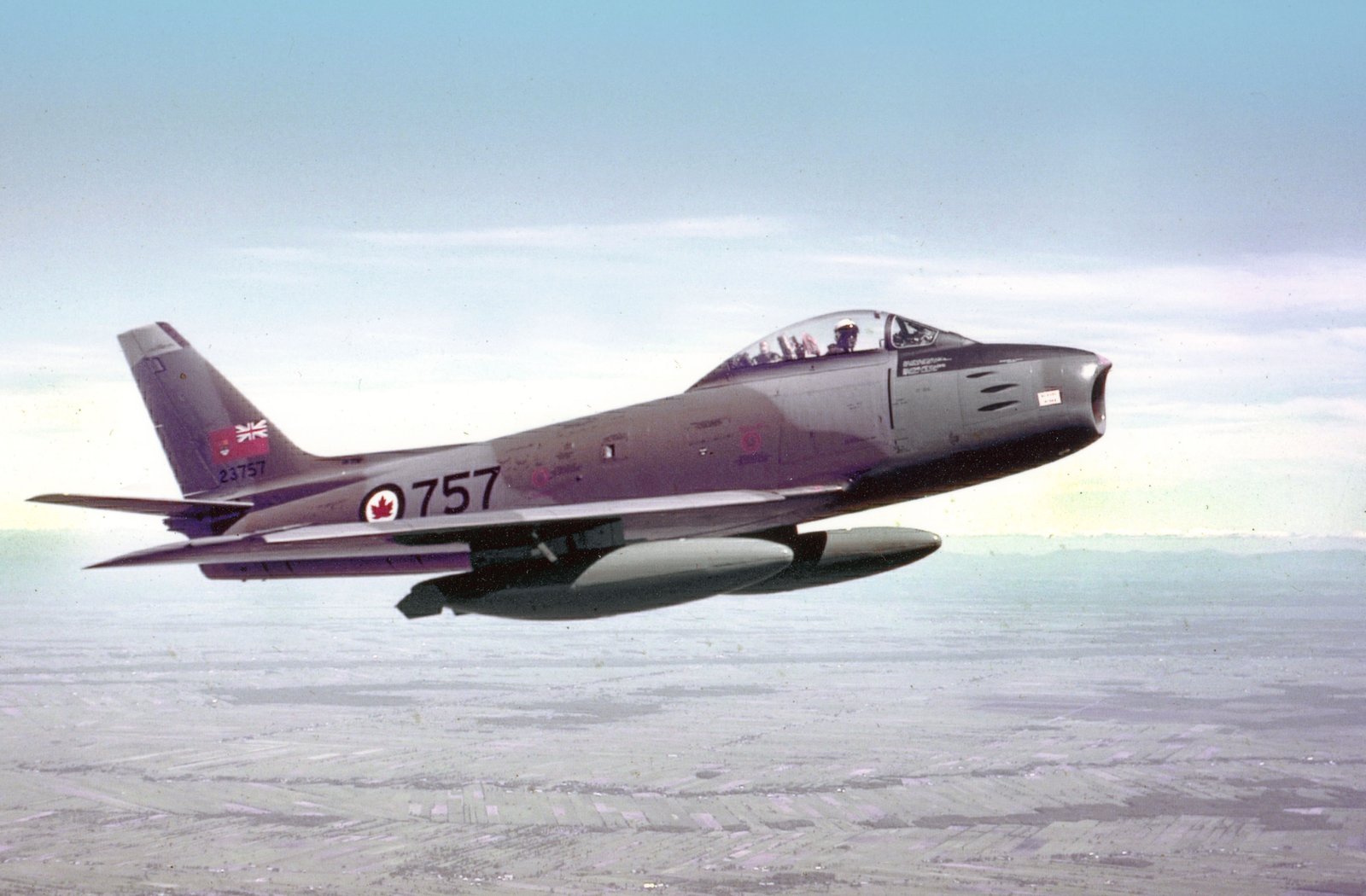
Production and Manufacturer History
The Canadair CL-13 Sabre was produced by Canadair Ltd. at its manufacturing plant in Cartierville, Montreal, Quebec. Production ran from 1950 until October 9, 1958, resulting in a total of 1,815 aircraft. During this production window, Canadair transitioned in corporate ownership, becoming part of General Dynamics by 1954. The aircraft served as a cornerstone of Canadian aerospace industry, establishing the nation as a major producer of first-generation jet fighters.
Design and Technical Specifications
While the original F-86 Sabre was designed by North American Aviation in the United States, the CL-13 was a license-built adaptation. The design's significance lay in the integration of the swept-wing, transonic airframe with increasingly powerful Canadian-made Avro Orenda turbojets. The CL-13B Sabre Mk.6 is specifically noted as the ultimate production version of the Sabre family. This variant featured a modified "6-3" wing with re-introduced leading-edge slats, which provided exceptional low-speed handling and maneuverability without sacrificing high-speed performance.
Technical specifications for the Mk.6 include a length of 37.54 feet and a wingspan of 37.12 feet. It was powered by a single Avro Canada Orenda 14 turbojet producing 7,275 lbf of thrust. This powerplant enabled a maximum speed of approximately 710 mph (Mach 0.93), a service ceiling of 54,000 feet, and a rate of climb of 11,800 feet per minute. For long-range operations, the aircraft could carry two 200-US-gal drop tanks, extending its ferry range to 1,481 miles. Armament consisted of six 0.50 in M3 Browning machine guns and four hardpoints capable of carrying 5,300 lb of payload, including bombs, rockets, and AIM-9B Sidewinder missiles.
Service History
The Royal Canadian Air Force (RCAF) took the CL-13 on strength in 1950 and utilized it as a primary air-defence interceptor and day fighter, particularly within No. 1 Air Division in Europe. The RCAF operated 1,184 units before striking the type off strength in 1970. Additionally, the RCAF Golden Hawks aerobatic team flew the Mk.6 starting in 1961. Other international operators included the West German Luftwaffe, which acquired 225 Mk.6 aircraft, and the South African Air Force, which operated 34 units. The Colombian Air Force also operated six Mk.6 aircraft.
Combat service was most notable in the Pakistan Air Force (PAF), which used second-hand Mk.6 Sabres equipped with AIM-9 Sidewinder missiles. These aircraft formed the backbone of the PAF during the Indo-Pakistani War of 1971 and remained in combat service until 1980. In the civilian realm, the aircraft has been used as a flight-test chase plane by The Boeing Company and as a private warbird.
Legacy and Records
The CL-13 is remembered for its role in aviation record-breaking. In May and June 1953, pilot Jacqueline "Jackie" Cochran flew an Orenda-powered CL-13 Sabre Mk.3 (serial 19200) to set several FAI world speed and altitude records, including a speed of 1,067.68 km/h on June 3, 1953. In doing so, she became the first woman to break the sound barrier. Today, several examples are preserved, including the final Canadair-built Sabre (serial 23651) at the Royal Aviation Museum of Western Canada and a Mk.6 at the Museum of Flight in Seattle.