
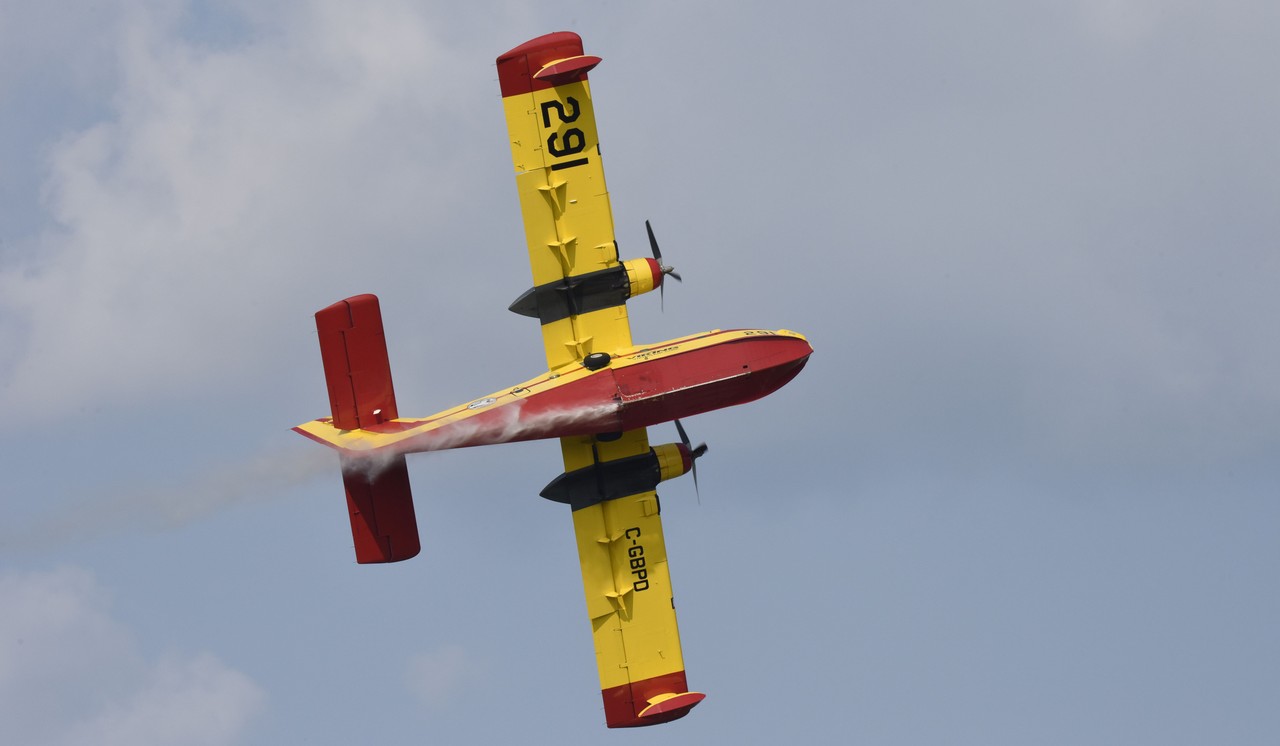
Service Dominance
The CL-215 transformed aerial firefighting from converted military surplus aircraft to purpose-built professional equipment. France's Sécurité Civile became the launch customer in June 1969, taking delivery of the first production aircraft and ultimately operating ten CL-215s. The Quebec government quickly followed, replacing their aging Consolidated Canso water bombers with CL-215s that could fly twice as fast and required significantly shorter landing distances. By production's end in May 1990, the CL-215 had become synonymous with aerial firefighting across the Mediterranean, where pilots and ground crews universally referred to water bombers as "Canadairs" regardless of manufacturer.
The Manufacturer
Canadair Limited emerged as Canada's premier aircraft manufacturer following World War II, establishing their reputation with the CL-44 cargo aircraft and CF-104 Starfighter production. Founded in 1944 from the wartime Victory Aircraft facilities, Canadair operated independently until 1976 when the Canadian government nationalized the struggling company. Bombardier Aerospace acquired Canadair in 1986, continuing production and development of the water bomber series until selling the design rights to Viking Air in 2018. The CL-215 represented Canadair's most successful original design, spawning a family of aircraft that continues in production today as the CL-515.
Design Genesis
The CL-215 originated from an early 1960s concept for a float-equipped transport aircraft serving remote Canadian communities. Quebec forestry officials redirected the project when they requested a dedicated water-carrying aircraft for forest fire suppression. Lead engineer Pierre Nadeau and his team developed the definitive design between 1963 and 1966, receiving program authorization in February 1966. The aircraft made its public debut at the 1965 Paris Air Show, where Flight International noted it as the first large aircraft specifically designed for water bombing rather than adapted from existing designs.
Technical Innovation
Two Pratt & Whitney R-2800-83AM radial engines, each producing 2,100 horsepower, drove three-bladed Hamilton Standard Hydromatic constant-speed propellers. The high-wing configuration provided essential ground clearance for water operations while housing the aircraft's 380-gallon fuel capacity in wing tanks. The CL-215's hull design incorporated a unique water pickup system capable of scooping 1,400 gallons in just 12 seconds during a water run at 70 knots. Four retractable water tanks could be filled simultaneously through intake scoops, then discharged through eight belly doors in 0.8 seconds over the fire zone.
Operational Excellence
Pilots praised the CL-215's predictable handling characteristics during the demanding low-level water pickup maneuvers. The aircraft demonstrated exceptional slow-speed control, with a stall speed of just 76 mph and rate of climb exceeding 1,000 feet per minute at maximum gross weight. Operating crews appreciated the robust landing gear design that withstood countless water and rough-field operations. The cockpit accommodated a crew of two, with excellent visibility for the precise flying required during firefighting missions.
Variants and Evolution
Five distinct variants emerged during the 21-year production run. The baseline CL-215A served as the standard firefighting model, while the CL-215B incorporated search and rescue equipment for operators like the Royal Thai Air Force. The CL-215C removed firefighting systems to accommodate up to 36 passengers in commercial transport configuration. The revolutionary CL-215T, first flying on June 8, 1989, replaced the radial engines with Pratt & Whitney Canada PW123AF turboprops, improving performance and reducing maintenance requirements.
Global Impact and Legacy
Eleven countries operated CL-215s, with the largest fleets serving in France, Italy, Greece, Croatia, and Serbia. Thailand uniquely employed the type primarily for search and rescue missions rather than firefighting. The aircraft's success established the foundation for the CL-415 SuperScooper, which began production in 1993 and incorporated lessons learned from 125 CL-215 aircraft and over two decades of operational experience. Viking Air's current CL-515 development program continues the lineage, offering retrofit packages to upgrade existing CL-215s to modern standards with night firefighting capability and advanced avionics. The CL-215's influence extends beyond its production numbers, having established aerial firefighting as an essential emergency service and inspiring water bomber development programs worldwide.