
Market Dominance
The Challenger 350 achieved remarkable commercial success, capturing 58 percent of the super mid-size business jet market share in 2018 with 60 deliveries that year alone. By July 2020, approximately 350 aircraft had been delivered to operators worldwide, with the 300th delivery milestone reached in July 2019. This dominance established the type as the backbone of fractional ownership fleets and redefined performance expectations in its category.
Launch and Early Operations
NetJets served as the worldwide launch customer, placing a substantial order for 75 firm aircraft plus 125 options in 2014, potentially totaling 200 units over a ten-year period. The first delivery occurred on June 27, 2014, at Westchester County Airport in New York, marking the beginning of widespread commercial operations. Flexjet also became a major operator, incorporating the type as a fleet cornerstone and providing operational data from their Challenger 300 experience that informed the 350's design improvements.
Bombardier's Aviation Heritage
Bombardier entered aviation in the 1980s through strategic acquisitions, including the purchase of Canadair in 1986, which brought the original Challenger program under its control. Founded in 1942 as a manufacturer of snowmobiles and railcars, the company evolved into a major aerospace corporation. In 2020-2021, Bombardier sold its business jet division to private equity, resulting in a standalone Bombardier brand dedicated exclusively to business aviation that continues operations today.
Advanced Powerplant Technology
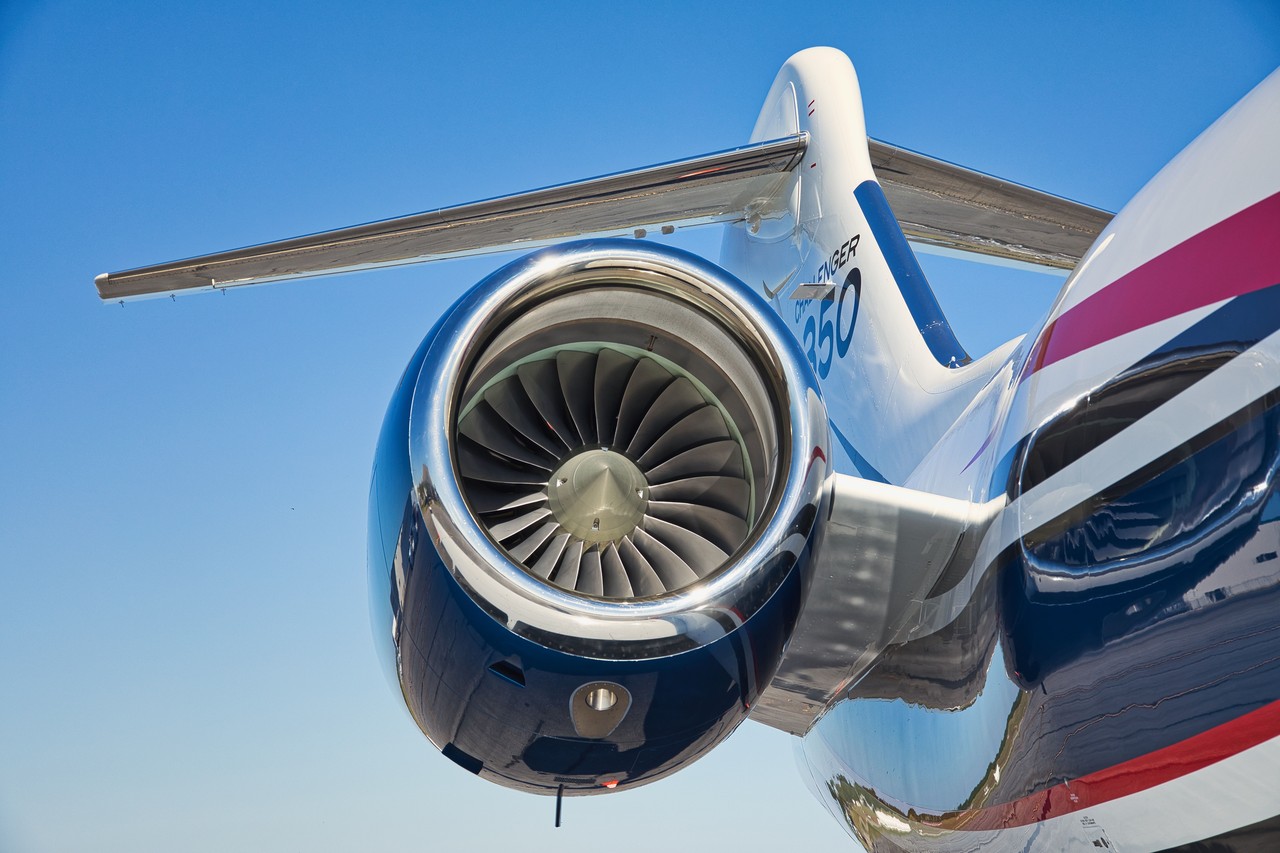
Two Honeywell HTF7350 turbofan engines, each producing 7,323 pounds of thrust, power the Challenger 350 and represent a significant advancement over the HTF7000 series used in the predecessor Challenger 300. These engines, evolved from the earlier AS907 design, deliver improved performance and enhanced fuel efficiency while reducing emissions under specific operating conditions. The powerplant selection contributed directly to the aircraft's extended range capabilities and operational economics.
Engineering Innovations
Bombardier's engineering team developed the Challenger 350 as an evolution of the Challenger 300's clean-sheet design, incorporating several technological advances. Mitsubishi Heavy Industries, serving as a risk-sharing partner, manufactured the single-piece wing structure that features increased wingspan with distinctive canted winglets for improved aerodynamic efficiency. The aircraft includes 20 percent larger cabin windows than its predecessor and integrates Rockwell Collins Pro Line 21 avionics for enhanced flight management capabilities.
Operational Characteristics
The Challenger 350 accommodates up to 10 passengers in a cabin measuring 25.2 feet long, 7.2 feet wide, and 6 feet high, operated by a standard two-pilot crew. Its transcontinental range of 3,200 nautical miles enables non-stop flights across North America and extended international missions, fulfilling the original design objective of bridging the gap between smaller mid-size jets and larger cabin aircraft. This mission versatility attracted operators requiring dependable long-range performance in the super mid-size category.
International Operations
TAG Aviation Europe became the first Swiss operator, basing their Challenger 350 in Geneva for executive charter services. This European expansion demonstrated the aircraft's appeal beyond North American markets and established its presence in international business aviation. The type's range capabilities made it particularly suitable for trans-oceanic positioning flights and extended European charter missions.
Production and Current Status
Final assembly takes place at Bombardier's facility in Montreal, Quebec, with production continuing as of recent reports. Approximately 355 units have been constructed, with 354 remaining airworthy and one retired from service. Ten aircraft remain at the manufacturer's facility, likely undergoing completion or testing. The production success led to the development of the successor Challenger 3500, launched in September 2021.
Legacy and Impact
The Challenger 350 established new benchmarks in the super mid-size business jet category, validating Bombardier's BD-100-1A10 platform that originated with the Challenger 300's 2003 certification. Its combination of range, cabin comfort, and operational reliability influenced competitor designs and customer expectations throughout the private aviation industry. The type's success demonstrated the market demand for enhanced capabilities in the super mid-size segment and secured Bombardier's position as a leading business jet manufacturer.