
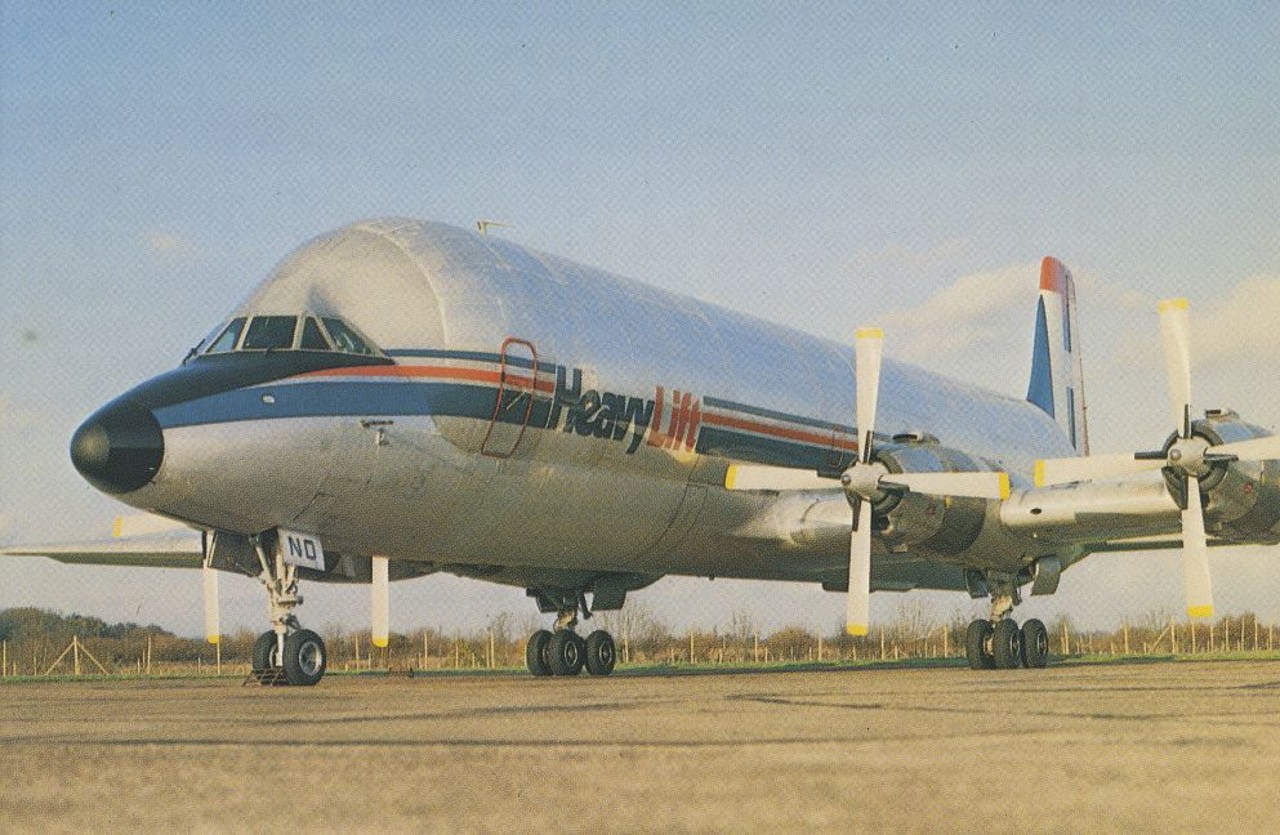
The Vision Behind the Conversion
Jack Conroy conceived the CL-44-O project after departing from Aero Spacelines, seeking to create a commercial version of his successful Guppy concept for oversized cargo transport. He specifically selected the Canadair CL-44 because of its existing swing-tail design, a critical feature necessary for outsize cargo operations that eliminated the need for complex structural modifications required by previous conversions.
Development and Construction
The conversion process began in 1969 at Santa Barbara Airport in California, where Conroy Aircraft Corporation undertook the ambitious project of transforming a standard CL-44D4-2 airframe. The original aircraft, registered as N447FT, had been delivered to Flying Tiger Lines in August 1961 before being selected for this experimental conversion.
Engineers removed the entire upper fuselage half above the floorline and constructed a temporary hangar over the exposed airframe to protect the delicate work from weather conditions. Unlike previous B-377 Guppy conversions that required stretching and sections from other aircraft, the CL-44 conversion demanded considerably less engineering and fabrication, making it an economically attractive option for specialized cargo operations.
Technical Innovation
The modified aircraft featured a completely rebuilt upper fuselage section that created an oval cross-section measuring eleven feet high and thirteen feet wide at mid-height. This represented a significant volumetric increase, with the cabin height raised by 1.5 meters compared to the standard CL-44 configuration. The conversion retained the original four Rolls-Royce Tyne turboprop engines, maintaining the aircraft's proven powerplant reliability.
The swing-tail mechanism, originally designed for the standard CL-44's cargo operations, proved ideally suited for the enlarged fuselage configuration. This feature allowed the aircraft to load oversized cargo that would have been impossible to accommodate through conventional cargo doors.
Flight Testing and Certification
Captain Jim Seymour commanded the first flight on November 28, 1969, accompanied by Lockheed test pilot Herman "Fish" Salmon as co-pilot and Jeff Seidemen as flight engineer. Seymour brought extensive experience to the program, having logged more than 5,000 hours on the CL-44 type. The aircraft underwent a comprehensive test and certification program throughout spring 1970, validating its airworthiness and operational capabilities.
Commercial Operations
Operational service began in 1969 when TransMeridian Air Cargo of Stansted, England, took delivery of the aircraft, now registered as N447T. The company operated the aircraft under multiple names, including "Skymonster," "CL-44 Guppy," and "Bahama Trader," though the reasons for these various designations remain unclear.
Conroy had initially pursued the project in partnership with Flying Tiger Lines, anticipating significant logistical requirements for Lockheed's L-1011 Tristar production program. The aircraft was designed to transport large aircraft components and other oversized industrial cargo that conventional freighters could not accommodate.
Canadair's Legacy
Canadair, the original manufacturer of the base CL-44 aircraft, operated as a prominent Canadian aircraft manufacturer during the mid-20th century. The company produced a total of 39 CL-44 aircraft between 1959 and 1965, establishing the type as a capable turboprop airliner and freighter. The CL-44-O conversion represented the final evolution of this aircraft family, demonstrating the adaptability of Canadair's original design.
Operational Impact
The CL-44-O established important precedents for specialized cargo aircraft development, proving that existing turboprop airliners with appropriate structural features could be economically converted for outsize cargo operations. This concept influenced subsequent cargo aircraft development and remains relevant to modern heavy-lift operations.
The aircraft represented Jack Conroy's first independent conversion project after selling Aero Spacelines, establishing the foundation for his continued work in specialized cargo aircraft development. The success of the conversion validated the commercial viability of the Guppy concept beyond its original NASA applications.
Final Disposition
The CL-44-O Skymonster was eventually broken up and no longer exists, marking the end of this unique aircraft's operational life. While this singular conversion did not survive, its influence on cargo aircraft design principles continues through modern outsize cargo operations. Other Guppy variants have demonstrated greater longevity, with NASA's Super Guppy SGT-201 remaining in active service as of 2024, carrying oversized components for space program operations.