
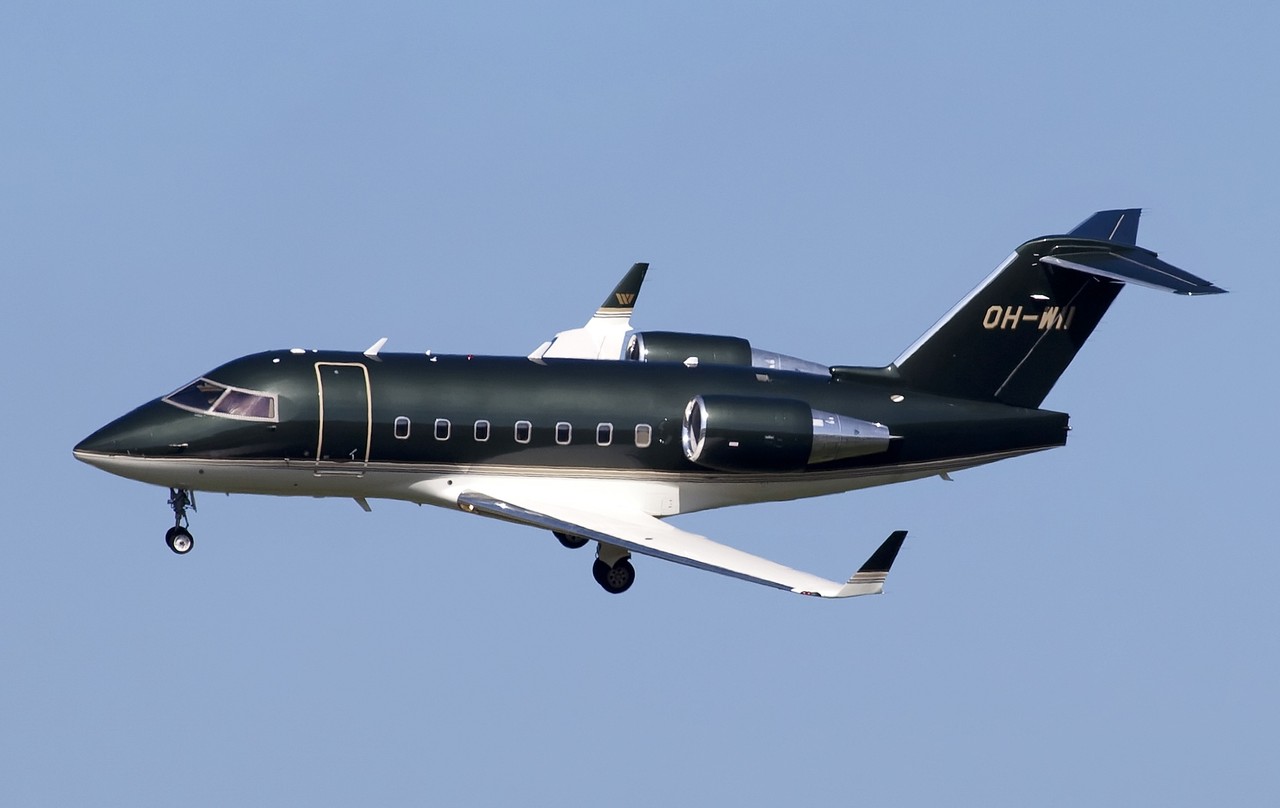
Dominance in Corporate Aviation
The Challenger 604 established itself as the benchmark for super-midsize business jets during its production run from 1995 to 2006. With 365 aircraft delivered, it captured a significant share of the high-end corporate market, competing directly with the Dassault Falcon 900B and Gulfstream GIV-SP. The aircraft's ability to fly non-stop for eight hours across the Atlantic while maintaining fuel efficiency of 350 gallons per hour made it the preferred choice for international corporations and charter operators.
Manufacturing Heritage
Bombardier Aerospace inherited the Challenger design through a complex corporate history that began with American aviation pioneer Bill Lear's LearStar 600 concept. Canadair, founded in 1944, acquired the design rights from Lear and developed the original Challenger prototype, which first flew on November 8, 1978, in Montreal. The ambitious program nearly bankrupted Canadair in the early 1980s due to massive development costs, leading to Bombardier's acquisition of the company in 1986. Under Bombardier's ownership, the company became Bombardier Aerospace and transformed the struggling Challenger program into one of the most successful business jet families in aviation history.
Technical Innovation
The 604 variant introduced significant improvements over its predecessors, most notably the adoption of General Electric CF34-3B turbofan engines producing 8,729 pounds of thrust each. These powerplants replaced the earlier Lycoming ALF 502L engines and provided the reliability and efficiency needed for transcontinental operations. The aircraft featured one of the first super-critical wing designs in business aviation, along with structural improvements to the wing and tail sections that enabled a maximum takeoff weight of 48,200 pounds.
Engineering teams incorporated a new undercarriage system with larger wheels, tires, and brakes to handle the increased operating weights, while Collins ProLine 4 avionics provided state-of-the-art navigation and flight management capabilities. The fuel capacity was increased to 19,850 pounds, enabling the impressive range of 4,024 to 4,027 nautical miles under NBAA IFR conditions with four passengers.
Operational Excellence
Pilots praised the Challenger 604 for its handling characteristics and operational flexibility. The aircraft could cruise at speeds between Mach 0.74 and 0.82 while maintaining a service ceiling of 41,000 feet. The spacious cabin, with 1,035 cubic feet of interior volume and dimensions of 28.4 feet in length, 8.2 feet in width, and 6.1 feet in height, could accommodate 10 to 16 passengers depending on configuration, though 12 passengers was typical for most operators.
The aircraft required a crew of two to three, with many operators choosing to fly with two pilots and a flight attendant on longer international routes. Corporate operators such as Daimler Chrysler Aviation, which operated aircraft D-ADNE beginning in 1999, found the 604's combination of range and cabin comfort ideal for executive transport across multiple continents.
Production Success
Production varied significantly year to year, reflecting market conditions and customer demand. Peak production occurred in 2002 and 2005, with 24 aircraft delivered each year, while the lowest output came in 1997 with just four aircraft completed. The final aircraft rolled off the production line in 2006, though one additional example was delivered in 2008, likely completing a delayed order.
Specialized Applications
While designed primarily for civilian use, the Challenger 604 found limited military applications. The Australian Maritime Safety Authority operated CL-604s through Cobham Aviation Services beginning in December 2016 for maritime patrol missions, demonstrating the aircraft's versatility beyond corporate transport.
Enduring Legacy
By 2020, 355 of the 365 Challenger 604s remained active, testament to the aircraft's robust construction and continued relevance in the business aviation market. The strong resale market reflects the type's reputation for reliability and performance. The 604's success contributed to the broader Challenger family achieving over 1,000 deliveries by 2015, with design elements and manufacturing techniques influencing Bombardier's CRJ regional airliner program. Today, the aircraft continues to serve operators worldwide, from private owners in Pakistan to charter companies like Bluejets and International Jet Management, maintaining its position as one of the most successful business jets ever produced.