
Market Dominance
The Challenger 605 achieved remarkable commercial success during its nine-year production cycle, establishing sales records as the fastest-selling variant in Bombardier's Challenger lineup. Between 2006 and 2015, the aircraft captured significant market share in the super-midsize business jet segment, competing directly with aircraft like the Gulfstream G200 and Citation X. By October 2012, the 200th unit had entered service, demonstrating the model's rapid market acceptance among corporate and charter operators worldwide.
The Manufacturer Legacy
Bombardier Aerospace inherited the Challenger program through its 1986 acquisition of Canadair, a company founded in 1944 that had purchased Bill Lear's LearStar 600 design in April 1976. The original Challenger 600 series program launched on October 29, 1976, with government backing and initial orders for 53 aircraft, scaling to 116 confirmed orders by May 1978. Canadair established production capabilities for up to seven aircraft per month, creating the foundation for what would become one of business aviation's most successful aircraft families.
Bombardier, originally founded in 1942 as a snowmobile and railcar manufacturer, transformed into a major aerospace company following the Canadair acquisition. The company continued developing the Challenger series through multiple variants before divesting its business jet division to Spirit AeroSystems in November 2020, five years after Challenger 605 production had concluded.
Technical Innovation
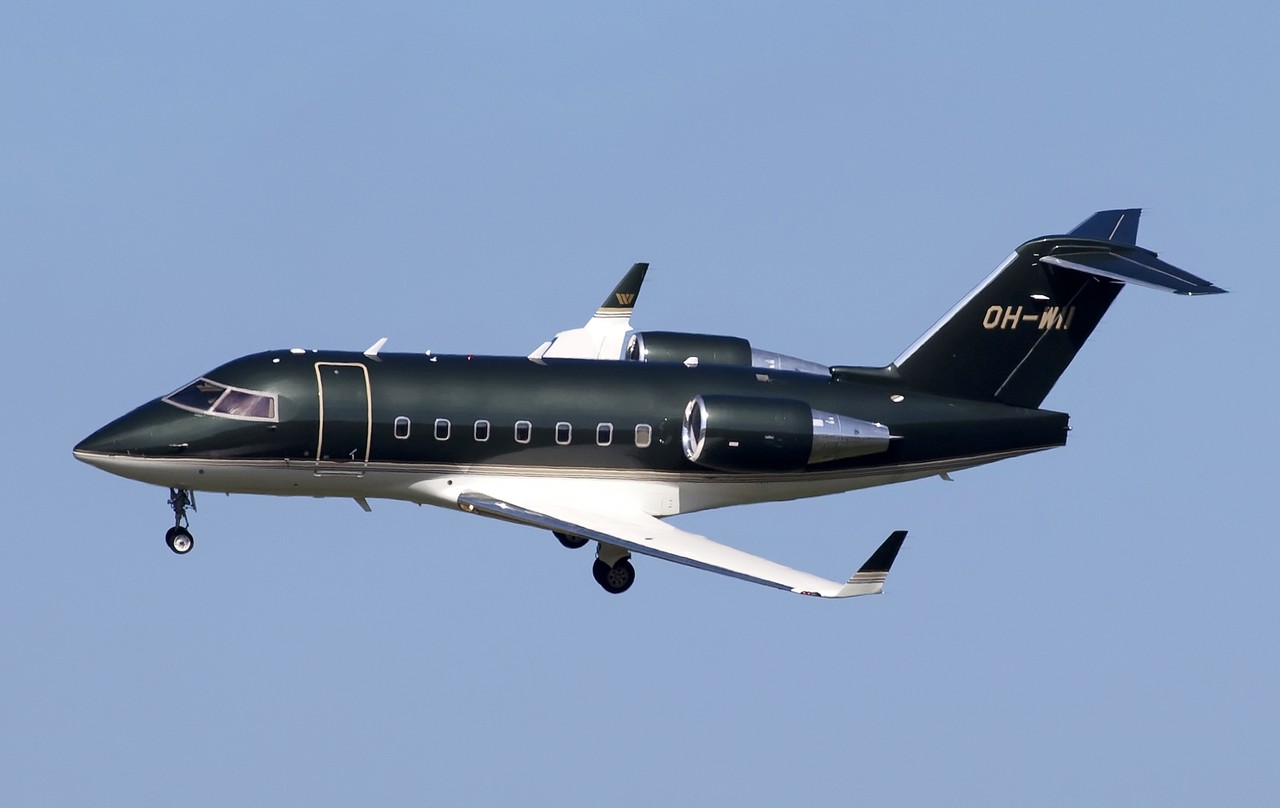
The Challenger 605 represented a significant advancement over its predecessor, the Challenger 604, incorporating several key improvements that enhanced both performance and passenger experience. Engineers positioned the cabin windows higher and made them larger, dramatically improving natural light and views for passengers. The aircraft featured a rounded tailcone design that improved aerodynamics and contributed to a 3% reduction in fuel consumption compared to earlier models.
The most significant technological upgrade was the integration of the Rockwell Collins Pro Line 21 avionics suite, which included Electronic Flight Bag capability. This advanced flight deck reduced pilot workload and enhanced safety through improved situational awareness and flight management capabilities.
Engine Performance
Powering the Challenger 605 were two General Electric CF34-3B turbofan engines, each producing 8,729 pounds of thrust. These high-bypass engines replaced the Lycoming ALF 502L powerplants used in the original Challenger 600, providing substantially improved efficiency and performance. The CF34-3B engines featured flat-rated thrust capability, maintaining full power output even in hot and high altitude conditions that typically degrade aircraft performance.
The engine installation achieved a combined fuel burn rate of 358 gallons per hour, enabling the aircraft's impressive 4,047 nautical mile range when carrying four passengers under NBAA IFR conditions. This range capability allowed nonstop transcontinental flights across North America and transatlantic routes to Europe.
Operational Characteristics
The Challenger 605 typically operated with a two-person flight crew and could accommodate 10 passengers in its spacious cabin. The interior featured flexible seating arrangements including forward and aft-facing seats plus a four-place divan configuration. With a cabin volume of 1,150 cubic feet, passengers enjoyed generous space for a super-midsize business jet.
Operational speeds included a maximum cruise speed of 470 knots (870 kilometers per hour) for time-critical missions, while long-range cruise speed was 424 knots (785 kilometers per hour) for maximum efficiency. The aircraft's 64.3-foot wingspan and operating empty weight of approximately 27,000 pounds positioned it ideally in the super-midsize category.
Production and Current Status
Bombardier manufactured exactly 288 Challenger 605 aircraft during the model's production run, with final delivery occurring in 2015. As of May 2025, 287 aircraft remain in active service worldwide, with only one unit retired from the fleet. This exceptional retention rate demonstrates the aircraft's reliability and continued value in the business aviation market.
In the United States, 150 Challenger 605s remain active, with 97% compliance with ADS-B requirements. The pre-owned market shows healthy activity with 68% of the fleet having changed hands at least once. Average time on market for aircraft sales is 261 days, with approximately 4.9% of the US fleet listed for sale at any given time.
Legacy and Impact
The Challenger 605 successfully bridged the gap between Bombardier's earlier 1970s designs and modern business aviation requirements. Its commercial success contributed to the development of the Challenger 650, which incorporated many of the 605's innovations while adding further refinements. The aircraft exemplified the evolution of business jets from simple corporate transports to sophisticated flying offices capable of intercontinental missions.
The model's strong residual values and continued operational popularity validate its design objectives. Early Challenger 604 models traded for $4-4.5 million in 2016, while later variants commanded prices under $8 million, demonstrating sustained market confidence in the Challenger platform that the 605 helped establish.