
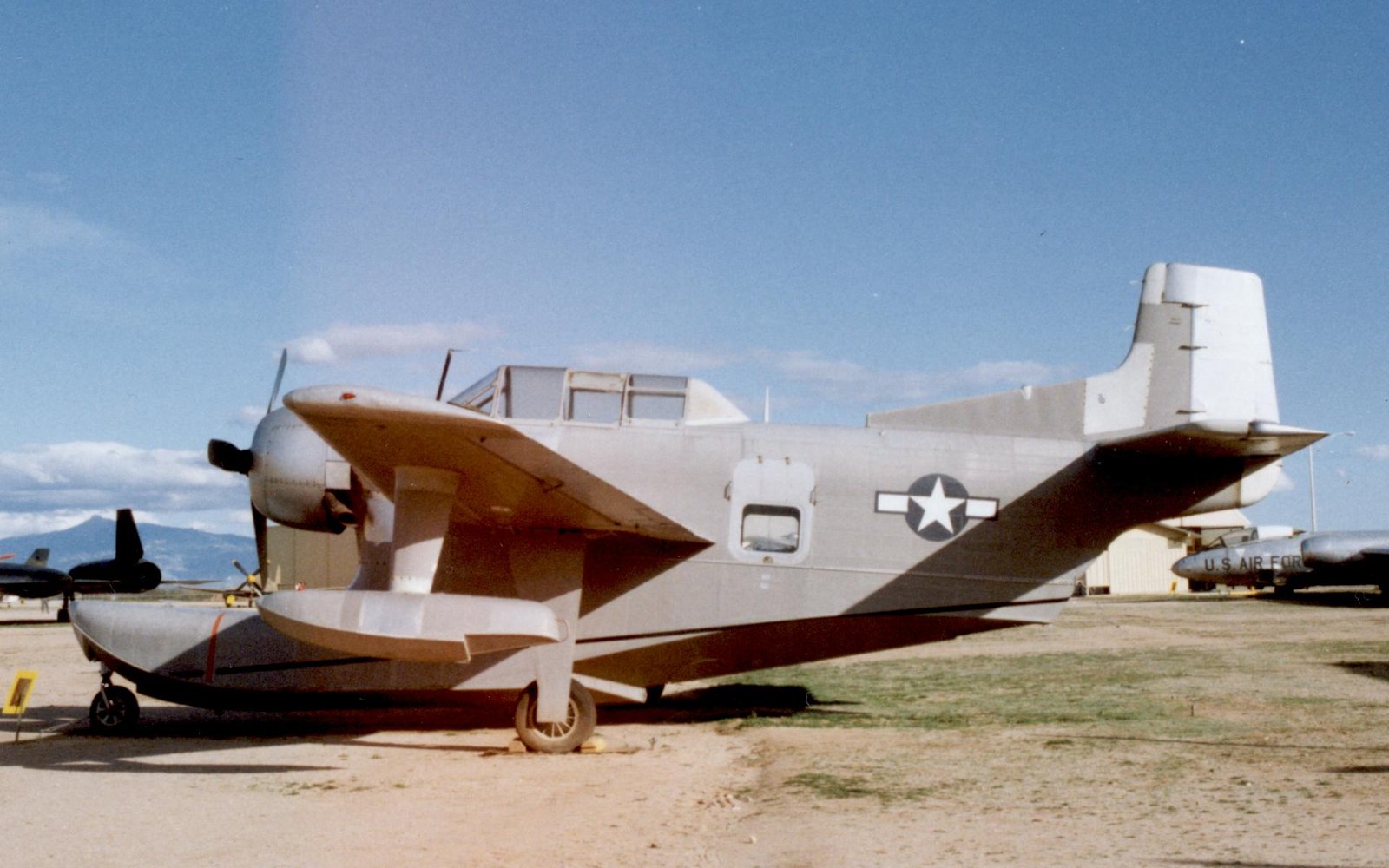
The Columbia XJL was an experimental amphibious aircraft developed after World War II to modernize the U.S. Navy's utility fleet. Designed by the Grumman Aircraft Engineering Corporation, the aircraft was intended to replace the aging Grumman J2F Duck biplane. To allow Grumman to prioritize fighter production, the development and construction of the XJL prototypes were assigned to the Columbia Aircraft Corporation, based in Valley Stream, Long Island, New York. This specific company was distinct from the later Lancair-derived Columbia Aircraft that ceased operations in 2007.
The U.S. Navy ordered three XJL-1 experimental aircraft. One airframe was dedicated to ground-based destructive static and strength testing and never flew. The remaining two prototypes, bearing Bureau of Aeronautics (BuAer) numbers 31399 and 31400, were delivered for evaluation in 1946 to the Naval Air Test Center at Patuxent River Naval Air Station in Maryland. The XJL represented a significant design shift, moving from the J2F's biplane configuration to a cantilever monoplane with a flying-boat style hull and retractable tricycle landing gear.
Technically, the XJL-1 was powered by a single 1,350 hp (1,010 kW) Curtiss-Wright Wright R-1820-56 nine-cylinder, air-cooled radial piston engine. This powerplant provided a maximum speed of 200 mph and a substantial range of 2,070 miles. The aircraft was designed for utility roles, including reconnaissance and transport, with a capacity for a crew of two and six passengers. Its dimensions included a wingspan of 50 feet, a length of 45 feet 11 inches, and a gross weight of 13,000 lb.
Despite its improved performance over the J2F, the XJL-1 suffered from repeated structural failures of various components during its trials. Consequently, the U.S. Navy abandoned testing on September 21, 1948, and the aircraft were deleted from the Navy inventory in February 1949 without a series production order. Both flying prototypes were eventually sold as surplus in 1959. BuNo 31400 (registered as N54205) is currently on display at the Pima Air & Space Museum in Tucson, Arizona, while BuNo 31399 (registered as N54207) is undergoing restoration at the Yanks Air Museum in Chino, California.