
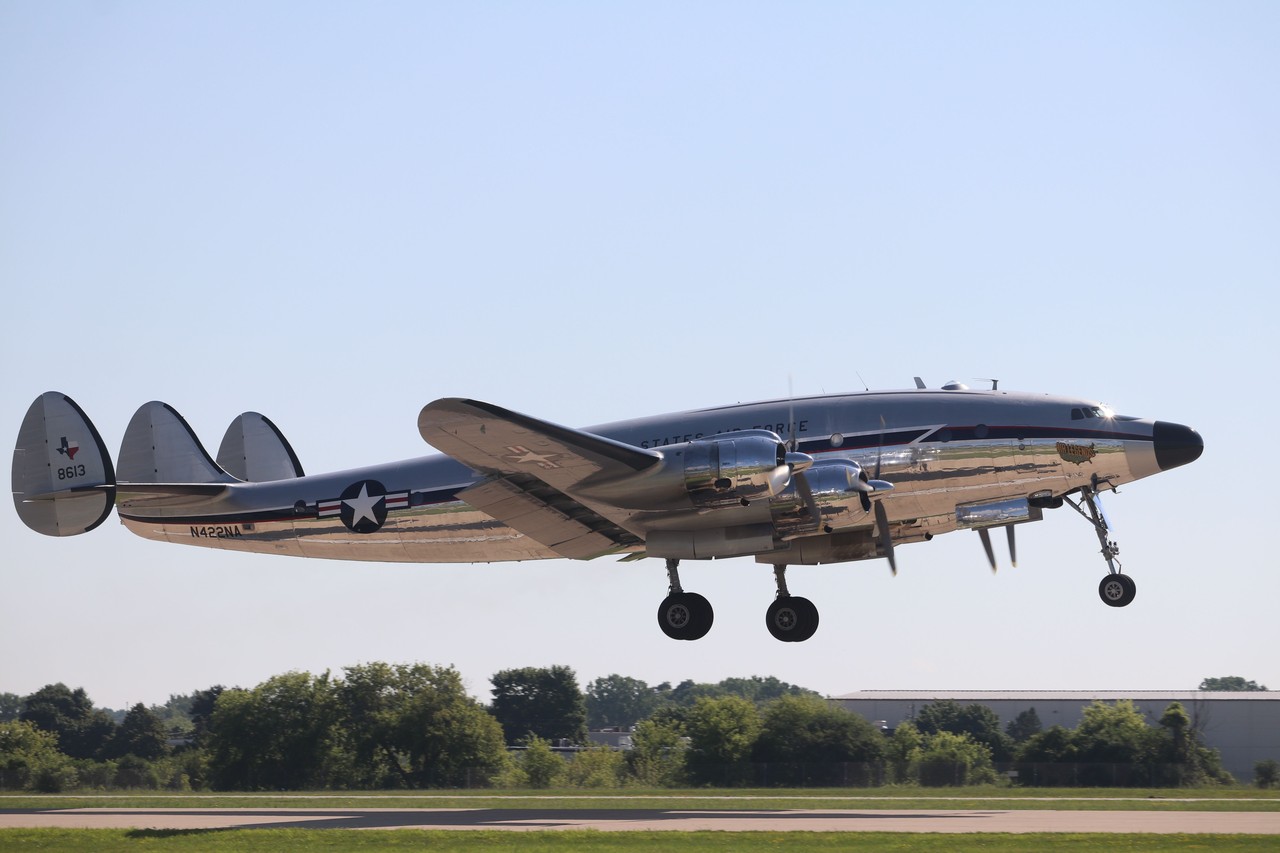
Service Dominance
The Constellation family dominated long-distance aviation for over two decades, with 856 aircraft built across all variants. Of the 579 Super Constellations produced, an impressive 55 percent were delivered to the U.S. Navy and Air Force, demonstrating the design's military importance. Airlines like QANTAS operated 16 Super Constellations on transcontinental routes, while Trans World Airlines used the type extensively for domestic and international services, cementing the Constellation's reputation as the backbone of post-war commercial aviation.
Military Service and Variants
The U.S. Air Force ordered 150 C-121A variants between 1948 and 1955, utilizing the aircraft for cargo transport, passenger service, and executive transport duties. The most significant military role came with the EC-121 Warning Star variant, which featured fuselages packed with electronic equipment and crews of 26 specialists for airborne early warning missions. In the mid-1960s, the Air Force deployed the first EC-121s to Southeast Asia for radar surveillance over North Vietnam, where they provided crucial MiG attack warnings and prevented American pilots from straying into Chinese airspace.
The most famous military Constellation was VC-121A "Columbine II," which served as the original Air Force One for President Dwight D. Eisenhower, making him the first president to fly under the Air Force One call sign. The final military Super Constellation, a Navy NC-121K, was formally retired on June 25, 1982, at Key West, Florida, ending a remarkable 39-year military career for the Constellation line.
The Manufacturer
Lockheed Aircraft Company designed the Constellation in 1939 as a response to the growing need for high-speed transcontinental passenger service. The company manufactured all Constellations at their Burbank, California plant from 1943 through the 1950s. Lockheed remained a major aerospace manufacturer throughout the 20th century, producing notable aircraft including the P-38 Lightning, F-104 Starfighter, and C-130 Hercules. The company merged with Martin Marietta in 1995 to form Lockheed Martin, which continues operating today as one of the world's largest defense contractors.
Design Innovation and Technical Excellence
Howard Hughes was instrumental in driving the Constellation's design as a high-speed transcontinental transport for his Trans World Airlines. The aircraft represented a quantum leap in commercial aviation technology, becoming the first commercial transport to achieve 300 mph cruise speeds. The C-121C Super Constellation was powered by four Wright R-3350-93A engines, 18-cylinder radials with fuel injection, internal superchargers, and three external power recovery turbines producing between 2,900 and 3,400 horsepower depending on fuel grade.
The engines consumed 445 liters per hour each, with Hamilton Standard 43H60 three-blade aluminum constant-speed propellers operating at approximately half engine speed. The aircraft required a crew of two pilots, a flight engineer, radio operator, navigator, and cabin staff, reflecting the complexity of 1940s aviation operations.
Performance and Capabilities
The Super Constellation achieved impressive performance figures for its era, with a cruising speed of 260 knots, maximum range of approximately 3,000 nautical miles, and service ceiling of 25,000 feet. The EC-121 variant had an empty weight of 80,611 pounds and maximum gross weight of 143,600 pounds, while carrying 24,790 liters of fuel. Commercial versions could accommodate 59 to 87 passengers depending on configuration, while military transports carried up to 44 troops.
Production Legacy and Survivors
The Super Constellation variant first flew in 1951, representing the pinnacle of propeller-driven airliner development. Despite mass scrapping in the 1960s and 1970s, approximately 55 Constellations survive today, though only one remains airworthy. VH-EAG "Southern Preservation," originally built as C-121C serial number 54-0157 and delivered on October 6, 1955, is the world's only flying Super Constellation.
The Historical Aircraft Restoration Society began restoring VH-EAG in November 1991, requiring 16,000 man-hours of volunteer labor and $800,000 in funding. After nearly 18 years on the ground, the aircraft returned to flight in September 1994. On February 3, 1996, VH-EAG completed a 39.5-hour Pacific crossing to arrive in Sydney, making stops at Oakland, Honolulu, Pago Pago, and Nadi.
The Constellation represents the final chapter of the great American propeller-driven airliners, bridging the gap between World War II military transport needs and the jet age that would follow. Its elegant triple-tail design and distinctive profile made it one of the most recognizable aircraft of the 1940s and 1950s, symbolizing the golden age of aviation when flying was still an adventure reserved for the fortunate few.