
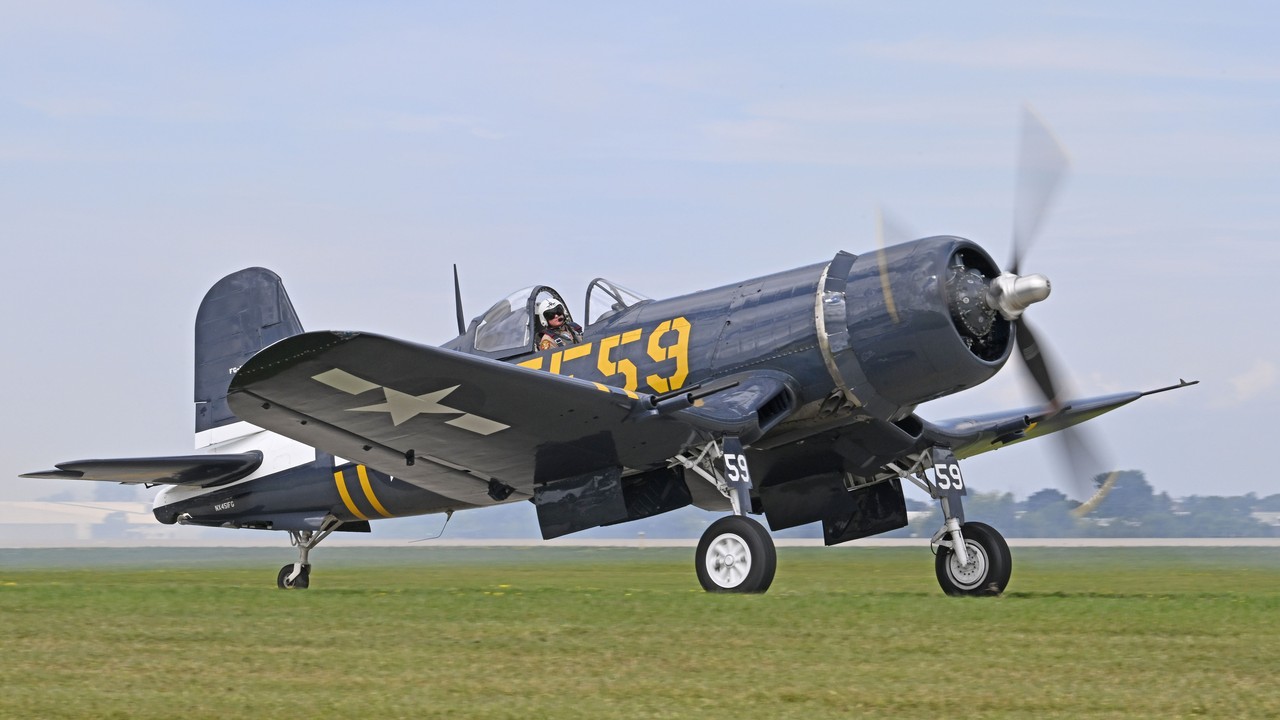
Combat Dominance
The F4U Corsair established itself as the most lethal fighter in the Pacific Theater, with pilots claiming 2,140 air combat victories against only 189 losses to enemy aircraft. This remarkable 11-to-1 kill ratio made it the most effective Allied fighter of World War II. Marine and Navy pilots flew 64,051 operational sorties in Corsairs, representing 44 percent of all U.S. fighter sorties in the Pacific, though surprisingly only 15 percent were flown from carrier decks due to initial landing difficulties.
The prototype XF4U-1 made aviation history on May 29, 1940, when it became the first single-seat fighter to exceed 400 miles per hour in level flight. This breakthrough performance convinced the Navy to award Chance Vought a contract for 584 F4U-1 fighters on June 30, 1941, just months before Pearl Harbor.
Manufacturing Marvel
Production began slowly with the first production Corsair flying on June 25, 1942, but rapidly accelerated into an industrial triumph. By May 1944, the three manufacturers were delivering 596 aircraft monthly—254 from Vought, 220 from Goodyear, and 122 from Brewster. At peak production, Chance Vought alone completed one Corsair every 82 minutes, rolling out 300 aircraft monthly from their Stratford, Connecticut facility.
The massive production effort involved three contractors building variants under different designations. Chance Vought produced 7,829 aircraft including 2,814 F4U-1s, while Goodyear Aircraft contributed 4,006 FG-1 variants and Brewster manufactured 735 F3A-1s before their contract cancellation in July 1944. This collaborative approach enabled the program to achieve 12,571 total aircraft by production's end on January 31, 1953.
The Powerhouse Engine
The Corsair's exceptional performance stemmed from its Pratt & Whitney R-2800 Double Wasp radial engine, the most powerful fighter engine of its era. Early F4U-1 models generated 2,000 horsepower on takeoff with the R-2800-8, while later F4U-4 variants produced 2,450 horsepower using the R-2800-18W. One experimental variant, the XF4U-1WM, tested an enormous Wasp Major R-4360 engine delivering 3,000 horsepower when first flown on September 12, 1943.
This massive power plant required significant design modifications, including moving the cockpit three feet aft to accommodate additional fuel capacity and redesigning the engine bay for the updated powerplant. The result was an aircraft that could sustain 453 miles per hour at maximum speed while carrying devastating armament.
Variants and Global Service
The Corsair family expanded into numerous specialized variants serving multiple nations. The F4U-1C mounted four 20-millimeter cannons in 200 aircraft, while 1,685 F4U-1Ds from Vought and 1,997 from Goodyear added bomb-carrying capability. Night fighter variants included the F4U-5N and F4U-5NL, among 223 total F4U-5 aircraft produced.
International operators received substantial numbers, with the Royal Navy acquiring 2,012 aircraft for Fleet Air Arm service and the Royal New Zealand Air Force operating 370 Corsairs. The French Navy received 94 specially-built F4U-7 variants, with 79 delivered in 1952 and 15 in 1953, representing the final production version.
Korean War Renaissance
When jets dominated the Korean War's air-to-air combat, the Corsair found new purpose in ground attack and night fighter roles. Production resumed to meet wartime demands, continuing until December 1952 as the veteran fighter proved its versatility beyond pure air superiority. The Corsair's ability to carry substantial ordnance loads—up to 4,000 pounds of bombs or eight five-inch rockets—made it invaluable for close air support missions.
Racing Legacy and Modern Survival
Five F2G-2 Super Corsairs, described as "the most powerful single-engine propeller-driven fighter ever built," transitioned to civilian racing after 1946. Cook Cleland purchased three surplus aircraft, with one Vought-overhauled example winning the Thompson Trophy Race in both 1947 and 1949, demonstrating the design's continued performance potential.
The Corsair's combat career extended well beyond major conflicts, seeing action in the 1969 Football War between Honduras and El Salvador. Today, surviving examples are preserved at institutions including the American Heritage Museum and CAF Airbase Georgia, representing one of aviation's most successful fighter designs and the culmination of piston-engine fighter development.