
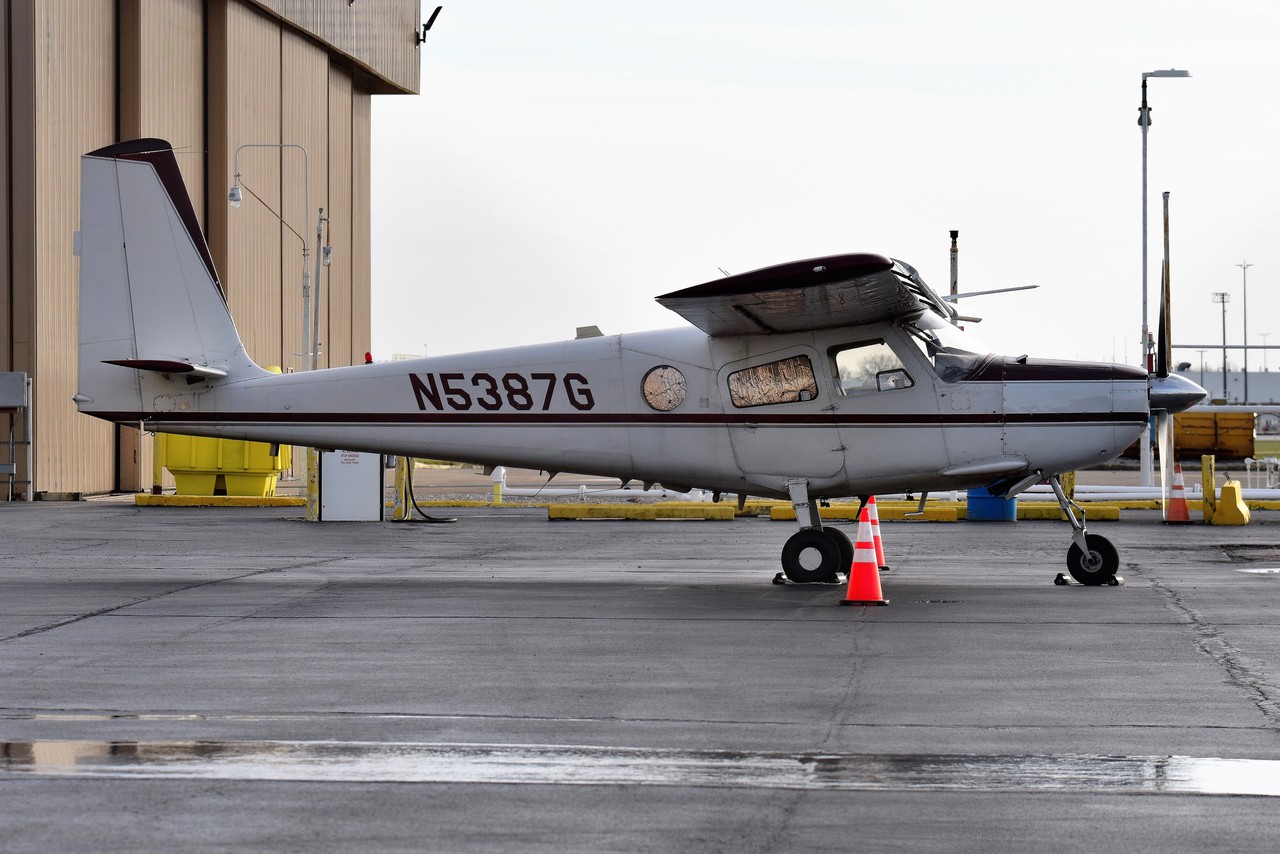
Military Adoption and CIA Operations
The U-10 Super Courier's military career began in 1958 when the U.S. Air Force purchased three aircraft, initially designated L-28A. Colonel Harry "Heinie" Aderholt recognized the aircraft's potential after a demonstration flight at Friendship International Airport in Maryland, reportedly landing an L-28A in the Pentagon courtyard. Aderholt immediately understood its value for CIA operations, stating it was exactly "what the CIA needed to exfiltrate people from hostile territory and to support partisans behind enemy lines."
Beginning in 1962, CIA operatives Aderholt and Larry Ropka introduced the Courier to Laos, where it operated from crude airstrips inaccessible to larger aircraft like the De Havilland L-20 Beaver. Air America, the clandestine airline operated by the CIA, became the most prominent civilian operator of the type.
Vietnam War Service
The Air Force formed the 5th Air Commando Squadron in July 1965 specifically to operate the improved U-10B variant in Vietnam. The squadron flew its first combat mission on November 23, 1965, over the Ia Drang Valley. Pilots trained at Forbes Air Force Base, Kansas, from August through October 1965 under Detachment 6 of the 1st Air Commando Wing.
The U-10B featured significant improvements over earlier variants, including a 295-horsepower engine and 120-gallon fuel tank that extended range to 1,200 miles and maximum speed to 200 mph. The Air Force procured 100 U-10B aircraft beginning in 1964. These aircraft performed liaison duties, light cargo transport, psychological warfare operations, forward air control missions, and special operations insertions and extractions.
Design Innovation and Founders
Otto Koppen and Lynn L. Bollinger founded Helio Aircraft Corporation and designed the Courier series. Their first proof-of-concept aircraft, a modified Piper PA-17 Vagabond, flew on April 8, 1949. The production design incorporated extensive high-lift devices including leading-edge slats, multiple-section flaps, and wing spoilers that provided exceptional short-field performance.
The aircraft's remarkable slow-speed handling allowed it to operate at approximately 25-35 mph, making it ideal for visual reconnaissance and operations in confined areas. Takeoff distance for the U-10D measured just 342 feet, while the aircraft could climb at 1,150 feet per minute to a service ceiling of 20,500 feet.
Engine and Technical Specifications
The U-10D Super Courier was powered by a single Lycoming GO-480 six-cylinder horizontally opposed engine producing 295 horsepower. This powerplant enabled a maximum speed of 180 mph and cruising speed of 160 mph, with a range of 1,100 miles. The aircraft accommodated one pilot and five passengers in its six-place cabin.
Unlike its armed derivative, the AU-24 Stallion, the U-10 carried no armament. Its value lay in its ability to access remote locations and operate safely at extremely low speeds, capabilities that made it invaluable for clandestine operations and humanitarian missions.
Production and Manufacturing
Helio Aircraft Corporation manufactured the Courier series in Pittsburg, Kansas, from 1954 to 1974, producing more than 500 aircraft in various configurations. Production briefly resumed in the early 1980s under Helio Aircraft Ltd, which built only 18 additional aircraft. The company ceased operations in 1974, and production rights subsequently changed hands multiple times with minimal manufacturing activity.
Civilian and Humanitarian Operations
Beyond military service, the Courier found success with missionary aviation organizations like Jungle Aviation and Radio Service (JAARS), which operated in remote worldwide locations. Bush pilots in Alaska and Canada embraced the aircraft for its ability to access unprepared landing strips in rough terrain.
Law enforcement agencies discovered that the Courier's 30-mph maneuvering capability provided a cost-effective alternative to helicopters for surveillance operations using infrared scanners. During Hurricane Camille relief efforts in August 1969, a U-10 circled Hurlburt Field with a speaker system to solicit donations. The aircraft also participated in a joint Air Force-Department of Agriculture program to eradicate screwworms from Puerto Rico and the Virgin Islands.
International Service and Retirement
Under the Military Assistance Program, several Central and South American countries received U-10B aircraft. The U.S. Army operated variants at Fort Bragg, North Carolina, the Panama Canal Zone, and Germany. The last three Air Force U-10s departed Hurlburt Field on July 10 and 13, 1973, ending the type's active military service.
Legacy and Museum Preservation
The Helio Courier earned recognition as an "unsung hero" of the Vietnam War, establishing benchmarks for short takeoff and landing aircraft design. A U-10D Super Courier is preserved at the National Museum of the United States Air Force, painted as an aircraft assigned to the 5th Air Commando Squadron in Southeast Asia in 1968. The aircraft's innovative high-lift system and versatility across military, civilian, and humanitarian roles secured its place as one of aviation's most capable specialized aircraft.