
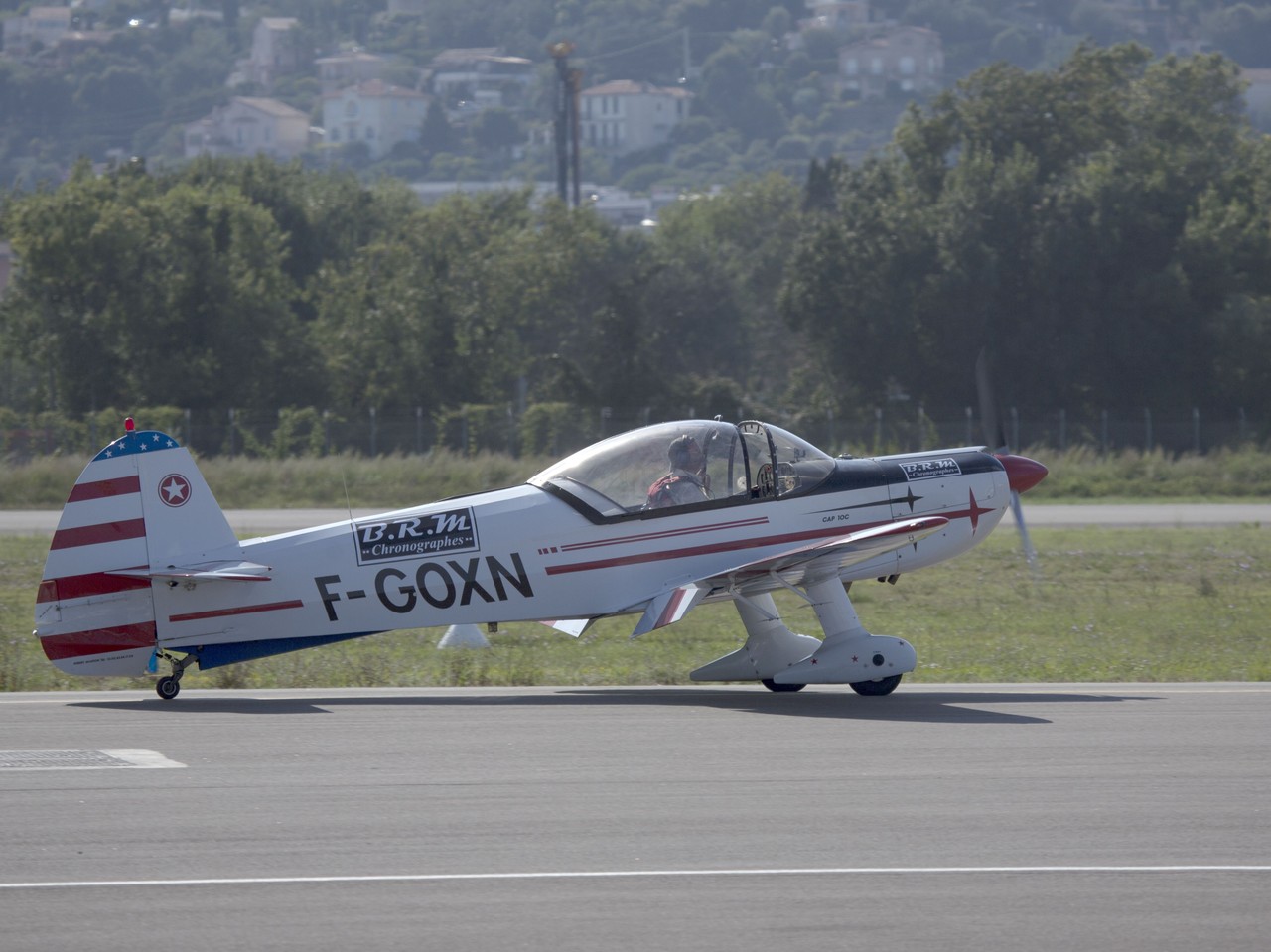
Design and Development
The CAP-10's development began when Auguste Mudry, working alongside engineer Nenad Hrisafović and test pilot Robert Buisson, sought to transform the gentle Super Emeraude into a capable aerobatic machine. The design team extensively modified Claude Piel's CP-301 Emeraude platform, strengthening the airframe structure and redesigning key components to withstand the stresses of aerobatic flight.
The prototype CP-100 made its maiden flight on August 13, 1966, powered by a 119-kilowatt engine. This initial version proved the concept, leading to the refined CAP-10 prototype (registration F-WOPX) which flew on August 22, 1968, equipped with the more powerful 134-kilowatt Continental O-360. The aircraft earned certification on September 4, 1970, with FAA VFR approval following in 1974.
Manufacturing History
Avions Mudry et Compagnie, originally founded as CAARP in 1958 by Auguste Mudry, established production at their Bernay facility in Normandy. Serial production commenced in 1970 and continued through 1996, during which Mudry manufactured 279 aircraft. The company had previously built Super Emeraude aircraft under license from Claude Piel's Scintex Aviation.
Following Mudry's bankruptcy in 1996, APEX Aviation acquired production rights in 1997. After a brief hiatus, manufacturing resumed in 2001 with the improved CAP 10C variant, now produced in Dijon. When APEX faced liquidation in 2008, Robin Aircraft assumed control, continuing production with the modernized CAP 10C NG. Total production reached over 300 aircraft by 2007.
Technical Innovation
The CAP-10's design incorporated several advanced features for its era. The aircraft featured a distinctive low elliptical wing with NACA 23012 airfoil section and 5-degree dihedral, optimized for aerobatic performance. Manual flight controls provided direct pilot feedback, while electric systems operated the flaps and trim tabs.
The CAP 10C variant, introduced in 2001, represented a significant advancement with its carbon fiber wing spar replacing the original aluminum structure. This modification reduced weight while increasing structural strength, resulting in a 25 percent larger aileron area and dramatically improved roll rates. The carbon spar underwent static testing on April 27, 2000, before the first retrofitted aircraft (HB-SAX) flew on March 5, 2001.
Military Service
Although designed for civilian use, the CAP-10 found favor with several air forces as a primary trainer. The French Air Force operated 56 aircraft before disposing of them in 1994-95, while the Mexican Air Force similarly utilized 20 examples during the same period. The French Navy acquired eight aircraft for training purposes.
The South Korean Air Force operated CAP-10s with their 208 Squadron, and the type saw training use in Australia and Morocco. By the end of 2000, approximately 60 aircraft remained in military service worldwide, all in training roles rather than combat applications.
Aerobatic Excellence
The CAP-10 quickly established itself in the competitive aerobatic world. Display teams such as the Patrouille Captens, featuring pilots Marianne Maire-Shaw and Adam Shaw, demonstrated the aircraft's capabilities at airshows throughout Europe. The French Connection aerobatic team, with pilots Montaine Mallet and Danil Héligoin, promoted the type in the United States for 25 years before a tragic mid-air collision in 2000.
The aircraft's docile handling characteristics made it ideal for introducing pilots to aerobatic flight, while its structural strength allowed advanced competition maneuvers. The three-position electric flap system (0, 15, and 45 degrees) provided versatility for both aerobatic and cross-country flight.
Global Operations
Civil operators embraced the CAP-10 for both training and sport flying. By 2000, approximately 180 aircraft served in civilian roles across Europe and beyond. Notable exports included aircraft to the United Kingdom and United States, with specific examples such as G-LORN (constructor number 282) delivered in 1999.
The type found particular success in European aeroclubs, where its combination of aerobatic capability and relatively modest operating costs made it attractive to both individual owners and training organizations. Pricing in 2002 ranged from €148,966 to €170,138 for new aircraft.
Legacy and Current Status
The CAP-10 established Mudry as a significant player in the aerobatic aircraft market, proving that specialized sport aircraft could achieve commercial success. Its influence extended beyond its production numbers, inspiring a generation of pilots to pursue aerobatic flying.
Today, Robin Aircraft continues the lineage with the CAP 10C NG, incorporating modern avionics and refined systems while maintaining the original's aerobatic DNA. Many original aircraft remain active in private hands and flying clubs, testament to the design's enduring appeal and structural integrity.