
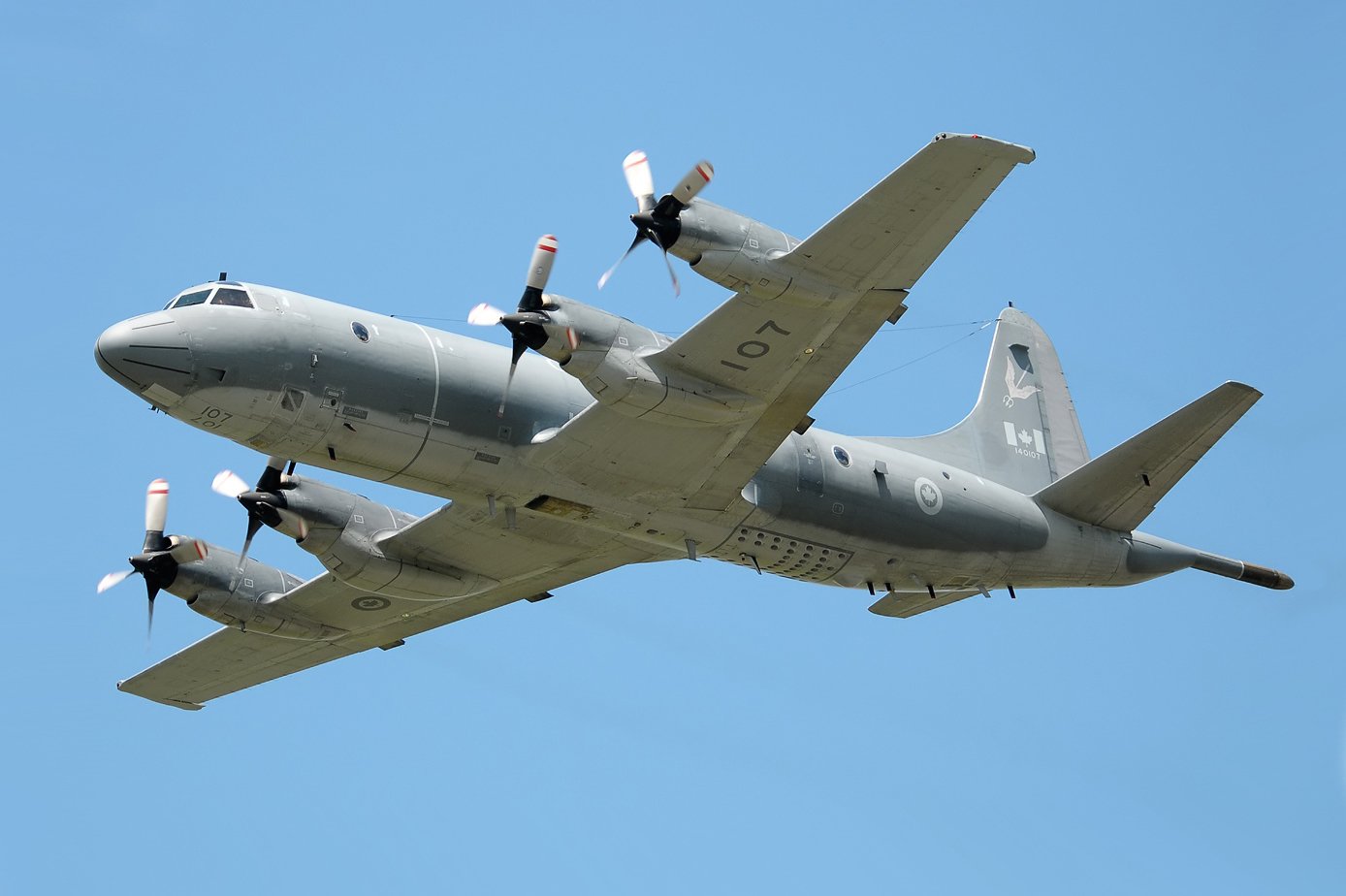
The Lockheed CP-140 Aurora is a specialized long-range maritime patrol and anti-submarine warfare (ASW) aircraft developed for the Canadian Armed Forces. The aircraft is a hybrid design, utilizing the proven airframe of the Lockheed P-3C Orion integrated with the more modern ASW mission systems of the S-3A Viking. This configuration provided Canada with a high-end sensor suite within a long-endurance platform capable of patrolling the vast Atlantic, Pacific, and Arctic regions.
Production was carried out by the Lockheed-California Company at the Hollywood–Burbank Airport in California. The prototype, serial 140101 (civil registration N64996), made its first flight on March 22, 1979. The first production aircraft was delivered to Canada on May 29, 1980, with the 18th and final full ASW-configured Aurora delivered in July 1981. Additionally, three CP-140A Arcturus variants, which lacked ASW equipment and were intended for training and surveillance, were delivered in the late 1980s using P-3C Update II.5 airframes. These three Arcturus aircraft were retired by 2011.
Technically, the CP-140 is powered by four Allison T56-A-14-LFE turboprop engines, each producing approximately 4,909 horsepower. The aircraft features a maximum gross weight of 64,410 kg, a wingspan of 30.37 m, and a length of 35.61 m. It is capable of reaching maximum speeds of approximately 750 km/h and possesses a range of roughly 7,400 km. For combat and rescue operations, the Aurora utilizes an internal weapons bay capable of holding eight weapons (approximately 4,800 lb) and ten wing-mounted hardpoints for up to 2,450 lb of stores, including Mk 46 Mod 5 torpedoes and depth charges.
In service with the Royal Canadian Air Force (RCAF), the CP-140 replaced the Canadair CP-107 Argus. It has been deployed in numerous international operations, including the NATO-led maritime blockade of the former Yugoslavia during Operation Sharp Guard (1992–1995), counter-terrorism maritime surveillance in the Persian Gulf during Operation Apollo (2001–2003), and maritime ISR and strike coordination in Libya during Operation Mobile in 2011. Domestically, the aircraft has supported search and rescue missions, such as during the 1997 Red River flood, and provided security ISR for the 2010 Vancouver Olympics.
To maintain the fleet, the Aurora Incremental Modernization Project (AIMP) updated the aircraft's avionics, and the Aurora Structural Life Extension Program (ASLEP) replaced major components like the outer wings and horizontal tail. A 2008 contract valued at US$156 million provided life-extension kits for 10 aircraft. With ASLEP completed in 2020, the CP-140 is expected to remain in service until approximately 2030.