
Service History
The French Air Force acquired six of the seven initial CAP-20 aircraft produced for their aerobatic demonstration team, the Équipe de Voltige Aérienne. This represented the military's commitment to establishing France as a competitor in international aerobatic competitions during the 1970s. The aircraft served exclusively in peacetime demonstration and competition roles, with no combat applications due to its specialized aerobatic design. Production variants included the CAP-20A, CAP-20B, and CAP-20E, each incorporating refinements based on operational experience.
The Manufacturer
Avions Mudry was founded by engineer Auguste Mudry, who served as president-director general during the CAP-20's development phase. The company operated from the late 1960s through the 1980s, focusing exclusively on aerobatic aircraft design to counter international competition in French aerobatics. Mudry had previously developed the two-seat CAP-10 trainer in the early 1970s, which served as the foundation for the single-seat CAP-20 series. The company is no longer independent under the Mudry name, though the lineage continued through successor aircraft like the CAP-230 and CAP-231.
Design and Development
Auguste Mudry led the CAP-20's design as both primary engineer and company founder, creating the aircraft as a single-seat derivative of his earlier CAP-10 with a significantly narrower fuselage. The design responded directly to French Air Force requirements for an aircraft capable of competing internationally in aerobatic competitions. Key innovations included an angular wing planform with reduced dihedral of 1.5 degrees and a rectangular vertical stabilizer designed to improve roll rate performance over the CAP-10.
Despite its aesthetic appeal, the initial CAP-20's performance disappointed relative to its predecessors, leading to the development of improved variants. The CAP-20L, first flown in 1976, addressed many of these shortcomings with a lighter structure weighing between 460-500 kilograms empty and enhanced aerobatic capabilities.
Engine and Technical Specifications
The CAP-20 was powered by a Textron Lycoming IO-360-A1B four-cylinder air-cooled horizontally-opposed engine producing 200 horsepower. This powerplant was paired with a two-bladed Hartzell constant-speed propeller, providing variable pitch optimization for aerobatic maneuvers. One variant, designated CAP-20L-180, utilized a 180-horsepower version of the engine, while a prototype known as "l'Arlésien" received an experimental 260-horsepower six-cylinder upgrade.
The aircraft's wing incorporated a V16F airfoil section optimized for aerobatic performance. The single-seat cockpit accommodated only the pilot, with no provision for passengers or cargo due to its specialized competition role.
Production and Variants
Total production of the CAP-20 family reached 44 aircraft manufactured between 1969 and 1987. The original CAP-20 series comprised nine aircraft: one CAP-20, three CAP-20A variants, four CAP-20B aircraft, and one CAP-20E. The improved CAP-20L accounted for 14 aircraft including two prototypes, produced from 1976 to July 1979. The final variant, the CAP-21, saw 18 aircraft built for civilian operators, including 17 production aircraft and one prototype.
All CAP-20L and CAP-21 aircraft were manufactured specifically for civilian aerobatic competition, as their enhanced performance characteristics made them more suitable for private ownership and competition flying than the original military variants.
Legacy and Current Status
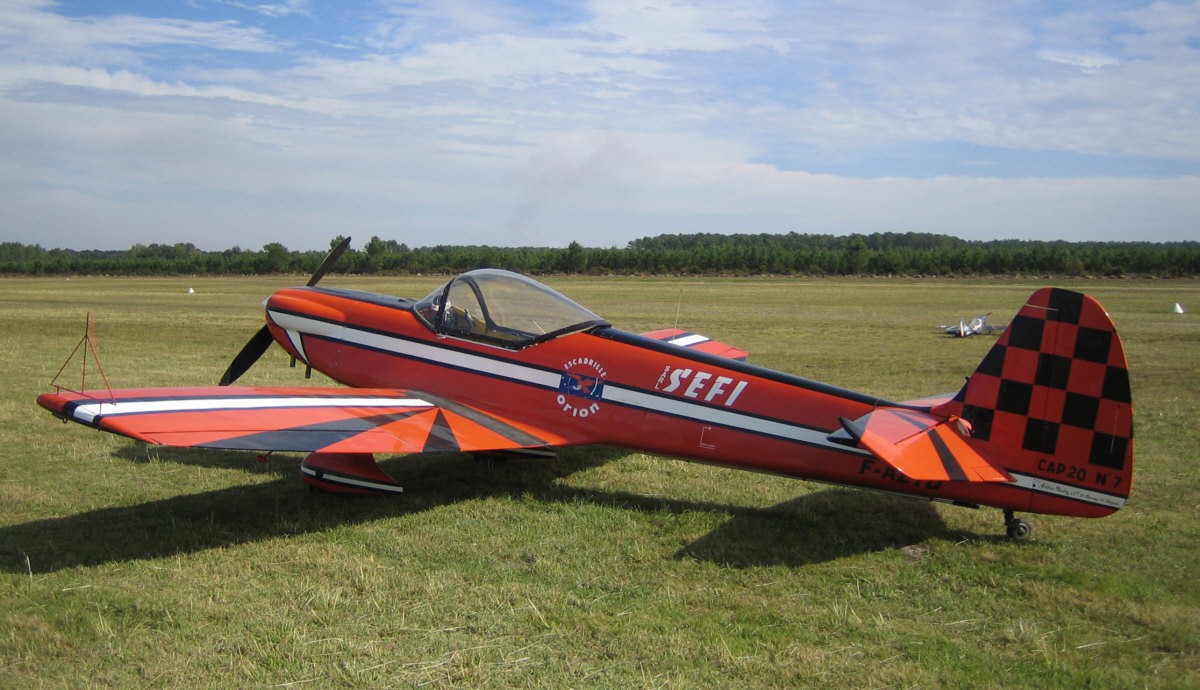
While the CAP-20 failed to achieve world championship success in aerobatic competition, it served as a crucial stepping stone in Mudry's aircraft development program. The experience gained from the CAP-20 series directly contributed to the more successful CAP-230 and CAP-231 designs that followed. Several CAP-20 aircraft remained in private hands following their retirement from French Air Force service, with photographic evidence from 2007 showing at least one example, CAP-20 number 7, still in existence.
The aircraft's primary historical significance lies in its role as a bridge between Mudry's CAP-10 trainer and the company's later high-performance aerobatic designs. Though production numbers remained small, the CAP-20 established important design principles and manufacturing techniques that influenced subsequent French aerobatic aircraft development throughout the 1980s and beyond.