
Development and Design Philosophy
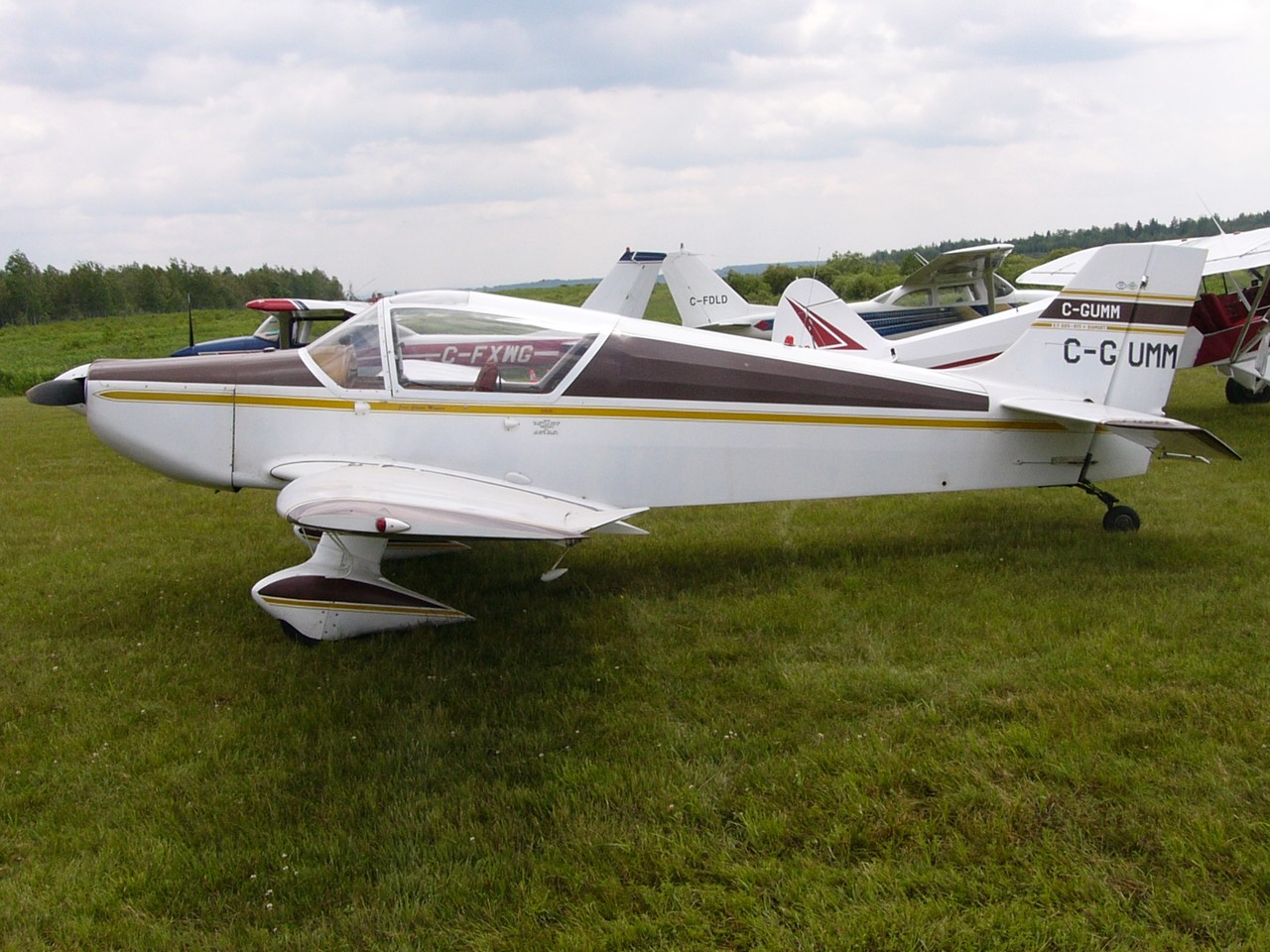
Claude Piel conceived the CP-60 Diamant in the late 1950s as a direct response to demands for a larger capacity version of his highly successful CP.30 Emeraude. Drawing from nearly two decades of aircraft design experience dating back to his 1943 CP.10 Pinocchio, Piel sought to create a homebuilt aircraft that could accommodate families rather than just two occupants. The Diamant retained the Emeraude's efficient cantilever low-wing monoplane configuration while incorporating a significantly enlarged fuselage and increased wingspan to handle the additional passenger load and higher gross weight.
The design featured a NACA 23015 airfoil and innovative seating arrangement with a rear bench seat behind the two front positions, allowing the aircraft to carry up to four occupants depending on the variant. This represented a substantial departure from the Emeraude's side-by-side two-seat configuration and positioned the Diamant as one of the few homebuilt designs of its era capable of true family transportation.
The Designer's Legacy
Claude Piel established himself as a pioneering figure in French general aviation through collaborations with multiple manufacturers throughout the 1940s and 1950s. His career included partnerships with Boisavia in 1948, Robert Denize in 1952 for the CP.20 development, and later with Copavia and Scintex-Aviation. The Scintex collaboration, beginning in 1959, focused primarily on commercial production of Emeraude variants rather than the Diamant, with the company eventually producing over 100 Emeraude aircraft before transitioning to CAP derivatives.
Unlike his earlier designs that achieved commercial production, Piel made the strategic decision to offer the Diamant exclusively as construction plans for amateur builders. This approach reflected the growing homebuilt movement of the 1960s and allowed builders worldwide to construct the aircraft without the complexities of type certification for commercial manufacturing.
Engine Variants and Performance
The Diamant family encompassed six distinct variants, each optimized for different performance requirements and engine availability. The base CP.60 utilized a 90-horsepower Continental engine, while the CP.601 increased power to 100 horsepower with the same manufacturer. The CP.602 incorporated a 115-horsepower Potez inline engine, representing one of the few applications of French powerplants in the series.
The CP.603 maintained the 115-horsepower output using a Lycoming engine, while the two Super Diamant variants pushed performance boundaries significantly higher. The CP.604 Super Diamant featured a 145-horsepower Continental engine, and the flagship CP.605 Super Diamant utilized the 150-horsepower Lycoming O-320-E2A flat-four engine. This powerplant selection provided the CP.605 with genuine four-seat capability and cruise performance competitive with factory-built aircraft of the era.
Construction and Distribution
Piel's decision to distribute the Diamant solely through construction plans proved both revolutionary and limiting for the design's proliferation. Plans were manufactured and distributed from France to builders worldwide, with documented construction occurring in countries including Canada, where the aircraft CF-AQT was completed in 1970. The plans-only approach eliminated the substantial capital investment required for tooling and type certification while allowing builders to customize their aircraft for local conditions and preferences.
This distribution method also meant that exact production numbers remain unknown, as no central manufacturer tracked completed aircraft. Forum discussions among homebuilders indicate continued interest in the design decades after its initial introduction, though the complexity of four-seat construction likely limited the total number completed compared to simpler two-seat designs.
Technical Specifications and Innovation
The CP.605B variant, representing the most capable version of the Diamant family, measured 23 feet in length with a wingspan of 30 feet 2 inches and wing area of 143.2 square feet. The aspect ratio of 6.4:1 provided efficient cruise performance while maintaining reasonable low-speed handling characteristics essential for amateur-built aircraft operations. Empty weight of 1,146 pounds and maximum takeoff weight of 1,874 pounds gave the aircraft a useful load of 728 pounds, sufficient for four occupants with limited baggage or three occupants with full fuel.
The cantilever wing construction eliminated external bracing while providing space for optional fuel tanks, extending range capability beyond the standard fuselage tank configuration. Landing gear options included both fixed tricycle and retractable configurations, allowing builders to choose between simplicity and performance based on their skill level and intended use.
Legacy and Current Status
While never achieving the widespread adoption of Piel's earlier Emeraude design, the Diamant established important precedents for homebuilt four-seat aircraft development. The design demonstrated that amateur constructors could successfully build complex, multi-passenger aircraft given proper plans and guidance. Contemporary homebuilt four-seat designs owe conceptual debt to Piel's pioneering work in scaling up two-seat formulas for family transportation.
Today, surviving Diamant aircraft remain active in enthusiast circles, though exact numbers of airworthy examples are unknown due to the distributed nature of construction records. The design continues to represent Claude Piel's vision of democratizing aviation through accessible construction plans and practical family aircraft design.