
Service History
The CP-65 Collegiate emerged as a significant player in America's massive Civilian Pilot Training Program (CPTP), which operated from 1938 to 1944 to build a pipeline of pilots for military service during World War II. By July 1940, Porterfield was producing 10 to 12 aircraft per week, competing fiercely with established manufacturers like Piper, Aeronca, and Taylorcraft for lucrative training contracts. Flying schools across the United States operated CP-65s to train the thousands of pilots needed for the war effort, with the aircraft serving primarily in the War Training Service (WTS) program.
Production and Manufacturing
Porterfield Aircraft Corporation ramped up production dramatically to meet wartime demand, opening a new manufacturing facility in 1940 that tripled the previous year's output. From 1939 to 1942, the company built approximately 400 to 476 Collegiate variants across all models, with the CP-65 representing the most numerous variant. Production records show aircraft serial number 1,029 was manufactured on November 5, 1941, demonstrating the steady flow of completed airframes. However, production ceased abruptly in 1942 when the United States entered World War II and Porterfield shifted resources to building gliders for the U.S. Army's preparation for the Normandy invasion.
The Manufacturer
Edward E. Porterfield founded Porterfield Aircraft Corporation in Kansas City, Missouri, after the bankruptcy of his previous venture, American Eagle Aircraft Corporation. Operating primarily from the mid-1930s until 1942, the company focused on building affordable training and touring aircraft for the civilian market. Despite involvement in the War Training Service and attempts to secure military contracts, Porterfield Aircraft Corporation ultimately failed to transition to wartime production and shut down permanently in 1942. The company never resumed operations after the war, leaving the CP-65 as its most successful and enduring design.
Engine and Technical Innovation
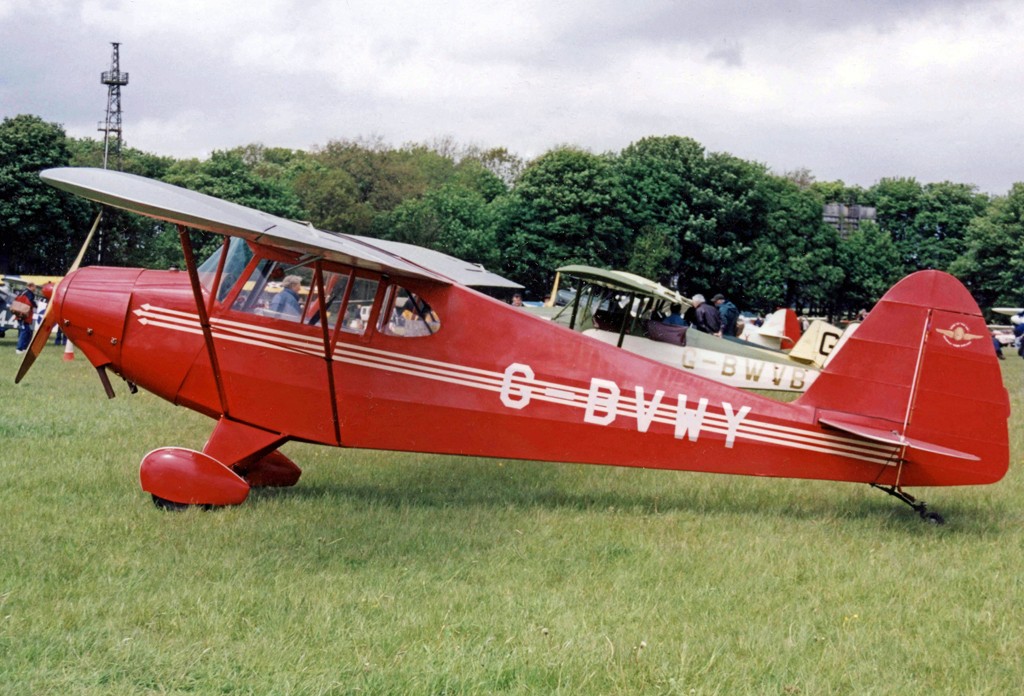
The CP-65 was powered by Continental's reliable A65-8 or A65-9 engine, a 65-horsepower four-cylinder horizontally-opposed air-cooled powerplant that became a standard in light aircraft training. This represented a significant upgrade from earlier Porterfield models that used 40 to 50-horsepower engines, providing improved performance for training operations. The aircraft featured several innovative design elements, including parallel struts connecting the high wing to the fuselage bottom, fixed tailskid landing gear (with optional tailwheel upgrade), and dual magnetos for reliability.
Design Philosophy
Engineers at Porterfield developed the CP-65 as an evolution of the earlier Model 35 Flyabout and Zephyr designs, focusing on creating an affordable yet capable trainer for the expanding civilian pilot training market. The aircraft's distinctive slim fuselage, which earned it the "Skinny Bird" nickname, accommodated tandem seating that provided excellent communication between instructor and student. Porterfield offered practical options including Edo floats and Federal skis for the 65-horsepower models, expanding the aircraft's versatility beyond traditional airport operations.
Operational Characteristics
The CP-65 gained approval under Approved Type Certificate (ATC) 720, validating its airworthiness for training operations. Its braced high-wing configuration provided stable flight characteristics ideal for student pilots, while the Continental engine delivered reliable performance essential for daily training flights. The tandem seating arrangement allowed instructors to closely monitor student progress while maintaining good visibility from both cockpit positions.
Legacy and Survivors
More than 80 years after production ended, the CP-65 Collegiate maintains a dedicated following among vintage aircraft enthusiasts. In 2001, over 100 examples remained active in private ownership worldwide, testament to the aircraft's robust construction and enduring appeal. Notable survivors include G-AFZL, a 1939 CP-65 based in the United Kingdom, and F-AYRJ, a 1940 example operating in France. Old Rhinebeck Aerodrome in New York preserves a CP-65 as part of its collection, ensuring future generations can appreciate this significant training aircraft.
The CP-65's importance extends beyond its production numbers, representing the critical role civilian aircraft manufacturers played in preparing America for World War II. While it never achieved the iconic status of the Piper J-3 Cub, the Porterfield CP-65 Collegiate successfully trained hundreds of pilots who went on to serve their country during the war, earning its place in aviation history as a capable and reliable trainer that helped build America's pilot force when it was needed most.