
Design Innovation and Amateur Aviation
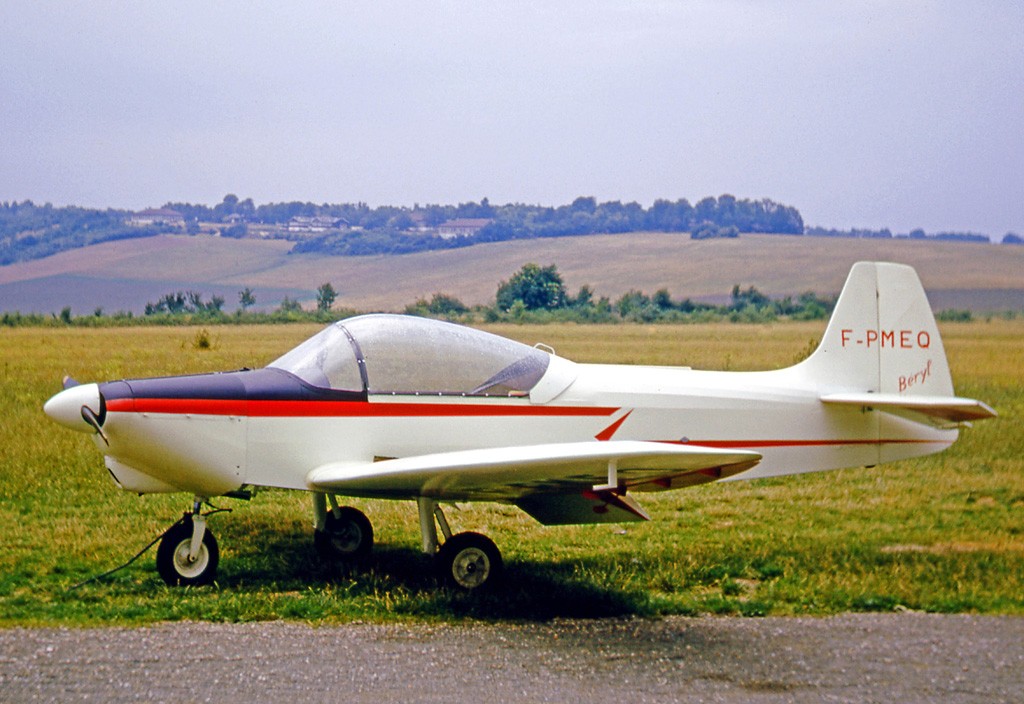
Claude Piel's CP-70 Béryl represented a significant evolution in homebuilt aircraft design, adapting the proven wing structure of his successful Emeraude while introducing tandem seating to the amateur construction market. The prototype F-PMEQ completed its maiden flight in France in 1965, establishing a new category of sport aircraft that would attract builders across three continents.
The Béryl's design philosophy centered on providing amateur constructors with a modern alternative to side-by-side seating arrangements. By utilizing the established Emeraude wing design, Piel reduced development risks while creating an entirely new fuselage that accommodated pilot and passenger in fighter-style tandem positions. This configuration offered improved aerodynamic efficiency and gave the aircraft a distinctive sporting appearance that appealed to recreational pilots.
The Designer's Legacy
Claude Piel emerged as one of France's most influential light aircraft designers, drawing from a background rooted in aeronautical craftsmanship. Born in Paris as the son of an aeronautical carpenter, Piel began his professional career in 1948 with Boisavia company before advancing through positions at Robert Denize, SCANOR, Scintex, and ultimately CAARP. In 1965, Auguste Mudry established CAARP as a specialized design bureau, utilizing Piel's expertise alongside Nenad Hrissatovic and Louis de Goncourt to create innovative amateur aircraft designs.
The CP-70 served as Piel's personal family aircraft, with which he and his family traveled extensively throughout France from their base at Moisselles airfield near Paris. This personal investment in the design validated its practical utility for the touring role that many amateur builders sought.
Engine Options and Performance Variants
The standard CP-70 accommodated two distinct powerplant options, reflecting the diverse needs of amateur constructors. The Continental A65-8F engine, producing 65 horsepower, provided economical operation for training and local flying, while the 118-horsepower Lycoming O-235 delivered enhanced cross-country performance. This flexibility allowed builders to match engine selection to their intended mission and budget constraints.
Piel expanded the design family with specialized variants addressing aerobatic applications. The CP.750 variant incorporated a 150-horsepower Lycoming O-320 engine, reduced wingspan for improved roll rate, and fixed tailwheel undercarriage for enhanced ground handling during aerobatic operations. The most powerful variant, the CP.751, utilized a 200-horsepower Lycoming O-360-A2A engine, providing substantial performance increases for advanced aerobatic maneuvers.
Construction Methods and Materials
The CP-70's construction combined traditional woodworking techniques with modern materials, making it accessible to amateur builders with varying skill levels. The basic airframe utilized doped fabric-covered wood construction throughout, a proven method that required minimal specialized tooling. The original tricycle undercarriage configuration included a steerable nosewheel, simplifying ground handling for pilots transitioning from training aircraft.
The aerobatic CP.750 variant introduced welded steel tube fuselage construction while retaining wooden wings, demonstrating Piel's willingness to adapt construction methods to specific performance requirements. This hybrid approach balanced structural strength requirements for aerobatic loads with the proven aerodynamic qualities of the original wing design.
Global Production and Distribution
Unlike conventional manufactured aircraft, the CP-70 achieved distribution through plan sales to individual constructors rather than factory production. Amateur builders completed examples in France, Brazil, and the United States, demonstrating the design's international appeal and the effectiveness of Piel's documentation. This approach allowed the design to reach markets where conventional aircraft importation might have been economically unfeasible.
By 2009, four examples remained active on the French civil aircraft register, indicating the design's longevity and continued operational utility. The prototype F-PMEQ remained airworthy as of 2014, having been modified as a CP.703 with tailwheel undercarriage, serving as a testament to the design's structural durability after nearly five decades of operation.
Technical Specifications and Performance
The standard CP-70 achieved respectable performance figures within its 540-kilogram gross weight limitation. Maximum speed reached 175 kilometers per hour, while operational range extended to 600 kilometers, providing genuine cross-country capability for recreational flights. The service ceiling of 3,000 meters offered sufficient altitude capability for European touring operations while remaining within the performance envelope of naturally aspirated engines.
Empty weight of 320 kilograms allowed a useful load of 220 kilograms, accommodating two occupants plus baggage for weekend touring. The 10.9 square meter wing area provided benign handling characteristics suitable for amateur-built aircraft operations, while the 1.60-meter height facilitated hangar storage at typical general aviation facilities.
Enduring Appeal
The CP-70 Béryl's continued presence in amateur aviation decades after its introduction reflects successful integration of proven design elements with innovative configuration choices. Claude Piel's approach of combining established wing technology with new fuselage design created an aircraft that satisfied both performance expectations and construction feasibility for amateur builders. The design's international distribution and operational longevity demonstrate the effectiveness of well-documented amateur construction projects in expanding global general aviation access.