
Design and Development
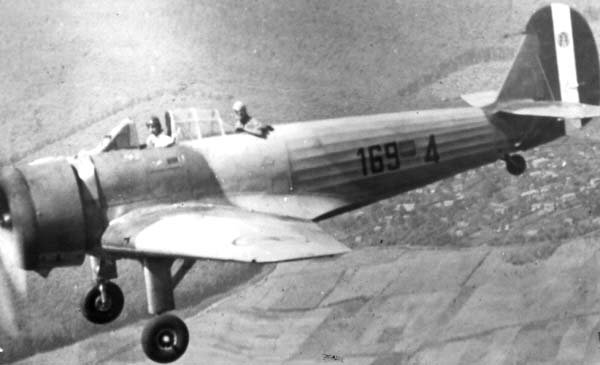
The Caproni A.P.1 was designed by Cesare Pallavicino, a former Breda engineer who joined the Caproni group. The aircraft evolved from the Caproni Ca.301, a single-seat fighter prototype that never entered production. The A.P.1 was developed as a two-seat attack variant of this concept, featuring a more powerful engine to support its assault role. The prototype first flew on April 27, 1934. Its design was characterized by a low-wing monoplane configuration of mixed construction, featuring fixed landing gear enclosed in large trouser fairings. While the monoplane layout was progressive for the mid-1930s, the fixed gear was considered an anachronism compared to the retractable systems emerging at the time.
Production and Technical Specifications
Manufacturing was handled by Caproni Bergamaschi, a division of Società Italiana Caproni based in Bergamo, Italy. Production occurred primarily between 1936 and 1938. An initial series of 12 aircraft was delivered in 1936, followed by a second improved series. Records indicate that 66 production aircraft were delivered during this window, bringing the total to approximately 67 including the prototype.
The aircraft utilized Alfa Romeo radial piston engines. Early and export models were equipped with the 9-cylinder air-cooled Alfa Romeo 125 RC.35, producing 580 hp. Later Italian series aircraft used the Alfa Romeo 126 RC.34, which provided 582 kW (780 hp). In its standard Italian configuration, the A.P.1 reached a maximum speed of 347 km/h, a service ceiling of 6,500 m, and a range of 1,500 km. Armament typically consisted of two 7.7 mm Breda-SAFAT machine guns for forward fire and a single rear-facing machine gun (either 7.7 mm or 12.7 mm depending on the variant). It could carry up to 500 kg of bombs in a vertical rack located behind the rear cockpit.
Military Service
The Regia Aeronautica operated the A.P.1 across eight assault wing squadrons. The type saw operational service during the Spanish Civil War, where at least 10 aircraft were deployed to Nationalist forces by late 1938. However, its performance was deemed unsatisfactory, leading to its replacement by Breda Ba.64, Ba.65, and Ba.88 aircraft.
In South America, Paraguay ordered 26 aircraft in 1936, though only seven landplanes arrived in late 1939 due to Italian priority needs and diplomatic issues. These aircraft, assigned to the Segundo Escuadrón de Caza and based at Ñu-Guazú, became Paraguay's first dedicated dive-bombers. They were used for training in the Paraguayan Chaco and later saw limited reconnaissance and attack missions during the Paraguayan Civil War of 1947. El Salvador also operated the type, acquiring four aircraft for its Escuadrilla de Caza, with a fifth delivered as a replacement for a ferry flight crash.
Legacy
Società Italiana Caproni ceased operations in 1950, though the Caproni Vizzola branch survived until its acquisition by Agusta in 1983. No examples of the A.P.1 were preserved, and no airworthy aircraft exist today.