
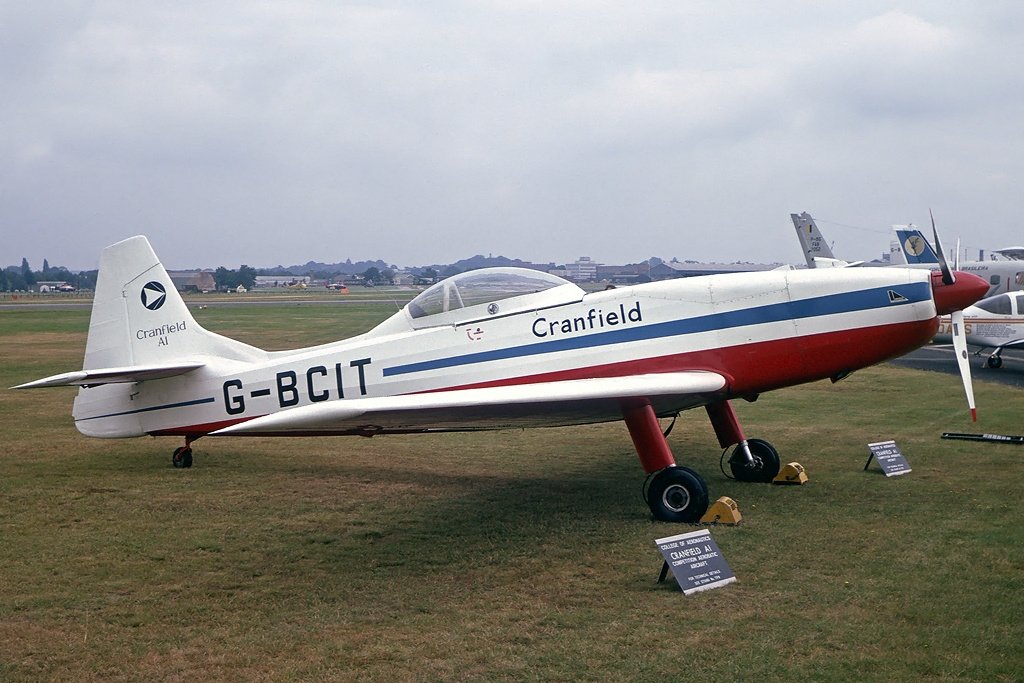
Design Genesis and Educational Mission
The A-1 Eagle emerged from Cranfield Institute of Technology's Master of Science aircraft design program, beginning conceptual work in 1968 as a hands-on educational project. The aircraft's primary objective was creating a high-performance aerobatic platform that would serve dual roles as a competition aircraft and training vehicle while demonstrating innovative lightweight construction methods. Dr. Kenny-Wallace and J.P. Fielding led much of the design development, incorporating student input throughout the eight-year development process.
Funding challenges significantly delayed construction, with the single prototype not reaching completion until 1976. The extended development timeline, while problematic from a production standpoint, allowed multiple student cohorts to contribute to various design aspects, fulfilling the aircraft's educational mission even before its maiden flight.
Technical Innovation and Construction
The Eagle incorporated several advanced design features that distinguished it from contemporary aerobatic aircraft. The wing utilized a single-piece light alloy construction with NACA 23 series airfoil sections, providing the structural integrity necessary for extreme aerobatic maneuvers while maintaining relatively light weight. Frise ailerons enhanced control authority throughout the flight envelope, particularly during high-g maneuvers.
The fuselage employed welded tube construction covered with a combination of fabric and plywood, balancing structural strength with weight considerations. This hybrid approach allowed the aircraft to achieve its impressive +7/-5 g structural limits while keeping the aerobatic gross weight to just 1,874 pounds. The undercarriage was adapted from the proven de Havilland Chipmunk design, providing reliable ground handling characteristics.
Powerplant Evolution
The A-1's engine installation underwent significant modification during its early service life. Initial flights used a 210-horsepower Rolls-Royce Continental IO-360-D flat-six engine, which powered the aircraft for approximately 40 flight hours through mid-1977. Recognizing the need for additional performance, Cranfield upgraded to a specially modified 280-horsepower Lycoming IO-540-D engine paired with a three-bladed Hoffmann variable-pitch propeller measuring 6 feet 7 inches in diameter.
This powerplant change transformed the aircraft's performance characteristics, providing a remarkable rate of climb of 2,190 feet per minute and enabling operations up to 16,000 feet service ceiling. The IO-540 engine family, entering production in the 1960s, had established itself as a reliable powerplant across numerous general aviation applications, making it an ideal choice for the Eagle's demanding aerobatic mission.
Operational History and Modifications
Following its first flight on 23 August 1976, the Eagle served primarily as an aerobatic demonstration and training aircraft at Cranfield. The single example, registered as G-BCIT with serial number 001, accumulated flight hours in both competition aerobatics and pilot instruction roles. The aircraft's never-exceed speed of 239 miles per hour and stall speed of just 56 miles per hour provided an excellent envelope for aerobatic training.
In the late 1990s, Cranfield undertook a major modification program, transforming the single-seat aircraft into the two-seat A1-200 Eagle variant. This conversion incorporated student design projects including an enlarged rudder, composite wing studies, and semi-monocoque fuselage modifications. The modified aircraft completed its official first flight as a two-seater on 30 September 1998, with Cranfield's Chief Test Pilot at the controls.
The Cranfield Legacy
Cranfield Institute of Technology, established in 1946 as the College of Aeronautics, evolved into Cranfield University while maintaining its focus on aerospace engineering education. The institution's aircraft design programs gained international recognition, with the A-1 Eagle serving as a tangible demonstration of the practical skills developed within its Master of Science curriculum.
The A-1 project exemplified Cranfield's hands-on educational philosophy, allowing students to experience the complete aircraft development process from initial concept through flight testing. This approach produced graduates who understood not just theoretical aerodynamics, but the practical challenges of translating designs into flying aircraft.
Current Status and Preservation
As of 2010, the sole Cranfield A-1 Eagle remained in storage at Cranfield University, no longer in airworthy condition. The aircraft's limited range of 120 miles and endurance of 90 minutes reflected its specialized aerobatic mission rather than cross-country capability. Its compact dimensions, with a wing area of just 161.5 square feet, contributed to the aircraft's exceptional maneuverability within the aerobatic box.
While the A-1 Eagle never achieved production status beyond its single prototype, its significance lies in its educational impact and demonstration of innovative design approaches. The aircraft served as a platform for advanced student projects well into the 1990s, contributing to aerospace education long after its initial construction. The Eagle stands as testament to Cranfield's commitment to practical engineering education and the institution's ongoing contribution to aerospace engineering development.