
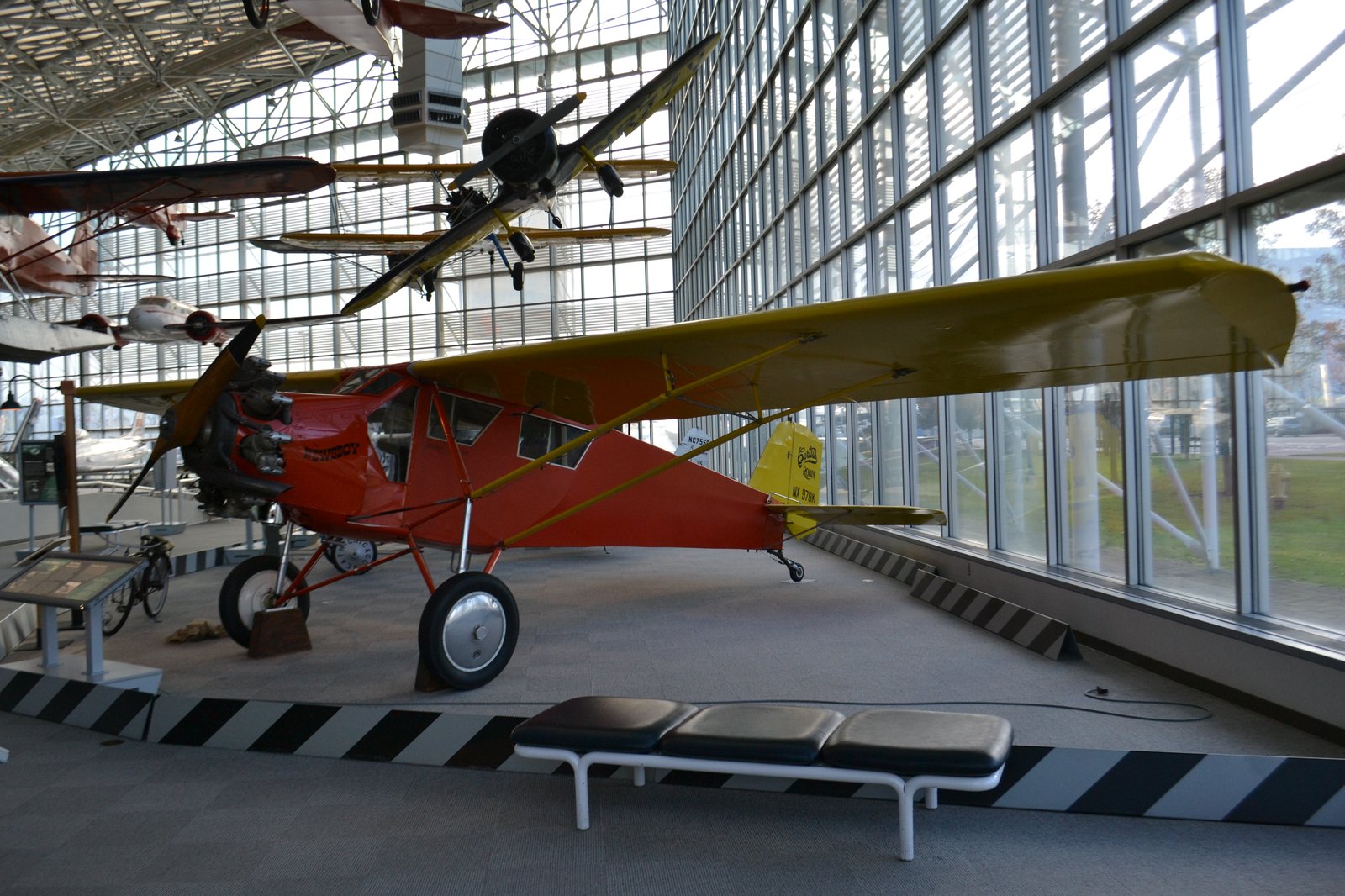
Civilian Aviation Pioneer
The Robin emerged during aviation's Golden Age as manufacturers pivoted from military to civilian markets following World War I. Curtiss capitalized on abundant surplus OX-5 engines, creating an affordable enclosed-cabin aircraft that contrasted sharply with the open-cockpit designs dominating general aviation. The Robin's enclosed cabin featured side windows extending nearly to the floor, providing unprecedented weather protection and passenger comfort.
The Manufacturer
Curtiss-Robertson Airplane Manufacturing Company formed in 1928 through a partnership between the established Curtiss Aeroplane and Motor Company and Robertson Aircraft Corporation of St. Louis, Missouri. Initial design work began at Curtiss facilities in Garden City, New York, before production moved to St. Louis. The parent Curtiss Aeroplane and Motor Company merged into Curtiss-Wright Corporation in 1929, but the economic devastation of the Great Depression ended Robin production in 1930. Today's Curtiss-Wright Corporation continues as an aerospace components manufacturer, though no longer produces complete aircraft.
Engine Variants and Performance
The Robin's success stemmed partly from its adaptability to multiple powerplants. The original Model 50A and Robin B variants used the 90-horsepower Curtiss OX-5 V-8 water-cooled engine, a reliable World War I surplus unit that kept costs low but provided modest performance. The Robin C series, powered by 170 to 185-horsepower Curtiss Challenger air-cooled radials, became the most popular configuration with over 200 examples built. The Challenger's six-cylinder double-row radial design offered superior power-to-weight ratios compared to inline engines.
Other variants included the Robin J-1 and J-2 with 165-horsepower Wright J-6-5 Whirlwind radials, and the Robin W with 110-horsepower Warner Scarab engines. Performance varied by engine, with OX-5 powered examples achieving maximum speeds of 99.7 mph and cruise ranges up to 785 miles on 50 gallons of fuel.
Record-Breaking Achievements
The Robin gained fame through spectacular endurance and distance flights. Fred and Algene Key set a world endurance record in their Robin C-1 "Ole Miss" during June and July 1935, remaining airborne for 653 hours and 34 minutes—27 continuous days over Meridian, Mississippi. Their flight required 432 in-flight refueling operations despite encountering storms and an engine fire.
Even more famous was Douglas "Wrong Way" Corrigan's unauthorized transatlantic flight in July 1938. After being denied permission for a New York-to-Ireland flight, Corrigan claimed he accidentally flew east instead of west to California in his modified Robin J-1, landing in Dublin after a 28-hour solo flight. Whether truly accidental or deliberately defiant, Corrigan's exploit captured public imagination and demonstrated the Robin's surprising long-distance capabilities.
Commercial Operations
Beyond private ownership, Robins served specialized commercial roles. The "Newsboy" Robin C-1 operated daily newspaper delivery flights from 1929 to May 1930, carrying the McCook, Nebraska Daily Gazette nonstop 380 miles to rural Nebraska and Kansas communities. Flying at 500 feet, crews dropped newspaper bundles to subscribers below, demonstrating aviation's practical applications in isolated areas.
Robertson Aircraft Corporation, co-developer of the Robin, also operated the type on contract airmail routes between St. Louis and Chicago, continuing the company's pioneering role in commercial aviation.
Limited Military Service
While primarily a civilian aircraft, the Robin saw minimal military use. The United States Army Air Corps purchased one modified Robin W with a 110-horsepower Warner R-420-1 engine, designating it XC-10 for radio-controlled unmanned flight experiments. Paraguay acquired a Robin C in 1932 for its air arm, using the aircraft intensively as VIP transport and air ambulance during the Chaco War against Bolivia from 1932 to 1935.
Technical Innovation
The Robin incorporated several advanced features for its era. Some variants featured retractable landing gear, unusual for light aircraft in the late 1920s. The wooden wing structure combined with steel-tube fuselage construction provided strength while maintaining reasonable weight. The Curtiss C-72 airfoil and 262.5 square feet of wing area delivered stable flight characteristics appreciated by pilots transitioning from open-cockpit designs.
Production Legacy
Of the 756 Robins manufactured, specific variants included approximately 325 Robin B models, over 200 Robin C-1s, about 50 Robin Cs, 40 Robin J-1s, and 11 four-seat Robin 4C-1A variants. Smaller numbers included six Robin C-2s and two Robin J-2s. Today, approximately 50 Robins remain registered with the Federal Aviation Administration, testament to the design's durability.
The National Air and Space Museum preserves the record-setting "Ole Miss" Robin J-1 Deluxe, honoring the Key brothers' endurance achievement. As America's first mass-produced cabin light aircraft, the Robin established design principles and market expectations that influenced general aviation development for decades.