
Service History
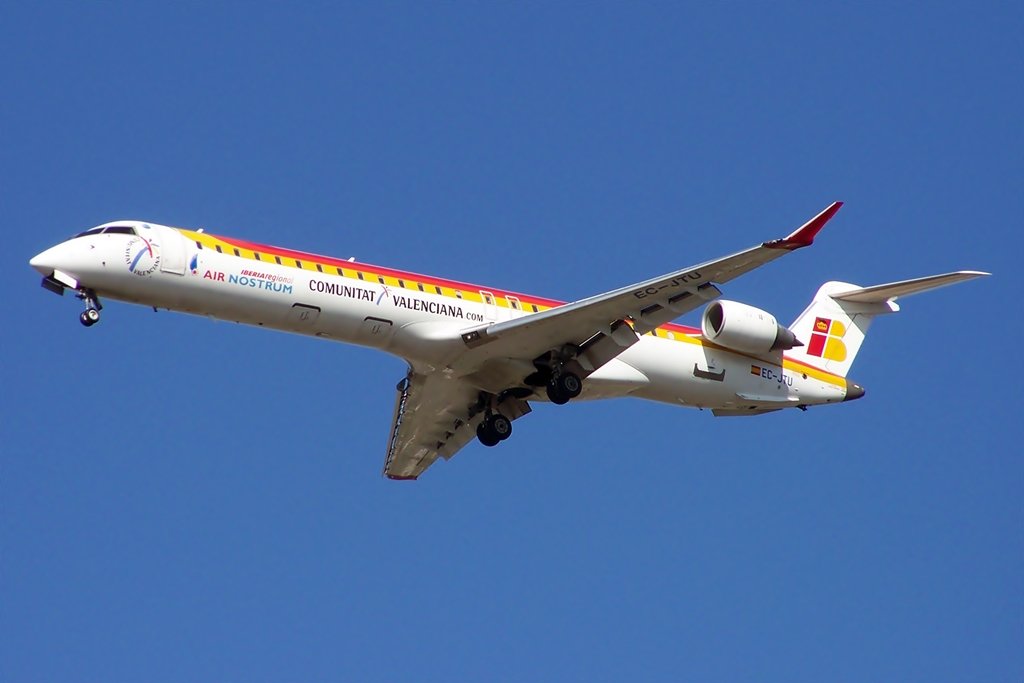
The CRJ-200 became the backbone of regional aviation across North America and Europe, with 709 aircraft delivered between 1992 and 2006. By July 2018, 498 CRJ-100/200 aircraft remained in active airline service, with 407 operating in North America alone. Major operators included SkyWest Airlines with 136 aircraft, Air Wisconsin with 62, and RusLine with 14. The aircraft's success stemmed from its ability to serve thin routes between major hubs economically, filling the gap between 30-seat turboprops and 100-seat mainline jets.
Delta Air Lines became the CRJ program's most influential customer, operating 223 aircraft by June 2003 and continuing to order additional units. Northwest Airlines placed a pivotal order in early 1999 for 54 CRJ-200LRs with options for 70 more, valued at $1.3 billion. This deal validated the regional jet concept and sparked the explosive growth that followed.
The Manufacturer
Bombardier Aerospace launched the CRJ program on March 31, 1989, after conducting design studies beginning in the third quarter of 1987. The Montreal-based company derived the regional jet from its successful Challenger 600 business aircraft, stretching the fuselage and reconfiguring the interior for airline service. Bombardier froze the basic configuration in June 1988 and assigned the engineering designation CL-600-2B19.
On June 1, 2020, Mitsubishi Heavy Industries acquired the entire CRJ program from Bombardier, including type certificates and production rights. Bombardier completed assembly of the remaining order backlog on Mitsubishi's behalf, delivering the final CRJ-900 to SkyWest Airlines on February 28, 2021. Service and support operations transferred to MHI RJ Aviation Group, which continues providing maintenance and spare parts from Montreal.
Engine & Technical Details
The CRJ-200 employed two General Electric CF34-3B1 high-bypass turbofan engines, an improvement over the CF34-3A1 engines used in the original CRJ-100. These powerplants provided superior fuel efficiency, increased cruise altitude capability, and higher speed compared to the earlier variant. The engines mounted on the rear fuselage in a configuration that reduced cabin noise and allowed for easier ground operations at smaller airports.
The aircraft required a two-pilot crew and incorporated advanced avionics for its era. Bombardier and Eaton Aerospace certificated a redesigned flap actuator system in August 2008 to improve cold weather performance, addressing operational challenges experienced by northern operators. The European Joint Aviation Authorities and U.S. Federal Aviation Administration awarded certification on January 14 and 21, 1993, respectively.
Pilot Perspective
Pilots appreciated the CRJ-200's responsive handling characteristics and reliability in demanding regional operations. The aircraft could operate from shorter runways than competing jets, enabling service to smaller airports previously limited to turboprop aircraft. Its higher cruising altitude of 41,000 feet allowed operations above most weather, reducing delays and providing smoother flights for passengers.
The CRJ-200's cruise speed of approximately 450 miles per hour represented a significant improvement over turboprops, reducing flight times on regional routes by 30 to 40 percent. This speed advantage, combined with jet aircraft reliability and passenger appeal, made the type highly profitable for airlines serving business markets where schedule frequency mattered more than seat-mile costs.
Production & Legacy
Bombardier manufactured 1,021 CRJ-100/200 series aircraft by 2015, comprising 226 CRJ-100s, 709 CRJ-200s, and 86 CRJ-440s. Production peaked at 14.5 aircraft per month in 2003, with annual targets reaching 174 units in 2004. The program concluded CRJ-200 production in January 2006, though the airframe continued as the basis for the Challenger 850 corporate shuttle.
The CRJ-200's success established Bombardier as a major force in commercial aviation and sparked the regional jet boom that transformed air travel. Airlines valued its relatively low operating costs of approximately $21 million per aircraft in 2003 dollars and its remarkable safety record throughout two decades of service. The type's influence extended beyond its production run, proving that passengers preferred jets over turboprops on routes longer than 200 miles, fundamentally changing regional airline business models and route structures across North America and Europe.