
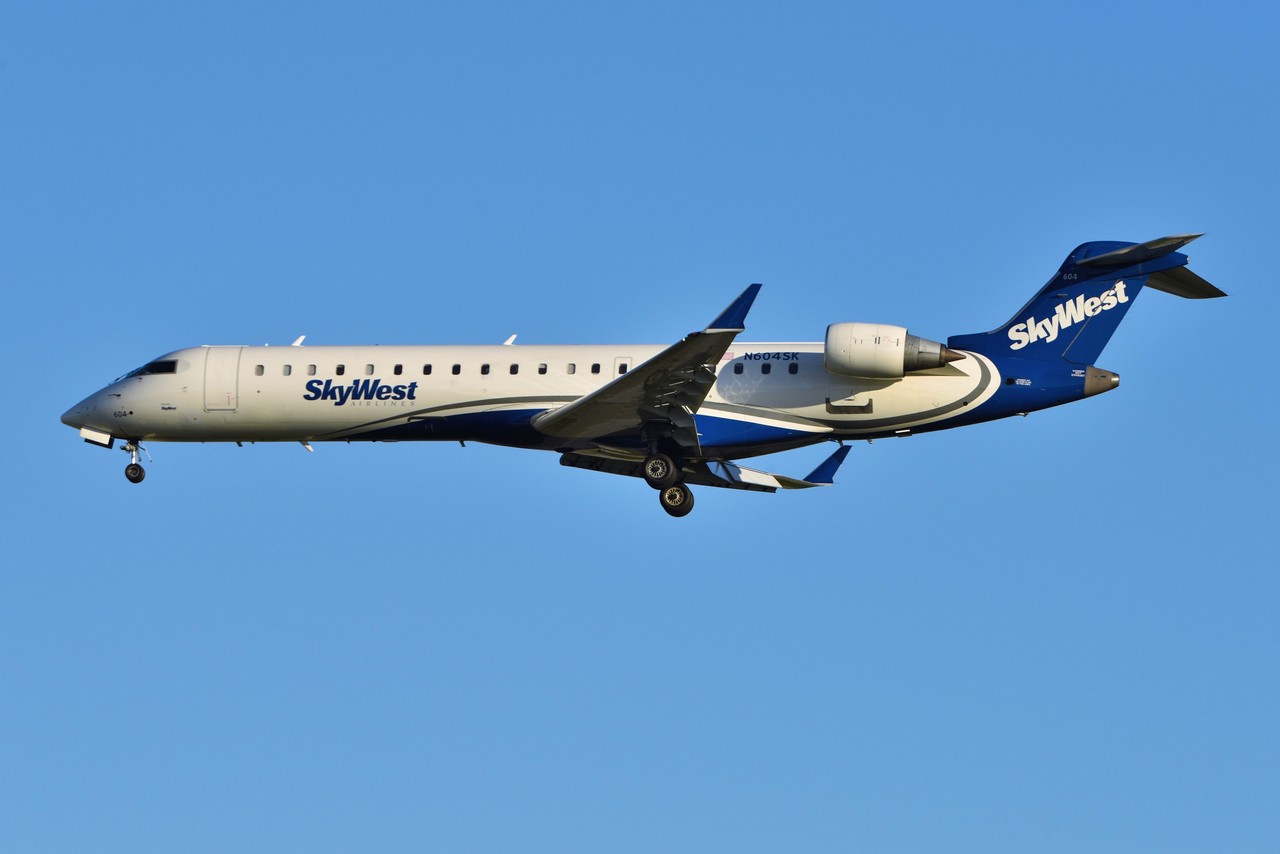
Service History
The CRJ-900 captured significant market share in the 90-seat regional jet category, with 499 aircraft delivered over its 20-year production run. Mesa Airlines received the first production aircraft on February 2, 2003, operating it under the America West Express banner. Major operators including Endeavor Air, Lufthansa CityLine, and China Express Airlines built substantial fleets around the type, using it to feed passengers from secondary markets into their primary hub operations.
The aircraft filled a crucial gap in airline fleet planning, offering 20 percent more seats than the CRJ-700 while maintaining similar operating economics. Airlines configured the CRJ-900 in various arrangements, from high-density 90-seat layouts to premium 76-seat configurations featuring dual or triple-class service with enhanced legroom.
The Manufacturer
Bombardier Aerospace developed the CRJ-900 after acquiring Canadair in 1987, inheriting the regional jet expertise that traced back to Bill Lear's original LearStar 600 design from 1974. The company had already invested 440 million dollars in the CRJ-700 program before committing an additional 136 million dollars to stretch the design for the 90-seat market.
Bombardier's Montreal Mirabel final assembly plant opened specifically for CRJ production on October 22, 2001. The facility became the birthplace for 2,023 CRJ aircraft across all variants between 1991 and 2021, making the CRJ family what Bombardier claimed as "the most successful family of regional jets in the world."
On June 1, 2020, Bombardier sold the entire CRJ program to Mitsubishi Heavy Industries for undisclosed terms. Bombardier continued assembly operations on Mitsubishi's behalf, delivering the final CRJ-900 on February 28, 2021. Mitsubishi Heavy Industries now provides product support through its Canadian division, though the Mirabel facility has been converted to Airbus A220 production.
Engine & Technical Details
General Electric CF34 high-bypass turbofan engines power the CRJ-900, mounted in rear-fuselage pods characteristic of the CRJ family design. These proven powerplants provided the reliability and fuel efficiency necessary for the demanding regional airline environment, where aircraft often complete four to six flight cycles daily.
The aircraft requires a two-pilot crew operating from a modern glass cockpit featuring integrated flight management systems. The design maintained commonality with other CRJ variants, allowing airlines to cross-train crews and reduce operational complexity.
Extended Range variants offered greater operational flexibility, enabling airlines to serve longer thin routes that traditional larger aircraft could not operate profitably. The CRJ-900ER expanded the type's mission capability beyond typical regional feeder routes.
Pilot Perspective
Regional airline pilots appreciated the CRJ-900's handling characteristics, which closely matched the smaller CRJ-700 despite the fuselage stretch. The aircraft maintained good performance at regional airports with shorter runways, a critical capability for serving smaller communities.
Cruising speeds comparable to larger mainline aircraft allowed the CRJ-900 to integrate seamlessly into airline hub operations without disrupting schedule timing. The type's relatively high service ceiling provided operational flexibility in weather and air traffic control situations.
Production & Legacy
The CRJ-900 achieved remarkable safety statistics during its service life, recording only two hull loss incidents with zero fatalities through 2024. The first hull loss occurred in July 2011 when a CRJ-900ER operating for Delta Connection collided with a Delta Air Lines Boeing 767 during ground operations at Boston Logan International Airport.
Production numbers reflected the aircraft's market success, with 499 CRJ-900s built compared to 347 CRJ-700s and just 64 of the larger CRJ-1000 variant. The CRJ-900 hit the market sweet spot for regional operations, offering optimal capacity for most thin routes.
Several major operators have since retired their CRJ-900 fleets, including Air Nostrum with 14 aircraft, Envoy Air, and Garuda Indonesia. However, many examples continue active service worldwide, particularly in North American and European regional operations.
Mitsubishi investigated restarting CRJ production in 2021, focusing on a CRJ550 variant based on the CRJ-700 airframe but limited to 50 seats. This concept would have required building new manufacturing facilities since Mirabel now serves Airbus production. As of March 2024, Mitsubishi has not pursued production restart, effectively ending the CRJ family's manufacturing legacy after three decades of continuous production.