
Design and Development
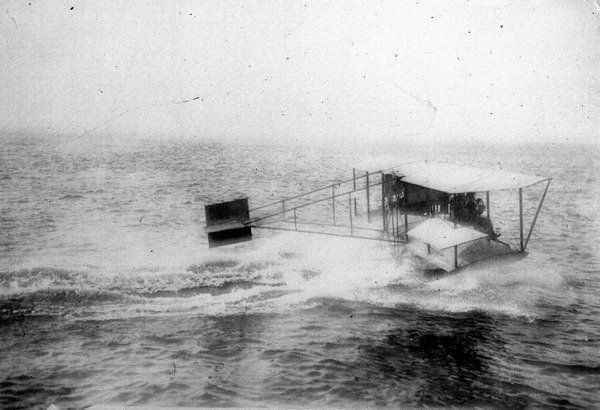
Designed by aviation pioneer Glenn Hammond Curtiss, the Model E was developed in 1911 as a versatile biplane capable of water operations. The aircraft existed in several configurations, beginning with the hydro-aeroplane, which first flew on January 26, 1911, utilizing a central float and wingtip outriggers. A significant evolution occurred in 1912 with the introduction of the Model E flying boat; unlike its predecessors, this variant featured a boat-shaped hull fuselage rather than separate floats, making it the first truly successful flying boat in the United States.
Technical Specifications
The Model E utilized water-cooled piston engines manufactured by Curtiss, typically installed in a pusher configuration driving a two-bladed propeller. Engine options varied by model: the Model E-4 used a 40 hp 4-cylinder engine, while the Model E-8 utilized a 60 hp V-8. The Navy's A-1 "Triad" configuration was powered by a 75 hp Curtiss O V-8 engine, achieving a maximum speed of 42 mph and a range of 112 miles. Later civil variants, such as the 1913 flying boat used by Logan A. "Jack" Vilas, were equipped with a more powerful 90 hp Curtiss OX 8-cylinder engine.
Production and Manufacturer History
Production was centered at Glenn Curtiss's main base in Hammondsport, New York, where the first Navy floatplanes were flown from Keuka Lake. The aircraft were produced by the Curtiss Aeroplane Company (also known as the Curtiss Aeroplane and Motor Company). While exact total production figures are unknown due to the customized nature of early manufacturing, records indicate the U.S. Navy purchased approximately 14 Model Es. The Aeronautical Division of the U.S. Signal Corps operated at least four units, including two Model E-4s and one ex-Navy seaplane.
Service History
The Model E is most notable for introducing the U.S. Navy to aviation. On May 8, 1911, the Navy ordered a Model E-8-75 floatplane for $4,400, which became the A-1 "Triad" and flew on February 25, 1911. These aircraft served as experimental platforms for maritime reconnaissance, night water landings, and surface-to-air communications. They also achieved the first catapult launch of a seaplane and set altitude records of 900 ft and 6,200 ft. In civil service, Logan A. "Jack" Vilas used a Model E flying boat in July 1913 to complete the first aerial crossing of Lake Michigan, flying from St. Joseph, Michigan, to Grant Park in Chicago.
Legacy
The Model E established the technical template for subsequent Curtiss flying boats, such as the Model F and Model H. Today, no complete original Model E is known to be airworthy. The most significant surviving artifact is the hull of Logan Vilas's 1913 flying boat, which was donated to the Smithsonian National Air and Space Museum in 1949.