
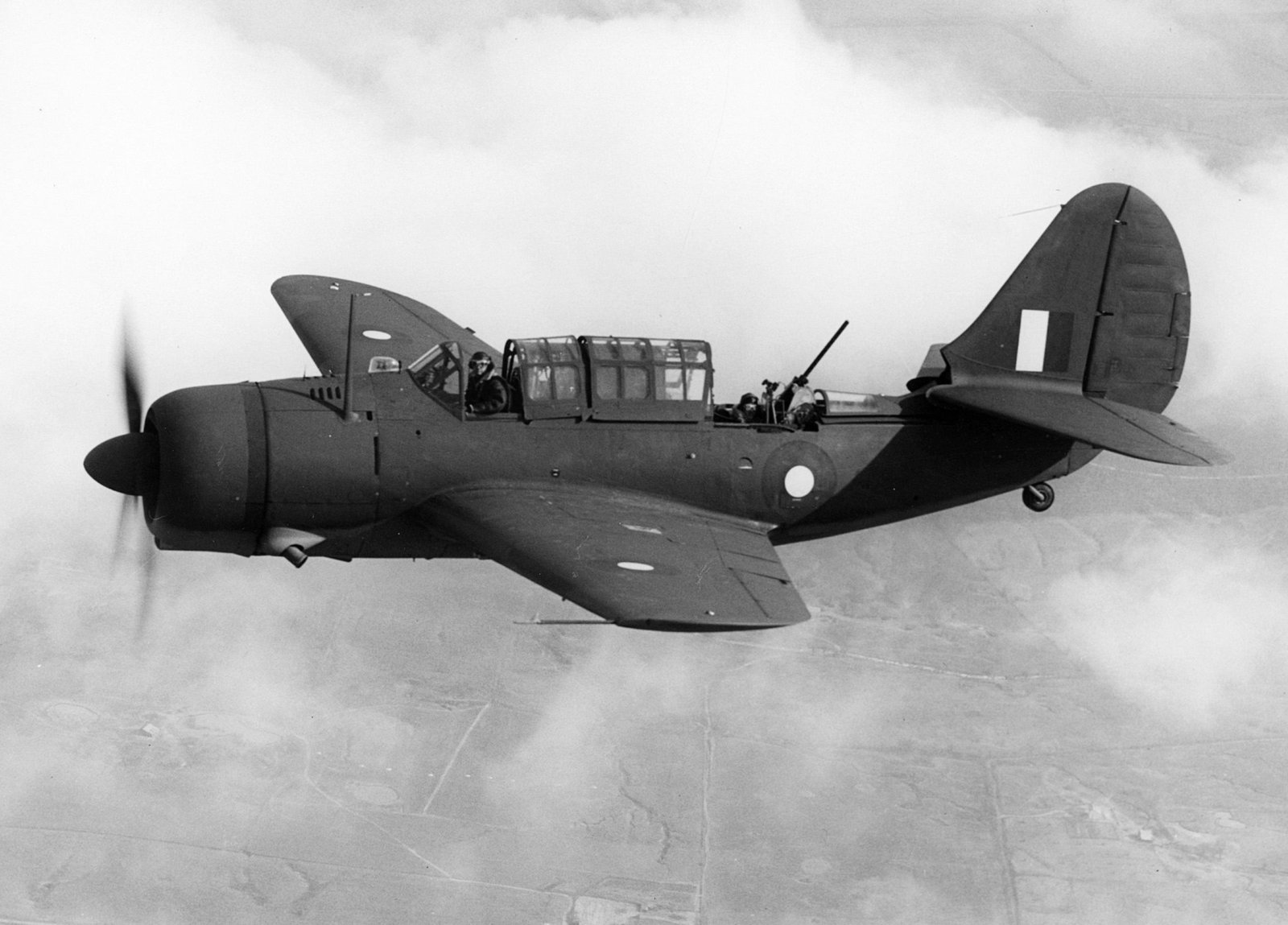
The Curtiss SB2C Helldiver was developed by the Curtiss-Wright Corporation to replace the Douglas SBD Dauntless and Curtiss SBC as the primary carrier-based dive bomber for the U.S. Navy. Designed as a two-seat, single-engine, all-metal low-wing monoplane, it represented the final evolution of the dedicated dive-bomber concept used by the United States. While the prototype first flew around late 1940, the aircraft did not enter combat until November 11, 1943, when Bombing Squadron VB-17 launched 23 SB2C-1s from the USS Bunker Hill (CV-17) for a strike on Rabaul.
Production of the Helldiver was extensive, with 7,140 aircraft completed between 1942 and 1945. The majority were built by Curtiss-Wright in the United States, totaling 5,946 units. Additionally, Canadian firms produced license-built variants: Fairchild Aircraft Ltd. manufactured 300 SBF models, and Canadian Car & Foundry Co. Ltd. produced 894 SBW models. The aircraft was powered by a Wright R-2600 Twin Cyclone air-cooled radial piston engine; later variants, such as the SB2C-4 and -5, utilized the R-2600-20 model capable of producing approximately 1,900 horsepower, enabling a maximum speed of roughly 260 mph.
Technically, the Helldiver featured an internal bomb bay capable of carrying a 1,000-lb bomb, supplemented by two 100-lb bombs under the wings. Armament evolved throughout production; while the SB2C-1 used four .50 caliber Browning machine guns, the SB2C-1C and subsequent models were upgraded to two 20 mm cannons with 400 rounds per gun. Defensive capabilities included a rear-cockpit mount that transitioned from a single .50 caliber gun to twin 7.62 mm guns on a powered ring mount.
During the Pacific War, approximately 30 Navy bombing squadrons operated the Helldiver from 13 different carriers, participating in critical campaigns including the Philippines, Iwo Jima, Okinawa, and strikes on the Japanese home islands. They contributed to the sinking of the super-battleships Yamato and Musashi. Following the war, the aircraft remained in U.S. Navy service until 1947 and in Naval Reserve units until 1950. Other operators included the French Navy, which used them in Indochina into the 1950s, as well as Italy, Thailand, Greece, and Portugal.
Today, the Helldiver's legacy is preserved in museums and through limited flight operations. The Smithsonian National Air and Space Museum holds an SB2C-5 that served with VB-92 aboard the USS Lexington. Currently, only one airworthy SB2C-4 is known to exist, restored by the Commemorative Air Force.