
Design and Development
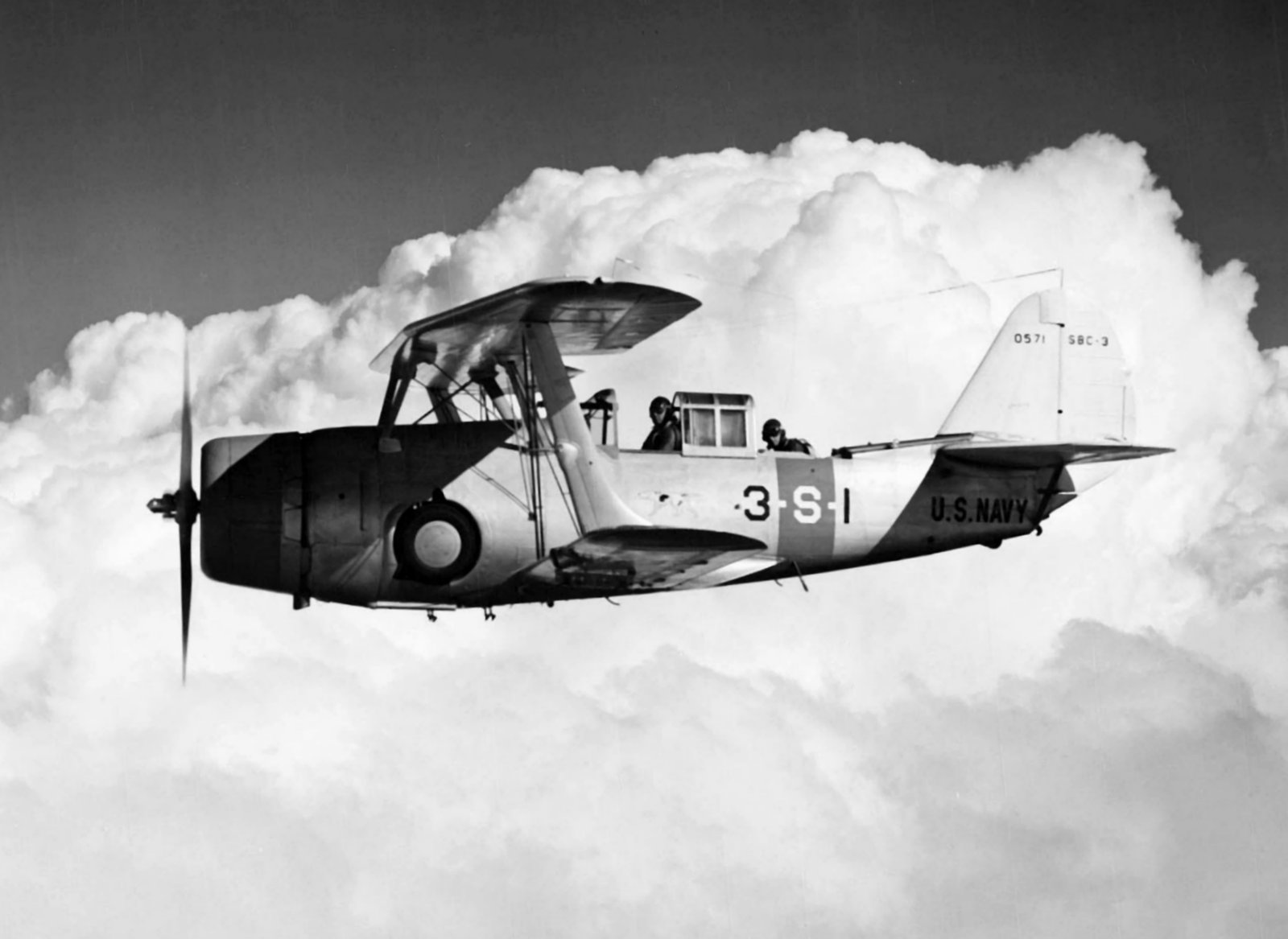
The Curtiss SBC Helldiver emerged from a complex development process that began between 1932 and 1934. The aircraft originally started as the XF12C-1, a design intended for a carrier-based fighter. Over time, the concept evolved into a scout and eventually a scout-bomber. Notably, the aircraft initially flew as a monoplane, but the final production versions were configured as biplanes. The resulting design was an all-metal, two-seat aircraft characterized by its I-type interplane struts.
Production and Manufacturer
The aircraft was manufactured by the Curtiss-Wright Corporation, a company formed in 1929 through the merger of Wright Aeronautical and the Curtiss Aeroplane and Motor Company. Series production of the SBC took place from 1937 to approximately 1940. While the aircraft was delivered to the U.S. Navy in 1937, it was already considered obsolete by the onset of World War II. Curtiss-Wright eventually exited the aircraft manufacturing industry in 1948, though the corporation continues to operate today as an industrial and defense contractor.
Technical Specifications
The most well-documented version, the SBC-4, was powered by a single Wright R-1820-34 air-cooled, nine-cylinder radial piston engine producing 850 horsepower. This powerplant enabled a maximum speed of 234 mph at 15,200 feet and a cruising speed of 175 mph. The aircraft had a service ceiling of 24,000 feet and a rate of climb of 1,630 feet per minute. Its armament consisted of one fixed forward-firing .30-caliber machine gun and one .30-caliber machine gun on a rear swivel mount for the radioman-gunner. For offensive operations, it could carry a single 500-lb or 1,000-lb bomb on its centerline.
Service History
In U.S. service, the SBC Helldiver operated as a scout and dive bomber. By December 1941, the U.S. Navy and Marine Corps operated 69 SBC-3 and 117 SBC-4 aircraft. Due to the emergence of superior monoplane designs, many production units were assigned to Naval Reserve units rather than front-line carriers. One Marine unit, VMO-151 in Samoa, continued using the SBC-4 until June 1943.
International interest led the French government to order 90 SBC-4 aircraft in 1939, featuring self-sealing fuel tanks. Following the outbreak of war in Europe, 50 of these were diverted to France. Some of these aircraft eventually reached Britain, where they were designated as the "Curtiss Cleveland" and used exclusively for mechanic training.
Legacy
The SBC Helldiver serves as a historical bookend to the biplane era in American naval aviation. It is frequently confused with the later SB2C Helldiver, which was a completely different monoplane dive bomber. The SBC's legacy is defined by its unusual transition from a monoplane prototype to a biplane production model and its status as the final combat biplane produced in the United States.