
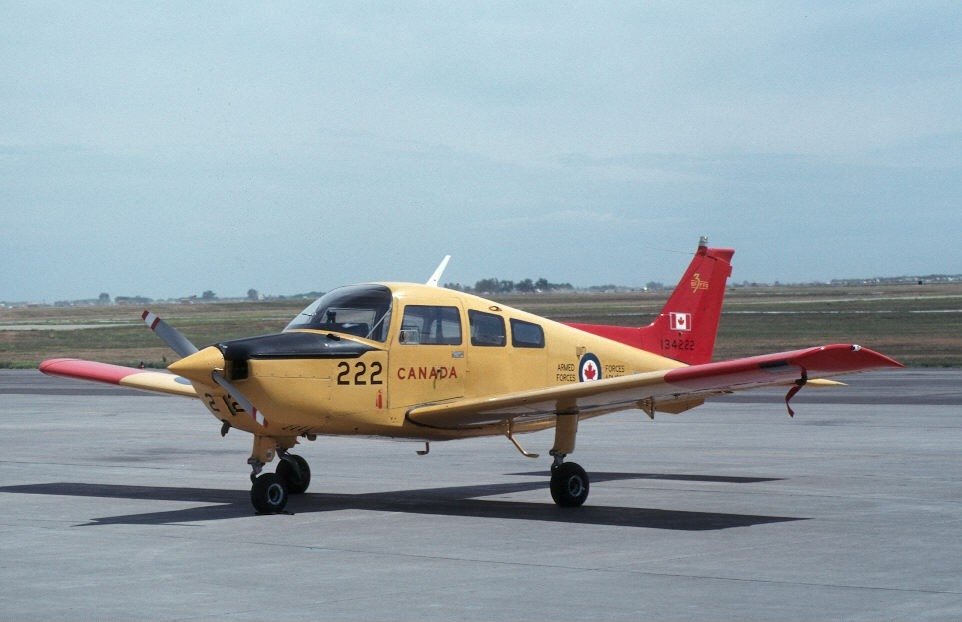
The Beechcraft CT-134 Musketeer was a specialized military trainer derived from the broader Beechcraft Musketeer family of light aircraft. Developed by the Beech Aircraft Corporation design team in the early 1960s, the Musketeer family first saw production aircraft fly in 1963. The aircraft was designed as a four-seat, low-wing light aircraft featuring fixed landing gear and limited aerobatic capabilities. While production totals for the entire Musketeer line vary across sources, reports indicate between 4,366 and 4,455 aircraft were built in the United States between 1963 and 1983.
In 1971, the Canadian Armed Forces adopted the type as the CT-134 to serve as a basic trainer. The initial acquisition involved 24 aircraft ordered in either 1970 or March 1971. To meet military training requirements, the CT-134 underwent specific airframe modifications to improve stall and spin behavior, including the addition of a ventral fin and strakes on the cowling and horizontal stabilizer. These modifications, combined with the aircraft's inherent stability, made it an ideal platform for student pilots. The CT-134 was powered by a Lycoming O-360-A4G piston engine producing 180 hp. In its military configuration, the aircraft typically carried two pilots and up to two passengers.
Throughout its service life from 1971 to 1992, the CT-134 operated primarily at the Canadian Forces Central Flying School in Winnipeg and No. 3 Flying Training School (also known as 3 Canadian Forces Flying Training School) in Portage la Prairie, Manitoba. One notable example of the fleet's versatility was its participation in the 1971 Musket Gold demonstration team, which was led by Captain G. Swiggum. Over its 21 years of service, the CT-134 is credited with training approximately 5,000 Canadian military pilots. The fleet was eventually retired in 1992 and replaced by the Slingsby Firefly, which was operated under contract by Bombardier Aerospace.
Technical specifications for the CT-134 include a wingspan of 25 ft 8 in and a total length of 32 ft 9 in. It possessed a service ceiling of 13,000 ft and a maximum range of 675 miles. Today, several examples are preserved in Canada. Aircraft 13401 (later renumbered 134201) served until October 22, 1987, and is now held by the National Air Force Museum of Canada. Another example, CAF 134222, is maintained in static display by the Canadian Warplane Heritage Museum at Mount Hope.