
Service History
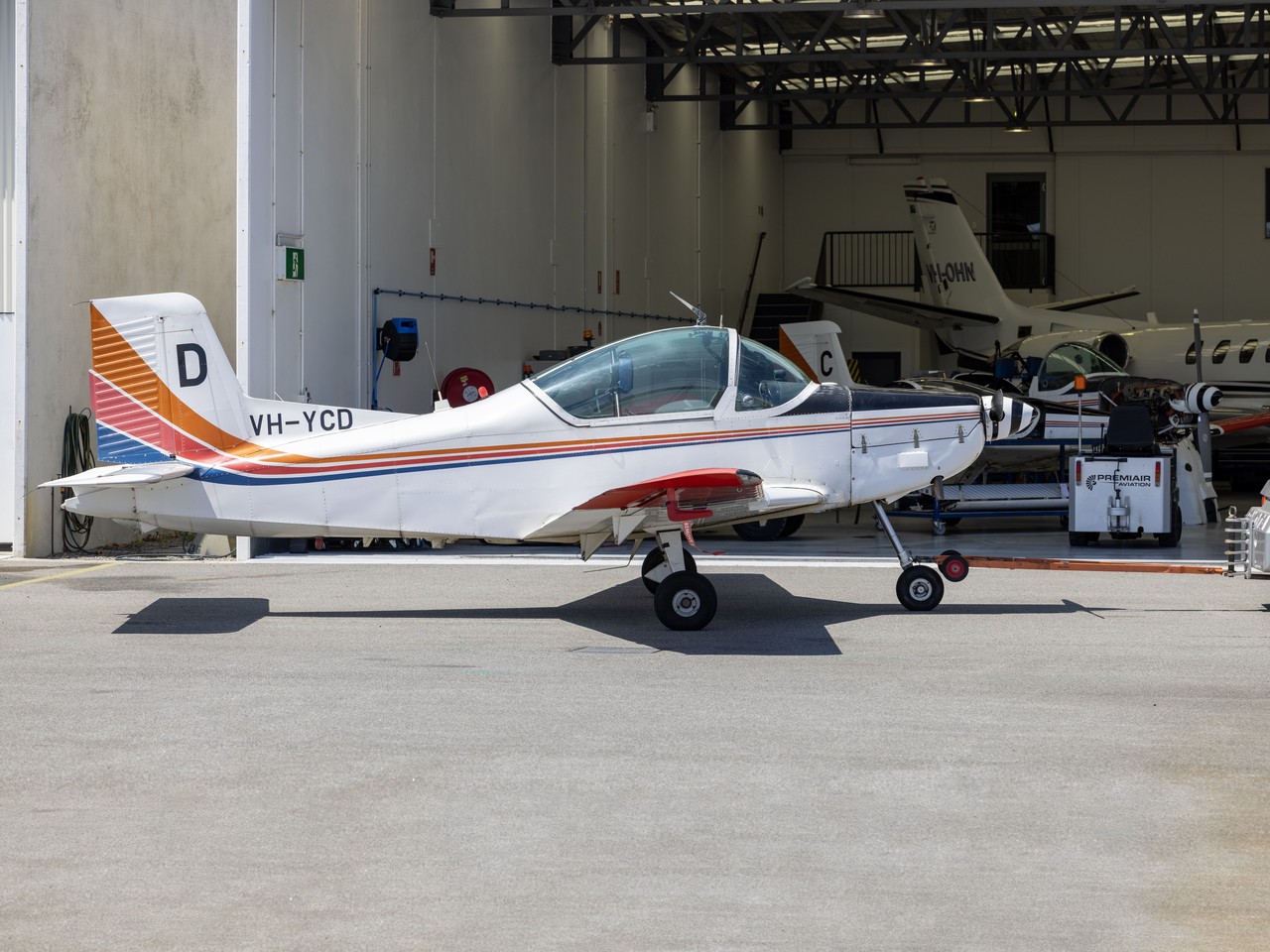
The CT-4 Airtrainer established itself as the backbone of basic flight training for three major air forces, with the Royal Australian Air Force becoming its largest operator. The RAAF received 37 initial CT-4A aircraft between January 1975 and 1981, designated A19-027 through A19-063, replacing the aging Commonwealth Aircraft Corporation CA-25 Winjeel. When additional aircraft were needed, the RAAF acquired 14 stored ex-Rhodesian CT-4s (A19-064 to A19-077) in 1981 to extend fleet operations until the Pilatus PC-9 entered service in 1986.
The Royal Thai Air Force began operations with 24 CT-4A aircraft from October 1973, eventually expanding their fleet with 6 CT-4B models in the early 1990s and 12 advanced CT-4E variants delivered between 1999 and 2000. The Royal New Zealand Air Force operated 13 leased CT-4E aircraft from 1996 onward, bringing total military deliveries to 96 aircraft across all variants.
Design Evolution and the Manufacturer
The aircraft's development began when Aero Engine Services Ltd (AESL) of Hamilton, New Zealand, exercised production rights on the Victa Aircruiser, a four-seat touring aircraft designed by Henry Millicer. Pat Monk led the transformation project, requiring extensive structural modifications to convert the civilian design into a fully aerobatic military trainer capable of withstanding the rigorous demands of ab-initio pilot instruction.
AESL underwent significant corporate changes throughout the CT-4's production life. In 1973, the company merged with Air Parts (NZ) Ltd to form New Zealand Aerospace Industries (NZAI). Financial difficulties led to receivership in 1982, with the company reforming as Pacific Aerospace Corporation (PAC). The Aeromotive Group acquired PAC in 1990, successfully securing new contracts that revived production after an eight-year hiatus.
Production followed an unusual stop-start pattern reflecting both market demands and corporate instability. Initial manufacturing ran from 1972 to 1982, resumed briefly from 1990 to 1992, then restarted again in 1996 with the CT-4E variant continuing through 2000.
Engine and Technical Innovation
The CT-4A employed a Rolls Royce/Continental IO-360-H six-cylinder horizontally-opposed engine producing 157 kilowatts (210 horsepower), driving a two-blade propeller. This powerplant provided sufficient performance for all required training maneuvers while maintaining relatively simple maintenance requirements crucial for military training operations.
The later CT-4E variant received a significant upgrade with the Textron Lycoming AEIO-540-L1E5 engine producing 224 kilowatts (300 horsepower) and driving a three-blade Hartzell propeller. This configuration improved performance margins and extended the aircraft's training envelope. An experimental CT-4C prototype tested an Allison 250-B17 turboprop engine producing 298 kilowatts (400 shaft horsepower) in 1991, though this variant never entered production.
The aircraft's structural design incorporated full aerobatic capability with +6/-3 G limits, essential for comprehensive military pilot training. The tandem seating arrangement optimized instructor oversight and communication during flight training sequences.
Operational Characteristics
Pilots appreciated the CT-4's predictable handling characteristics and robust construction, which proved ideal for the demanding environment of ab-initio military training. The aircraft's forgiving flight characteristics allowed student pilots to develop fundamental skills while its aerobatic capability provided advanced training in unusual attitude recovery and tactical maneuvering.
The type's reliability record proved exceptional throughout its service life, with high dispatch rates crucial for maintaining intensive training schedules. Its simple systems and straightforward maintenance requirements reduced operating costs compared to more complex alternatives.
Production Legacy and Current Status
Total CT-4 production reached approximately 114 aircraft across all variants by the program's conclusion in 2000. The production breakdown included 37 CT-4A aircraft for Australia, 24 for Thailand, 12 CT-4B civil variants primarily for BAE Flight Training Australia and Ansett operations, and various CT-4E models for New Zealand and Thailand.
Following military retirement, 55 former RAAF CT-4 aircraft entered civilian markets through government auction, extending their operational lives in private ownership and commercial flight training roles. Many examples continue flying today in Australia and New Zealand, testament to the design's durability and enduring utility.
The CT-4 Airtrainer represents New Zealand's most successful indigenous aircraft program, demonstrating how innovative engineering and adaptive design could create a globally competitive training aircraft from a small aerospace industry. Its three-decade service record across multiple air forces established the type as a significant contributor to pilot training throughout the Asia-Pacific region, while proving that specialized military variants could emerge from civilian designs through careful engineering adaptation.