
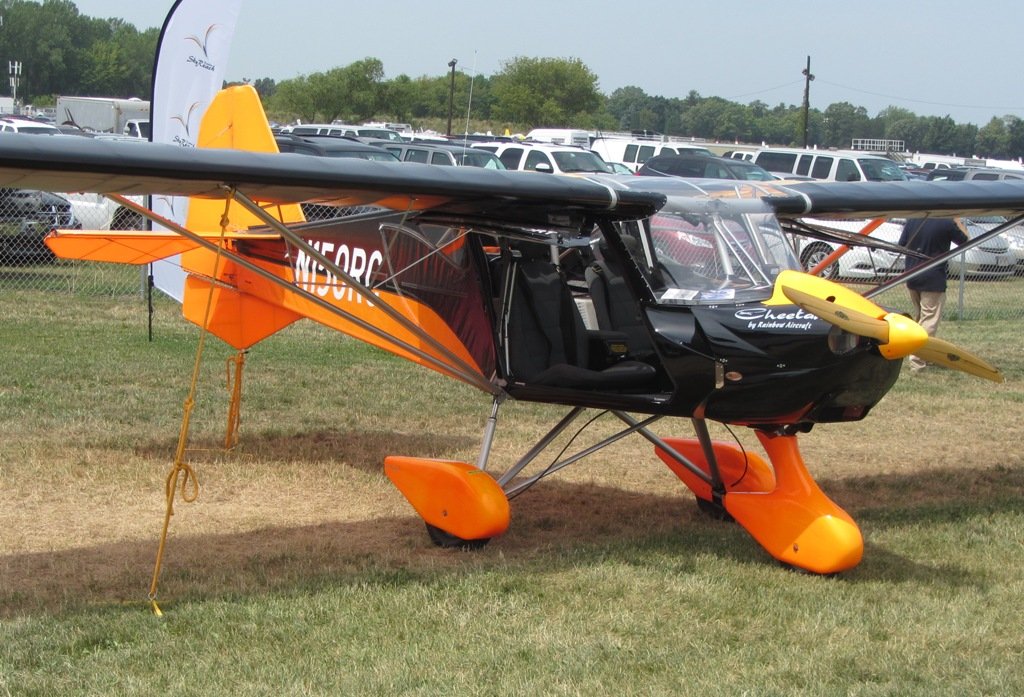
Development and Design
Vladimir Chechin designed the Rainbow Cheetah in the early 2000s, deriving it from the Best Off Skyranger to meet the emerging light sport aircraft regulations in North America. The aircraft made its maiden flight in 2001, representing Rainbow SkyReach's transition from ultralight trikes to more sophisticated three-axis aircraft. The design emphasized simplicity, ruggedness, and suitability for bush operations while maintaining compliance with ASTM/CS-LSA standards requiring ultimate loads of +6G/-4G at maximum weight.
The Cheetah featured a strut-braced high-wing design with a symmetrical airfoil profile and enlarged empennage surfaces—50 percent larger horizontal stabilizer and 30 percent larger vertical surfaces compared to its predecessor. The aircraft incorporated bolted aluminum tubing construction with Dacron-covered flying surfaces, representing a departure from traditional welded steel tube methods. Optional equipment included doors for the side-by-side cockpit and a choice between tricycle or conventional landing gear configurations.
The Manufacturer
Rainbow Aircraft (Pty) Ltd, later renamed Rainbow SkyReach in the 2010s, operated from Gauteng, South Africa, beginning in the 1990s. The company initially focused on ultralight trikes, producing 70 Rainbow Aerotrike Cobras by 2005, along with 45 Safari and 45 Scout variants by 2000. With 35 full-time employees, Rainbow SkyReach handled all composite work, sewing, and machining in-house at their South African facility.
Ownership changed dramatically in 2010 when founder Mike Blyth exited and the business transferred to the Maritz brothers, with Mike Gill assuming the role of General Manager. This transition marked the beginning of the BushCat development program, which would eventually supersede the original Cheetah design. In May 2024, SkyReach announced cessation of new aircraft manufacturing while continuing maintenance support, but by November 2024, the company ceased trading entirely. Bushcat Aircraft Australia acquired the intellectual property and manufacturing rights, ensuring continued support for the type.
Engine and Technical Specifications
The standard powerplant was the 100-horsepower Rotax 912ULS, a four-stroke liquid and air-cooled engine manufactured by BRP-Rotax in Austria. Alternative engines included the 64-horsepower Rotax 582 two-stroke, 80-horsepower Rotax 912UL, Verner VM133, and 85-horsepower Jabiru 2200A. The Rotax 912 series, in production since 1994 with over 40,000 units manufactured across all variants, provided the reliability expected for the aircraft's "keep it simple, stupid" philosophy.
The aircraft's power loading of 5.6 kilograms per horsepower enabled respectable performance while maintaining the simplicity desired for bush operations. Larger radiators were incorporated for operations in hot climates like Australia and Namibia, and the clamshell cowling design provided easy access for maintenance—a critical feature for remote area operations.
Service History and Operations
The Cheetah found its primary market among private owners and bush flying enthusiasts across South Africa, the United States, Canada, Australia, and Namibia. By August 2012, two aircraft appeared on the Transport Canada register and three on the Federal Aviation Administration registry, indicating modest but steady adoption in North America. The aircraft's 94-liter fuel capacity and robust construction made it particularly suitable for remote area operations where reliability outweighed raw performance.
Operators praised the Cheetah as a "fun-flying workhorse" that delivered on its promise of simple, rugged bush capability. The side-by-side seating configuration with optional doors provided comfort for extended flights, while the high-wing design offered excellent ground visibility and forgiving handling characteristics essential for bush strip operations.
Production and Legacy
Production continued from 2001 until approximately 2010, when the improved Cheetah XLS and later BushCat variants succeeded the original design. Over 200 aircraft from the Cheetah family, including derivatives, were produced or are currently flying, though exact numbers for the original Cheetah variant remain unspecified. Many kits remain under construction, demonstrating the type's enduring appeal among amateur builders.
The aircraft represented a successful South African export during an era of increasing international light sport aircraft competition. Its emphasis on rugged simplicity over sophisticated systems reflected the practical needs of bush operators while meeting the certification requirements of multiple countries. The Cheetah's legacy continues through the BushCat variant and ongoing support from Bushcat Aircraft Australia, ensuring that this distinctive South African design remains active in the global light sport aircraft community.
Today, with examples like N321WL still active, the Cheetah maintains a niche following among pilots who value its no-nonsense approach to recreational and utility flying, particularly in challenging environments where mechanical simplicity proves more valuable than electronic sophistication.