
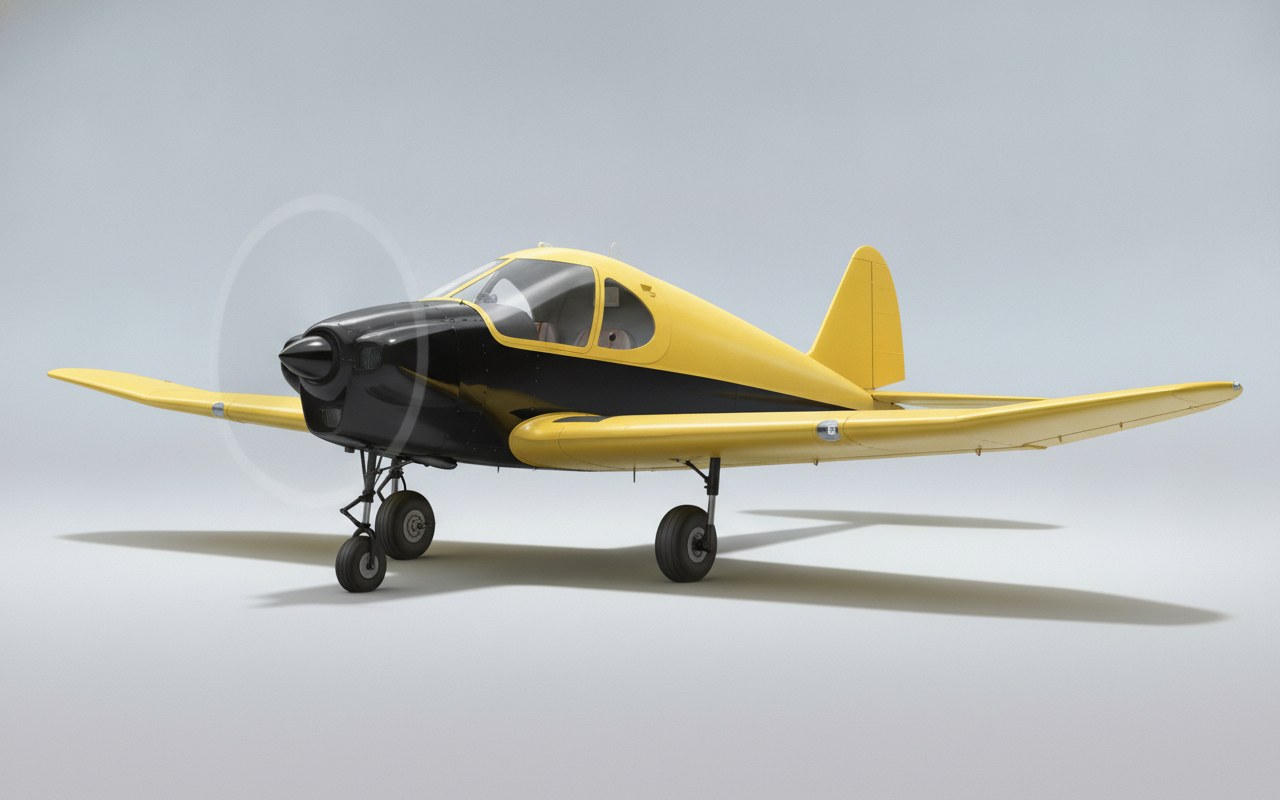
Revolutionary Design Philosophy
The Culver Model V emerged from the company's extensive wartime experience producing radio-controlled target drones for military training. Under the engineering leadership of Al Mooney and his brother Art Mooney, who served as production supervisor, the design team sought to create a sophisticated civilian aircraft that would incorporate lessons learned from both their pre-war Culver Cadet experience and their successful drone manufacturing program that produced over 3,000 units between 1941 and 1945.
The Simpli-Fly Innovation
The Model V's most distinctive feature was its patented Simpli-Fly Control system, a groundbreaking automation technology that represented one of the earliest attempts at simplified aircraft operation. This system utilized a wheel positioned between the two seats that allowed pilots to align arrows for automatic trimming in takeoff, landing, or cruise configurations. The interconnected controls would automatically adjust the aircraft's trim settings, reducing pilot workload during critical phases of flight. While innovative for its time, many pilots criticized the system as overly complex and unnecessary, preferring traditional manual controls.
Production Challenges and Market Reality
Culver Aircraft Company began production in 1946 but faced immediate challenges in the post-war aviation market flooded with surplus military aircraft. The company managed to build approximately 90 Model V aircraft before financial difficulties forced them into bankruptcy shortly after the war's end. The timing proved particularly unfortunate, as the civilian aviation market was saturated with inexpensive converted military trainers and surplus aircraft that could be purchased for a fraction of the Model V's price.
Corporate History and Transition
The Culver Aircraft Company traced its origins to the late 1930s when it was founded as Dart Manufacturing Corporation in Columbus, Ohio, by Knight K. Culver and Al Mooney. The company was renamed Culver Aircraft Company in 1939 and relocated to Wichita, Kansas, where it operated primarily from 1938 to 1946. Following the company's bankruptcy, the Mooney brothers departed to establish their own Mooney Aircraft Company, while the Culver plant was sold to Coleman Company.
Technical Specifications and Performance
The Model V featured a Continental C85 four-cylinder air-cooled horizontally-opposed piston engine producing 85 horsepower. This powerplant provided the aircraft with respectable performance for its era, including a cruise speed of 125 miles per hour, a service ceiling of 13,200 feet, and a range of 338 miles. The aircraft's empty weight of 1,070 pounds and gross weight of 1,600 pounds gave it a useful load of 530 pounds, adequate for two occupants and baggage.
The low-wing cantilever design incorporated dihedral outer wing panels and featured a wing area of 125.9 square feet. The enclosed cabin provided side-by-side seating with good visibility, while the tricycle retractable landing gear offered modern ground handling characteristics that were still relatively uncommon in light aircraft of the period.
Superior Aircraft Revival
In 1956, Superior Aircraft Company acquired Culver's assets and attempted to revive the design as the Superior Satellite. The new version featured an upgraded 95-horsepower Continental engine that increased cruise speed to 130 miles per hour. However, this revival proved short-lived, with Superior building only one prototype and five production aircraft before abandoning the project. The market conditions that had challenged the original Model V remained largely unchanged a decade later.
Military Connections
While the Model V itself saw no military service, it shared DNA with Culver's wartime drone program. The company developed the experimental XPQ-15 drone variant from the Model V design in 1945, though it never entered production. Additionally, variants including the TD4C for the U.S. Navy and UC/UC-1K utility and target conversions were developed, though production numbers remain unspecified.
Legacy and Survival
The Model V's production totaled approximately 96 aircraft when combining both Culver and Superior manufacturing runs. The aircraft gained some contemporary attention, including a feature in the August 1946 issue of Popular Science magazine with a pull-out photograph. However, none are confirmed as airworthy today, with at least one known example being scrapped in 1976 and deregistered in July 1977.
The Model V represents an important chapter in post-war aviation history, demonstrating both the innovative spirit of aircraft manufacturers and the harsh economic realities of the civilian aviation market. Its Simpli-Fly control system, while ultimately unsuccessful, anticipated later developments in aircraft automation and simplified control systems that would become commonplace decades later in modern general aviation aircraft.