
Military Innovation and Service Entry
The C-131 Samaritan entered United States Air Force service in 1954 as the C-131A, marking a significant advancement in military transport capabilities. As the first pressurized twin-engine aircraft operated by the Military Air Transport Service, it could operate at higher altitudes and in weather conditions that grounded earlier unpressurized transports. The aircraft's primary mission centered on aeromedical casualty evacuation, where it could accommodate 27 stretchers or 37 sitting casualties through large loading doors specifically designed for medical operations.
Multi-Service Operations
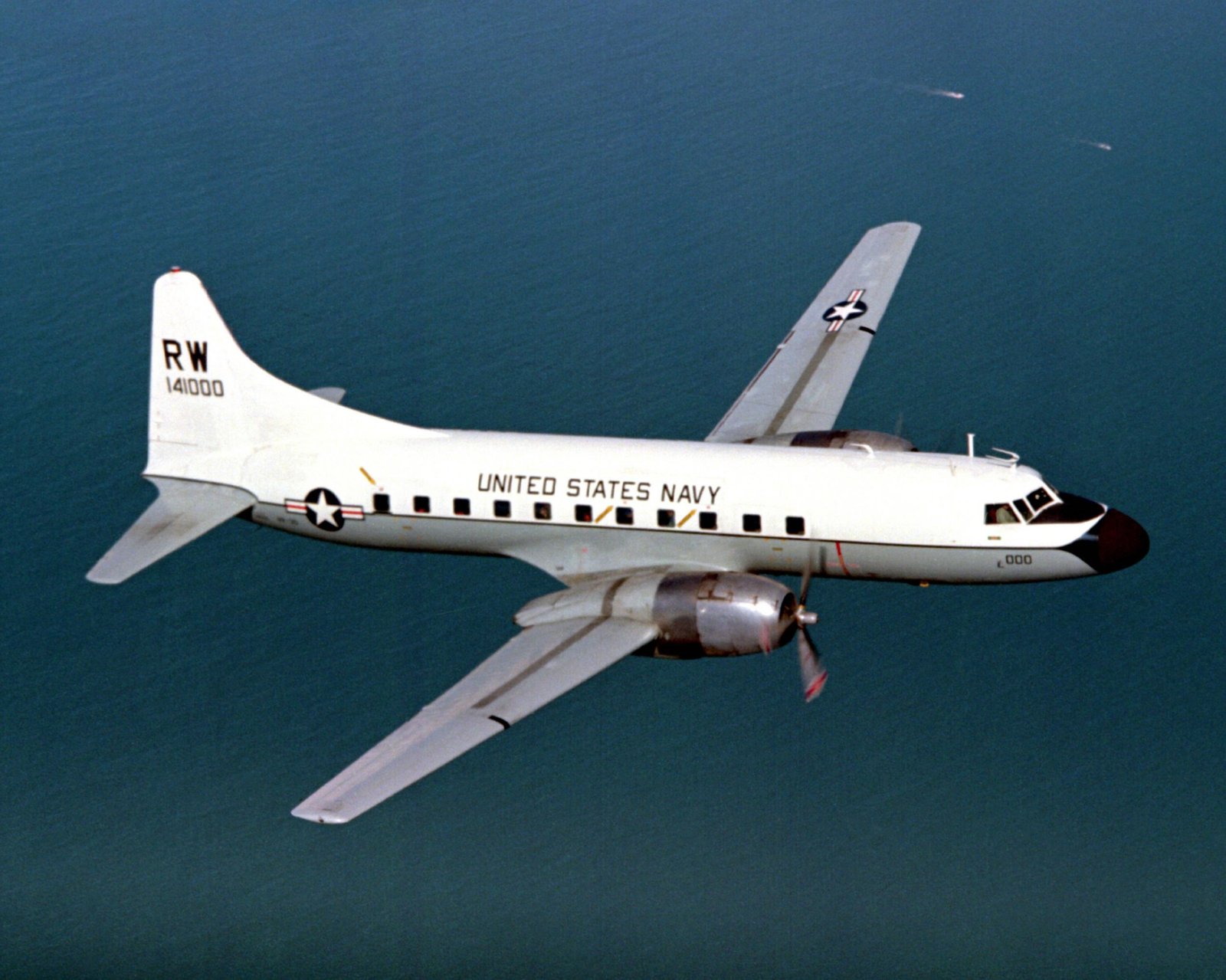
Beyond the Air Force, the Samaritan served across multiple military branches with various designations. The U.S. Navy received the aircraft as the R4Y-2 in 1952 during the Korean War, later redesignating it C-131F in 1962. The U.S. Coast Guard operated 22 modified HC-131A aircraft for search and rescue missions, replacing their aging HU-16 Albatross seaplanes. These Coast Guard variants remained in service until 1983, demonstrating the aircraft's versatility in maritime rescue operations.
Specialized Variants and Training Roles
Convair developed numerous specialized variants beyond the basic transport configuration. The T-29 "Flying Classroom" transformed the fuselage into an airborne training facility with student stations for bombardiers, navigators, and electronic warfare officers. The VC-131H served as a VIP staff transport, while the C-131B functioned as a camera test platform for photographic equipment development. The experimental YC-131C supported engine development testing programs, showcasing the airframe's adaptability to diverse military requirements.
The Convair Legacy
Convair, originally the Consolidated Vultee Aircraft Corporation, manufactured the C-131 at its Burbank facility. The company later became the Convair Division of General Dynamics Corporation before eventually being absorbed into the larger defense conglomerate. Convair's engineering team based the military Samaritan on their successful CV-240 commercial airliner, which had established exceptional safety standards in civilian aviation. The CV-240 fleet accumulated over 840,000 flight hours before experiencing its first fatal accident in 1952, representing the best safety record of any transport aircraft of that era.
Powerplant and Performance
Two Pratt & Whitney R-2800 "Double Wasp" 18-cylinder air-cooled radial engines powered the C-131 Samaritan, each producing 2,100 horsepower in standard configuration. The R-2800, one of aviation's most successful radial engines, provided the reliability and power necessary for military operations. This powerplant combination enabled the aircraft to achieve a maximum and cruise speed of 315 mph at 16,000 feet, with a service ceiling of 16,000 feet and a range of 1,200 miles. The aircraft required a crew of two or three, depending on mission requirements.
Commercial Foundation
The military success of the C-131 built upon the commercial achievement of its civilian counterpart. American Airlines launched the CV-240 into service on June 1, 1948, after receiving their first delivery on February 23, 1948. The commercial variants could carry 40 to 44 passengers depending on configuration, and airline orders totaled 176 deliveries. Sixteen American and foreign airlines placed orders for 160 CV-340 variants in 1952 alone, while Continental Airlines introduced the improved CV-440 variant on March 8, 1956.
Service Timeline and Retirement
The C-131 Samaritan maintained active military service for over three decades across various branches. Nearly all C-131s departed active USAF inventory in the late 1970s, though Air National Guard and Navy units continued operating additional airframes until 1990. The extended service life reflected the aircraft's robust construction and continued utility in transport and support roles well beyond its original design expectations.
Museum Preservation and Legacy
Several C-131 Samaritans survive today in museum collections, preserving the aircraft's historical significance. The Air Mobility Command Museum houses a C-131D Samaritan, while the Hill Aerospace Museum displays a VC-131 variant. The Minnesota Air National Guard Museum exhibits a C-131H, and the Naval History and Heritage Command preserves C-131F Bureau Number 141015. These preserved examples represent the aircraft's important role in the evolution of military transport aviation and its contribution to establishing pressurized flight as the standard for military passenger and medical transport operations.