
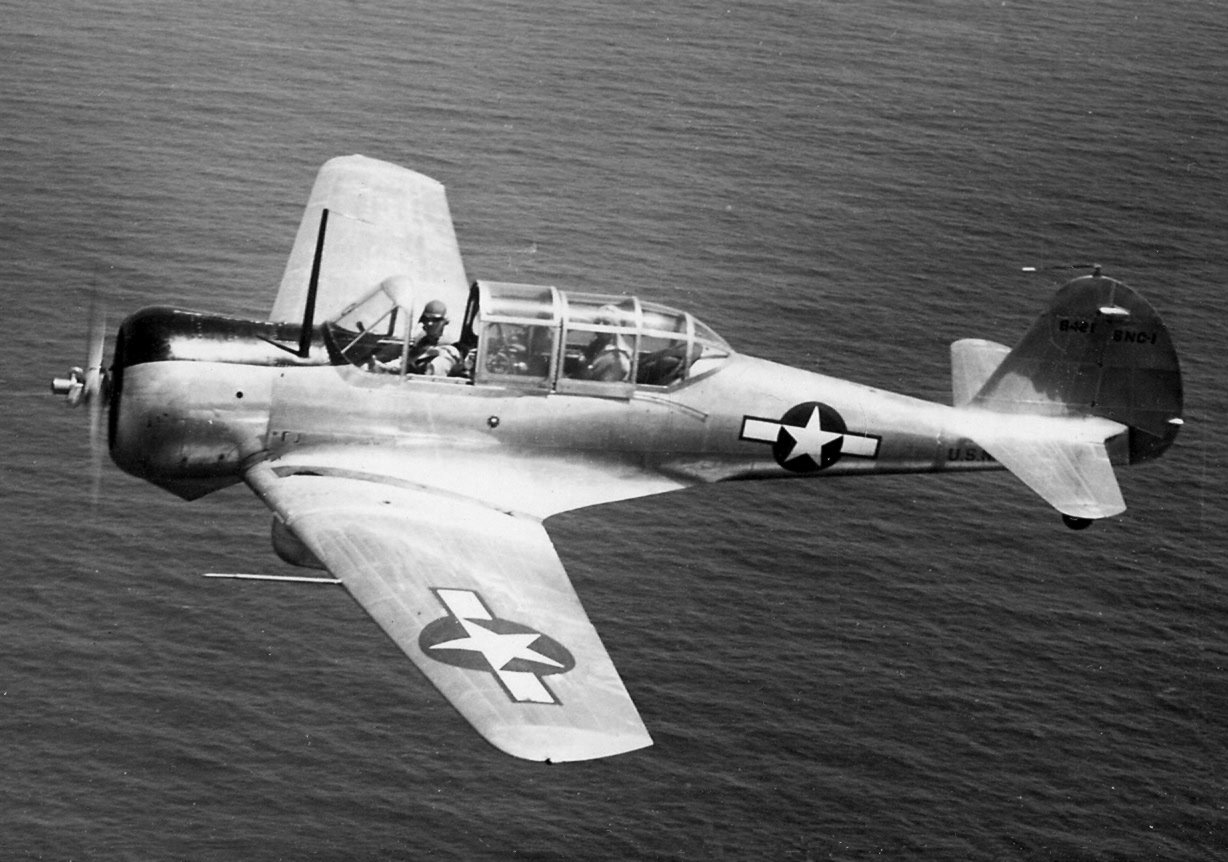
Developed in 1940 by the Curtiss-Wright Corporation at its St. Louis, Missouri factory, the CW-22 was designed as a multi-role aircraft capable of serving as a civil sport plane, an advanced trainer, or a light reconnaissance aircraft. The design evolved from the CW-19 civil utility aircraft and incorporated structural and aerodynamic elements from the CW-21 Demon interceptor. A defining technical feature of the CW-22 was its retractable tailwheel undercarriage, with main wheels retracting rearward into under-wing fairings and closing with clamshell doors.
Powered by a 9-cylinder air-cooled Wright R-975 Whirlwind radial engine (specifically the R-975-28 in some profiles) producing approximately 420 hp (313 kW), the aircraft featured a two-bladed variable-pitch Hamilton Standard propeller. The airframe was a low-wing, all-metal stressed-skin monoplane with tandem seating under a continuous glazed canopy. While the U.S. Navy's SNC-1 Falcon variant was unarmed for training purposes, export versions were equipped with two 0.30-in (7.62 mm) machine guns: one fixed forward-firing gun in the cowling and one flexible gun in the rear cockpit.
Production began in 1941, though total production numbers vary by source. At least 136 export aircraft were built, including 50 for Turkey, 25 for the Netherlands East Indies, and approximately 25 for various Latin American nations. The U.S. Navy ordered the SNC-1 in several batches, with sources citing either 305 or 455 aircraft delivered. Beyond the U.S. Navy, the Royal Netherlands East Indies Army Air Force (ML-KNIL) received 36 CW-22s in March 1942, delivered to northern Australia. Some of these Dutch aircraft were later captured and operated by the Imperial Japanese Army Air Force. Other operators included the Bolivian Air Force, the Peruvian Air Force, the Uruguayan Air Force (which operated nine SNC-1s from 1942 to 1951), and the Burma Volunteer Air Force.
Performance specifications for the CW-22/SNC-1 include a maximum speed of 198 mph at sea level, a range of 780 miles, and a service ceiling of 21,800 feet, with a rate of climb of 1,650 feet per minute. Following the war, many SNC-1s entered the U.S. civilian market as surplus. Today, several examples survive, including the original CW-A22 prototype owned by the Collings Foundation, which maintains a valid FAA airworthiness certificate. Other surviving airframes are displayed at the National Naval Aviation Museum in Florida, the Istanbul Aviation Museum in Turkey, and the Coronel Jaime Meregalli Aeronautical Museum in Uruguay.