
Competition Genesis and Original Success
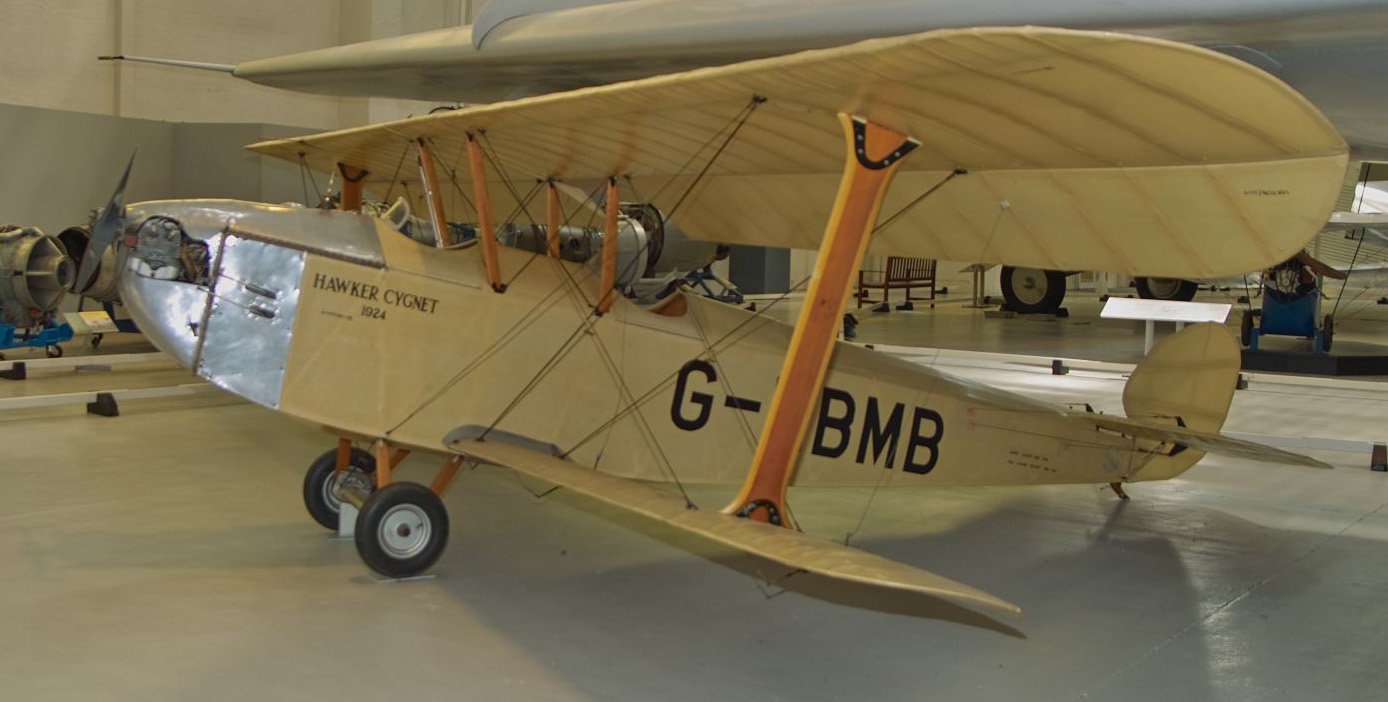
The original Hawker Cygnet emerged from the British Air Ministry's ambitious 1924 Light Aeroplane Competition, which offered £3,000 in prize money for ultra-light aircraft weighing no more than 1,100 pounds with engines under 1,000cc displacement. Sydney Camm, recently joined to H.G. Hawker Engineering in 1923, created his inaugural design to meet this challenge. Two prototype Cygnets, registered G-EBMB and G-EBJH, competed at the September-October 1924 Lympne Trials in Kent.
Flown by Walter Longman and Fred Raynham respectively, the Cygnets demonstrated exceptional performance despite not winning the overall competition. G-EBMB captured first place in both the "Best take-off performance" and "Short-landing Competition" categories while finishing third overall. G-EBJH secured fourth place in the general rankings. Maurice Piercey's Beardmore Wee Bee ultimately claimed the Air Ministry prize, but the Cygnets had established their reputation for superior handling characteristics.
Military Evaluation and Civil Success
Following the Lympne Trials, both aircraft underwent extensive military evaluation at the Aeroplane & Armament Experimental Establishment at Martlesham Heath from November 1924 through early 1925. Military pilots praised the type's flying qualities, though no specific military role emerged for the lightweight design. The aircraft received civil registration in July 1925, beginning a successful racing career that would span several years.
After re-engining both aircraft with 36-horsepower Bristol Cherub III engines in 1926, the Cygnets dominated British light aircraft competition. In 1925, G-EBMB won the 100-mile International Handicap Race at 75.6 miles per hour under pilot George Bulman, while G-EBJH placed second in the 50-mile Light Aeroplane Race. The following year proved even more successful when both aircraft captured first and second place in the prestigious Daily Mail competition worth £5,000, completing six days of flying throughout South-East England. They repeated this remarkable achievement in 1926-1927 with the same pilots.
Engineering Innovation
The Cygnet's design showcased advanced lightweight construction techniques that influenced subsequent aircraft development. The all-wood, fabric-covered airframe weighed just 270 pounds, with the complete aircraft achieving an empty weight of 373 pounds and maximum gross weight of 950 pounds. The 20-foot 5-inch fuselage employed four longerons strutted in Warren girder configuration, while the 28-foot wingspan wings featured dual box spars and Warren truss ribs across 165 square feet of wing area.
Initial powerplant installations differed between the two prototypes, with G-EBMB receiving a 34-horsepower British Anzani opposed twin-cylinder engine and G-EBJH equipped with a 30-horsepower ABC Scorpion I. Both aircraft achieved maximum speeds of 82 miles per hour at sea level, service ceilings of 8,900 feet, and could climb to 5,000 feet in 11 minutes 20 seconds.
The Cashmore Replica Project
Don Cashmore undertook construction of the replica Hawker Cygnet in the early 1990s as a tribute to Sydney Camm's pioneering design work. Registered G-CAMM in honor of the original designer, the replica incorporated faithful reproduction of the original's construction methods while utilizing modern materials where necessary for safety and durability. Cashmore selected a Mosler MM CB-35 35-horsepower flat-twin engine, closely matching the power output of the original Bristol Cherub III installations.
Completed in 1993, G-CAMM began flying from Old Warden, Bedfordshire in 1996, where it operated for over a decade. The aircraft's exceptional handling characteristics and historical significance attracted the attention of the Shuttleworth Collection, which acquired the replica in early 2009. Under Shuttleworth ownership, G-CAMM continues regular flight operations, appearing at airshows and demonstration events throughout Britain.
Preservation and Legacy
The replica serves as a flying monument to both Sydney Camm's design genius and the innovative spirit of 1920s British aviation. While the original G-EBMB survives in static display at the RAF Museum Cosford following extensive restoration in the mid-1980s, G-CAMM provides the only opportunity to witness Camm's first design in flight. The aircraft represents the beginning of a design career that would produce the Hurricane, Typhoon, Tempest, and numerous other significant military aircraft.
Today's pilots describe the Cygnet replica as remarkably docile and forgiving, characteristics that contributed to the original type's competition success. The lightweight construction and low wing loading provide exceptional slow-speed handling and short-field performance, while the reliable flat-twin engine ensures consistent operation. At Shuttleworth Collection events, G-CAMM continues demonstrating the flight characteristics that impressed both competition judges and military evaluators nearly a century ago, preserving an essential chapter in British aviation development.