
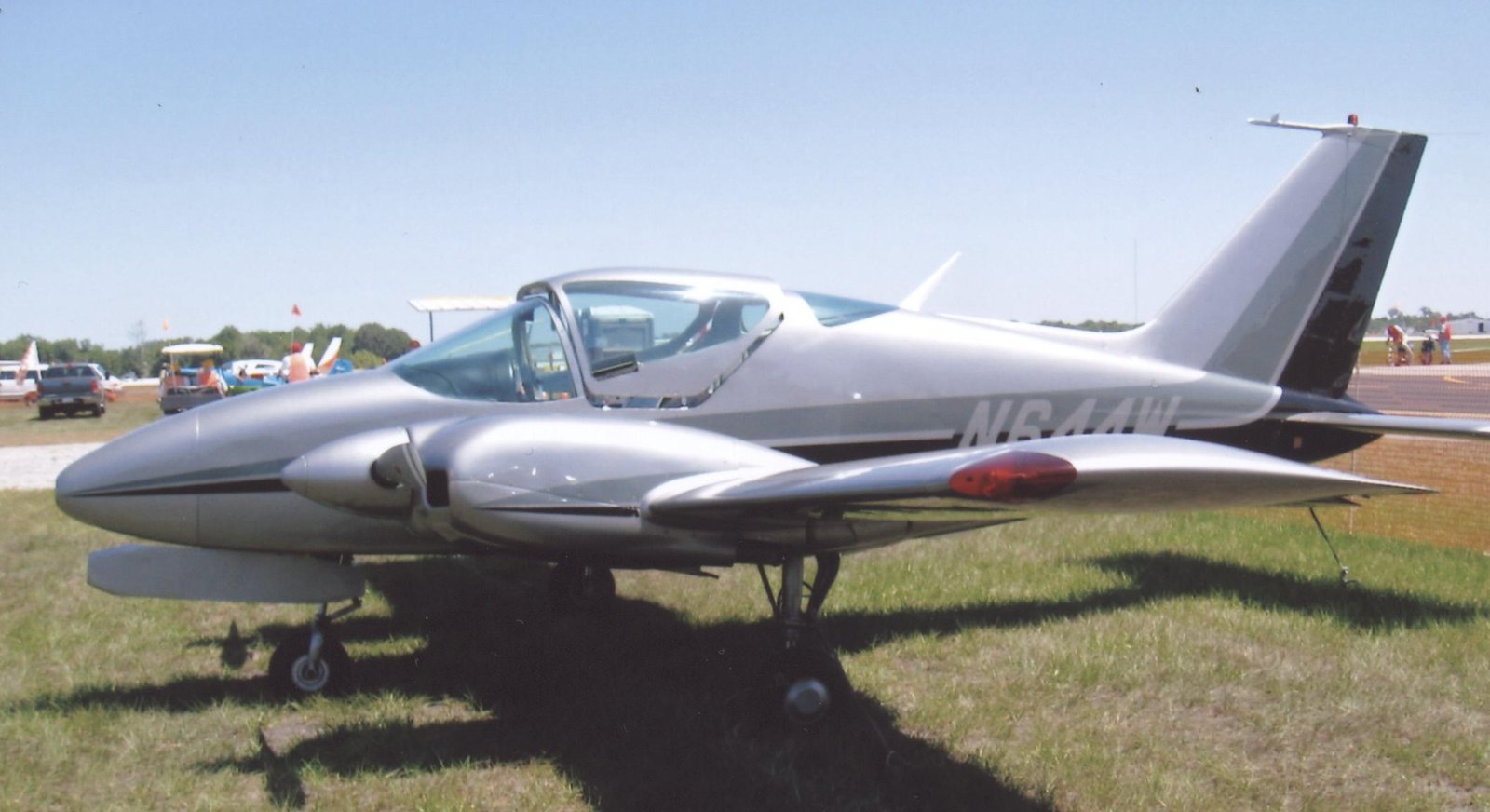
Design Genesis and Development
The Derringer emerged from the creative mind of John Thorp, who began developing the design in June 1960 by scaling up his earlier T-17 Twin Sky Skooter concept. Thorp's vision was later adopted by entrepreneur George Wing of Hi-Shear Corporation, who recognized the potential for a niche aircraft serving owners who typically flew alone or with one passenger but desired twin-engine safety margins without the operational costs of larger twins.
The prototype, registered N3621G, took to the skies on May 1, 1962, from Torrance, California, initially powered by two 115-horsepower Lycoming O-235 engines. However, development proved challenging when the second prototype suffered a catastrophic failure on December 12, 1964. Test pilot Thomas Heffner, despite his extensive 7,000 hours of flight experience including 128 hours on the Derringer, was killed when the horizontal stabilizer failed during a routine engine performance check, sending the aircraft into the Pacific Ocean near Palos Verdes.
Manufacturing Challenges and Revival
Production began tentatively in 1962 but faced immediate obstacles due to internal problems within Hi-Shear Corporation. The initial manufacturing was handled by Transland Aircraft, a Hi-Shear subsidiary also located in Torrance. Wing Aircraft Company, originally formed as a Hi-Shear division in 1960, became fully independent on June 27, 1966, but production remained sporadic until ceasing entirely in 1971.
George Wing revived the program in 1978 after departing Hi-Shear and establishing a new Wing Aircraft Company. This second phase yielded one pre-production aircraft followed by six production models before financial reality intervened. The company declared bankruptcy in July 1982, though one final aircraft was assembled from existing components after the bankruptcy proceedings.
Technical Innovation and Performance
The production Derringer incorporated several advanced manufacturing techniques for its era, including butt-joined, flush-riveted, chemically-milled, and stretched aluminum skins throughout the airframe. The aircraft featured an unusual upward and backward-opening canopy and a central quadrant housing throttle and propeller controls, with mixture controls mounted on vernier knobs along the right panel.
Production aircraft were powered by two 160-horsepower Lycoming IO-320-B1C engines, four-cylinder air-cooled units mounted on each wing's leading edge. These engines drove two-blade Hartzell constant-speed propellers with 5-foot, 6-inch diameters. The powerplant configuration enabled a maximum speed of 201 knots at sea level and a cruise speed of 184 knots at 13,000 feet while consuming 15.8 gallons per hour.
Flight Characteristics and Pilot Experience
Despite its tragic development history, pilots who flew the Derringer generally praised its handling qualities. Peter Garrison, writing for FLYING magazine in 1981, noted that "asymmetrical thrust produces so little slip that one can fly the airplane comfortably with aileron alone," highlighting the aircraft's manageable single-engine characteristics. The Derringer's blue line speed (best single-engine rate of climb) was established at 110 miles per hour, with an overall climb rate of 1,700 feet per minute on both engines.
With an empty weight of 2,070 pounds and maximum takeoff weight of 3,050 pounds, the Derringer carried 87 to 88 gallons of fuel, providing a range of 1,007 nautical miles at economical cruise settings. The aircraft's service ceiling reached 19,600 feet, with a stall speed of just 55 knots in landing configuration.
Limited Legacy and Current Status
Of the 12 Derringers built across both production periods, seven remain on the Federal Aviation Administration registry today, down from nine that were registered as of May 2009. The aircraft's extreme rarity has created challenges for owners seeking replacement parts, forcing creative fabrication solutions or adaptation of components from similar aircraft.
The type certificate has changed hands multiple times since Wing Aircraft's bankruptcy. Emerald Enterprises LTD of San Diego, California held the certificate as of June 1998, though the FAA announced its intention in July 2025 to designate the certificate as abandoned due to lack of support activity.
A brief revival attempt occurred in 1998 when Derringer Aircraft Company LLC modified an existing airframe into a four-seat prototype with 160-horsepower Lycoming IO-360 engines. This aircraft flew in 1999, with plans for training and executive variants, but no additional production materialized.
The Wing D-1 Derringer remains a footnote in aviation history, representing both the innovation possible in general aviation and the harsh economic realities facing niche aircraft manufacturers. Its dozen examples serve as rare reminders of an ambitious attempt to fill a specific market need that ultimately proved too narrow for commercial success.