
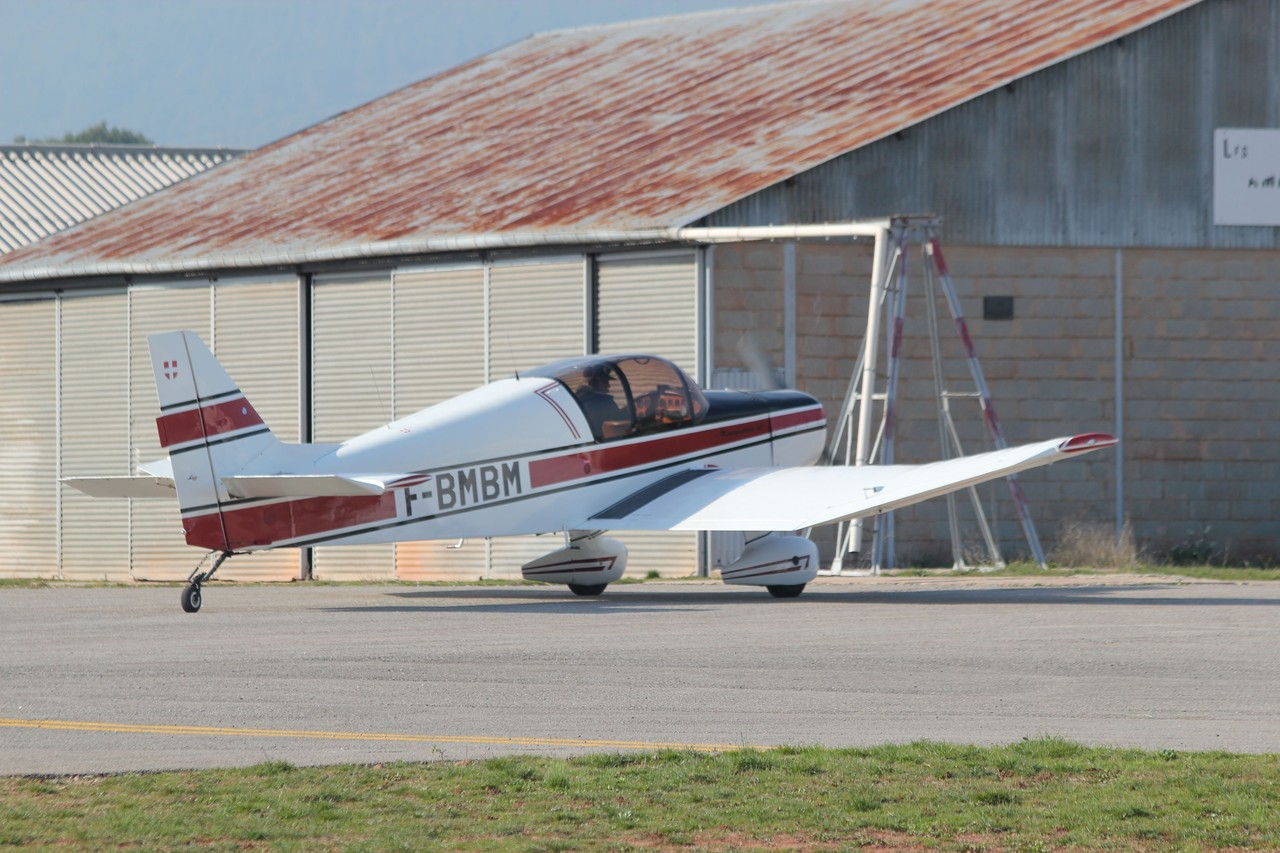
Development and First Flight
The D-140 emerged from the design partnership of Jean Délémontez and Edouard Jolly, who sought to expand the successful Jodel formula into the four-seat touring aircraft market. Built as an enlarged derivative of the earlier D.117 two-seater, the prototype registered F-BIZE took to the skies on July 4, 1958, at Bernay with test pilot Lucien Quérey at the controls. Two additional prototypes, F-BIZA and F-BIZB, joined the test program under pilot Léon Biancotto, validating the aircraft's design for both civilian touring and military training applications.
Production Success
Société Aéronautique Normande produced 215 factory-built D-140s between 1958 and 1970, establishing the type as a commercial success in the European light aircraft market. When SAN entered judicial liquidation in 1969, Avions Pierre Robin assumed production responsibilities, ensuring continuity for the final aircraft deliveries. Beyond factory production, more than 20 additional examples were constructed by homebuilders using available plans, demonstrating the design's appeal to amateur constructors.
Military Adoption
The French Air Force recognized the D-140's training potential, ordering 18 D-140E Mousquetaire IV variants and 15 specialized D-140R Abeille glider tugs. The D-140R, featuring a distinctive cut-down rear fuselage and high-visibility canopy, first flew in June 1965 under pilot Paul Talman. The École de l'Air acquired 12 D-140R aircraft bearing serials 507-518, replacing their aging Morane-Saulnier MS.500 Criquet fleet that had served glider training duties since the 1940s. The Centre d'Essais en Vol operated two additional D-140R aircraft, serials 519 and 520, for specialized test missions.
Engine and Performance
Powering the D-140 was the reliable Lycoming O-360-A1A, a horizontally-opposed four-cylinder engine producing 180 horsepower. This American-manufactured powerplant provided the aircraft with a maximum speed of 250 kilometers per hour and a practical cruise speed of 220 kilometers per hour. The generous 260-liter fuel capacity enabled a maximum range of 1,200 kilometers, while the service ceiling reached 4,500 meters. Homebuilt variants could accommodate the more powerful 200-horsepower Lycoming variant, enhancing performance for specialized applications.
Operational Characteristics
Pilots praised the D-140's forgiving handling characteristics and robust construction, which enabled operations from unprepared airfields in mountainous terrain. The aircraft's low stall speed of just 55 kilometers per hour provided excellent short-field performance, while the climb rate of 5.0 meters per second offered strong takeoff performance even when fully loaded to its maximum weight of 1,200 kilograms. Winter operations were facilitated by ski equipment compatibility, and the cabin configuration allowed emergency medical evacuation missions with stretcher installations.
Production Variants
The D-140 evolved through six distinct production variants, each incorporating progressive improvements. The initial D-140A Mousquetaire saw 45 examples built with basic cabin ventilation, followed by 56 D-140B Mousquetaire II aircraft featuring improved brakes and enhanced engine cowling. The D-140C Mousquetaire III introduced an enlarged swept tail fin in 1962, with 70 aircraft completed. From 1964, the D-140E Mousquetaire IV incorporated a further enlarged tail, modified ailerons, and an all-flying elevator, totaling 43 examples. The specialized D-140R Abeille glider tug comprised 28 aircraft with unique visibility modifications.
Civil Aviation Impact
French and European aero clubs embraced the D-140 as an ideal step-up aircraft for pilots transitioning from two-seat trainers to more complex touring machines. Its five-seat capacity made it suitable for small commercial operations, flight training organizations, and private owners seeking economical cross-country capability. The type's reputation for reliability and ease of maintenance contributed to its longevity in civilian service, with numerous examples remaining active through 2014.
Legacy and Preservation
The D-140 Mousquetaire established Jodel's reputation in the four-seat aircraft market and demonstrated the viability of robust, economical touring aircraft for diverse European operators. Construction plans remained available for homebuilders as late as 2015, ensuring the type's continuation beyond factory production. While many examples have been retired, surviving D-140s continue serving private owners and aero clubs, preserving the legacy of this successful French design that bridged the gap between simple trainers and complex touring aircraft in the crucial post-war aviation boom.