
Service History
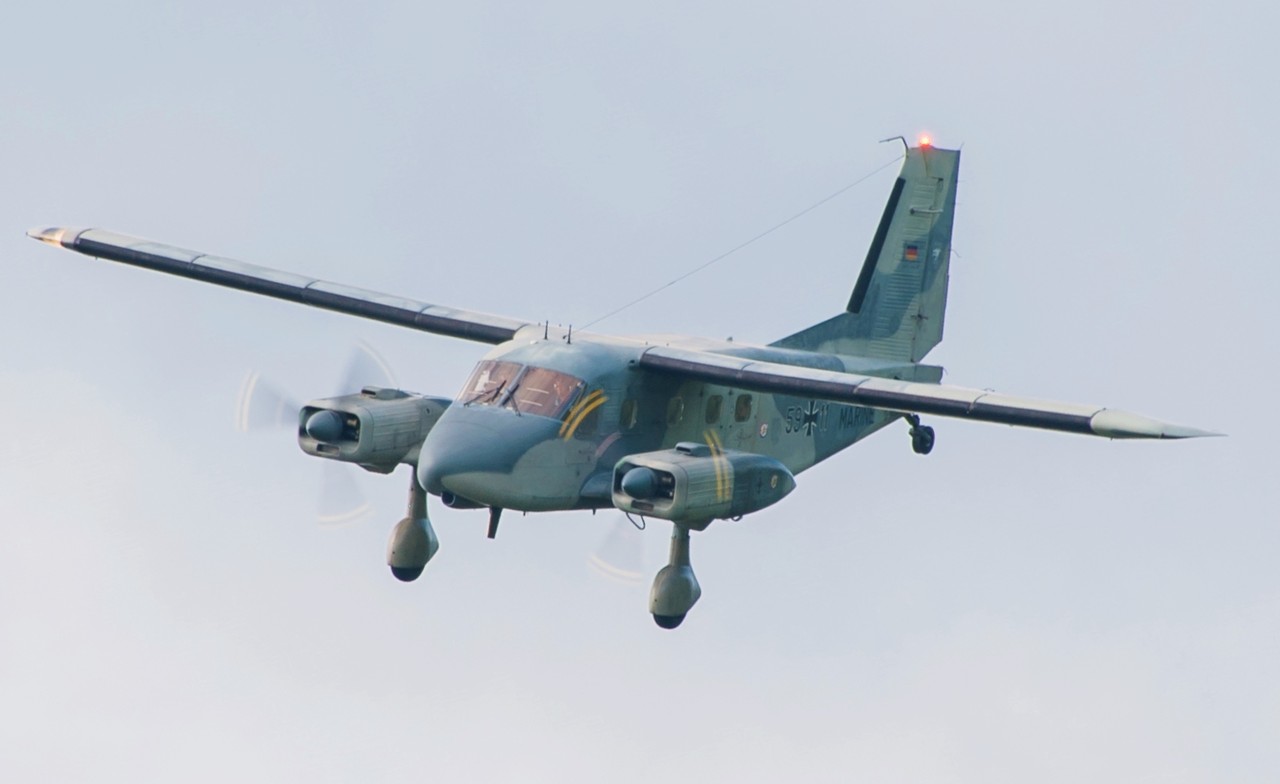
The Do-28D Skyservant carved out a specialized niche in both military and civilian aviation through its exceptional short-takeoff-and-landing capabilities. More than 220 Skyservants operated worldwide at the peak of their service, with over 30 air forces adopting the type for utility and liaison duties. The German Luftwaffe placed the largest military order for 125 aircraft, employing them for liaison and utility missions until the mid-1990s when they were replaced by the more modern Do-228. German forces affectionately nicknamed the aircraft "Bauernadler" (peasant's eagle), reflecting its rugged, no-nonsense character.
Military Operations
While the Do-28D entered service after the Vietnam War era and saw no combat operations, it served numerous air forces in utility roles including maritime reconnaissance, pollution monitoring, and personnel transport. Notable military operators included the German Bundesmarine for naval operations, along with air forces from Ethiopia, Morocco, Nigeria, Turkey, and Zambia. Turkey operated two aircraft under the designation "Anadolou" for signals intelligence gathering, demonstrating the type's adaptability to specialized missions.
The Manufacturer
Dornier GmbH, founded by aviation pioneer Claude Dornier, represented Germany's renaissance in aircraft manufacturing following World War II. The company resumed production with the Do-27, Germany's first mass-produced postwar aircraft that first flew in June 1955, before developing the larger Do-28 series with assistance from the German Ministry of Economics. Dornier operated as an independent entity from the 1910s through the 1990s, focusing on STOL transports and innovative designs. The company was integrated into Deutsche Aerospace (DASA) in 1985, which later became part of EADS (now Airbus). Dornier as an independent manufacturer ceased operations following bankruptcy in 1996, though its legacy continues through Airbus subsidiaries.
Engine & Technical Innovation
The Skyservant's impressive performance stemmed from its powerplant of two Avco Lycoming IGSO-540-A1E supercharged piston engines, each producing 380 horsepower. These inline engines were mounted in distinctive rectangular nacelles positioned on struts above the main landing gear, contributing to the aircraft's exceptional ground clearance for rough-field operations. The supercharging system enabled the Do-28D to maintain power at altitude, directly contributing to its record-setting climb performance.
The design team at Dornier focused on creating a simple, rugged aircraft optimized for operations from unpaved airstrips while providing easy maintenance access. The aircraft featured large double doors for passenger and cargo loading, and its boxy fuselage design prioritized internal volume over aerodynamic refinement. This practical approach resulted in an aircraft that could reliably serve remote locations where conventional twins would struggle.
Performance & Pilot Experience
The Do-28D's exceptional STOL capabilities made it invaluable for accessing remote airstrips throughout the world. Beyond its practical short-field performance, the aircraft demonstrated its high-altitude capabilities by setting multiple records, including the notable 1972 achievement of reaching 8,624 meters while carrying a 1,000-kilogram payload. The twin-engine configuration provided crucial safety margins over the earlier single-engine Do-27, particularly important when operating in challenging terrain or weather conditions.
The cockpit accommodated a two-person crew, with the main cabin configured for up to 13 passengers depending on the variant and mission requirements. The robust landing gear and high ground clearance allowed operations from grass strips, gravel surfaces, and other unprepared areas where conventional aircraft would risk damage.
Production Evolution & Legacy
Serial production commenced in 1971 with approximately 50 Do-28D and Do-28D-1 variants manufactured in the 4xxx construction number series. The refined Do-28D-2 became the most numerous variant with over 170 aircraft delivered, featuring improvements based on operational experience. The 1980 introduction of the Do-28D-2T incorporated turbocharged TIGO-540 engines for enhanced high-altitude performance, while the experimental Do-28D-5X TurboSky prototype explored further performance improvements.
The Skyservant's success led directly to the development of the Do-228, which emerged in the late 1970s featuring Dornier's advanced TNT wing technology. The Do-228 proved even more successful with approximately 400 built and more than 200 remaining active with 45 operators according to recent aviation databases. Many surplus German military Do-28D aircraft found second lives in civilian hands, with numerous examples remaining airworthy today, testament to their robust construction and enduring utility for specialized transport missions.