
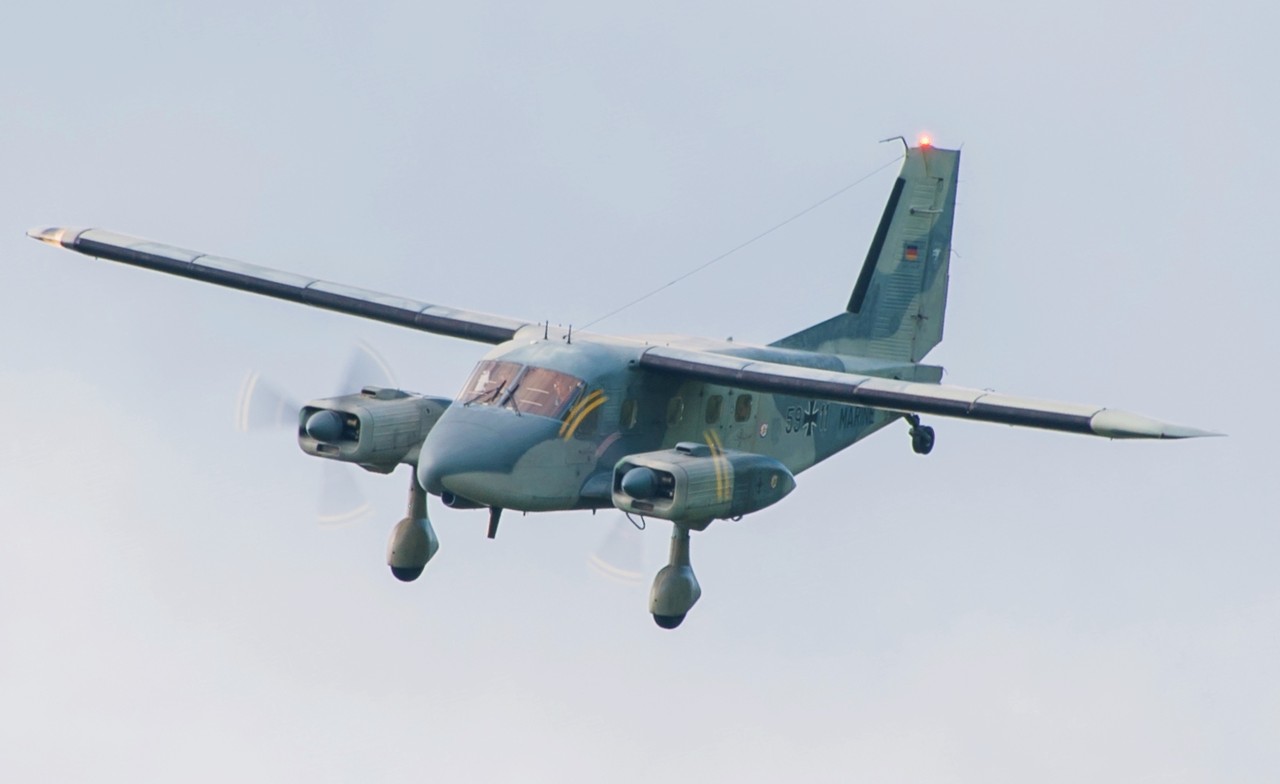
Development and Design Philosophy
The Do 28D-6 Turbo Skyservant emerged from Dornier's extensive experience with short takeoff and landing aircraft, building upon the successful Do 28D series that first flew on February 23, 1966. The Dornier engineering team, working under the legacy of Claude Dornier's design philosophy, focused on creating an aircraft capable of operating from unprepared airstrips with takeoff runs of approximately 150 meters. The boxy fuselage design, enlarged wing area, and redesigned tail surfaces all contributed to enhanced stability and STOL performance that defined the aircraft's operational capabilities.
The decision to develop a turboprop variant reflected the aviation industry's transition toward more reliable and efficient powerplants for utility aircraft. The prototype Do 28D-6X completed its maiden flight on March 4, 1980, validating the concept of marrying proven airframe design with modern turboprop technology.
Powerplant and Performance
Two Pratt & Whitney Canada PT6A-110 turboprops, each producing 298 kilowatts (400 shaft horsepower), powered the Do 28D-6. These engines, part of the legendary PT6 series that entered production in 1963, provided exceptional reliability with time between overhauls reaching 3,600 hours. The PT6A-110's flat power rating maintained performance capabilities in hot and high-altitude conditions that frequently challenged piston-powered aircraft.
The turboprop installation transformed the aircraft's operational envelope, enabling a maximum speed of 370 kilometers per hour and extending range to 1,800 kilometers. Service ceiling reached 7,000 meters, while climb rate improved to 500 meters per minute. These performance figures represented significant improvements over earlier piston-powered variants, particularly in demanding environmental conditions.
Limited Production and Military Service
Dornier built only six production Do 28D-6 aircraft around 1980, making it one of the rarest variants in the extensive Do 28 family. This limited production run contrasted sharply with earlier variants like the Do 28D-1, of which the German Air Force operated 54 examples beginning in 1967 under the Skyservant designation.
The broader Do 28D/128 series found extensive military applications despite seeing no direct combat use. The German Air Force and Navy utilized these aircraft for communications, utility transport, reconnaissance, and VIP transport missions during the Cold War era. International operators included Nigeria, which acquired 16 Do 128-6 aircraft, and Cameroon, which operated three radar-equipped examples for maritime patrol duties. Additional military users included Turkey and Ghana, demonstrating the aircraft's appeal for nations requiring reliable STOL utility aircraft.
The Dornier Legacy
Dornier Flugzeugbau GmbH, founded by Claude Dornier in 1914, experienced numerous transformations throughout its corporate existence. Following post-World War II revival in the 1950s, the company faced bankruptcy in the 1960s before restructuring under state support. The merger into Dornier GmbH in 1967 as part of the Heinkel-Dornier group preceded subsequent acquisitions by Daimler-Benz in 1987, integration into DASA in 1995, and eventual absorption into EADS (now Airbus) in 2000.
The Do 28 series represented a crucial element of West Germany's aviation industry revival, with total family production reaching 370 to 375 units between 1959 and the early 1980s. Manufacturing occurred primarily at Dornier's Oberpfaffenhofen facility and other German locations from 1966 onward.
Civilian Applications and Variants
While primarily designed for military utility roles, the Do 28 family found limited civilian applications. Specialized variants included the Do 28D-2/OU configured for pollution patrol duties. The related Do 28 G.92, powered by Walter M601-D2 turboprops, served the skydiving community with seven examples built in 1995. No major airlines operated the type, reflecting its specialized STOL mission rather than conventional transport requirements.
The aircraft's passenger configuration accommodated 8 to 10 individuals, with cargo capability available through removable seating arrangements. This flexibility proved valuable for operators requiring multi-mission capabilities in a single airframe.
Current Status and Heritage
Few Do 28D-6 aircraft remain airworthy today, reflecting both the limited production numbers and the passage of four decades since manufacture. Preserved examples include Do 128-6 D-IBUF, which served at Technische Universität Braunschweig before retirement. Museum collections house various Do 28 family aircraft, including examples at the Deutsches Technikmuseum in Berlin and other institutions preserving German aviation heritage.
The Do 28D-6 Turbo Skyservant stands as a symbol of post-war German aviation revival and innovative STOL design. Its influence extended to later Dornier products like the Do 228, while pioneering affordable short-field operations for developing nations and military liaison missions. Though few in number, these aircraft demonstrated the successful integration of modern turboprop technology with proven utility aircraft design principles.