
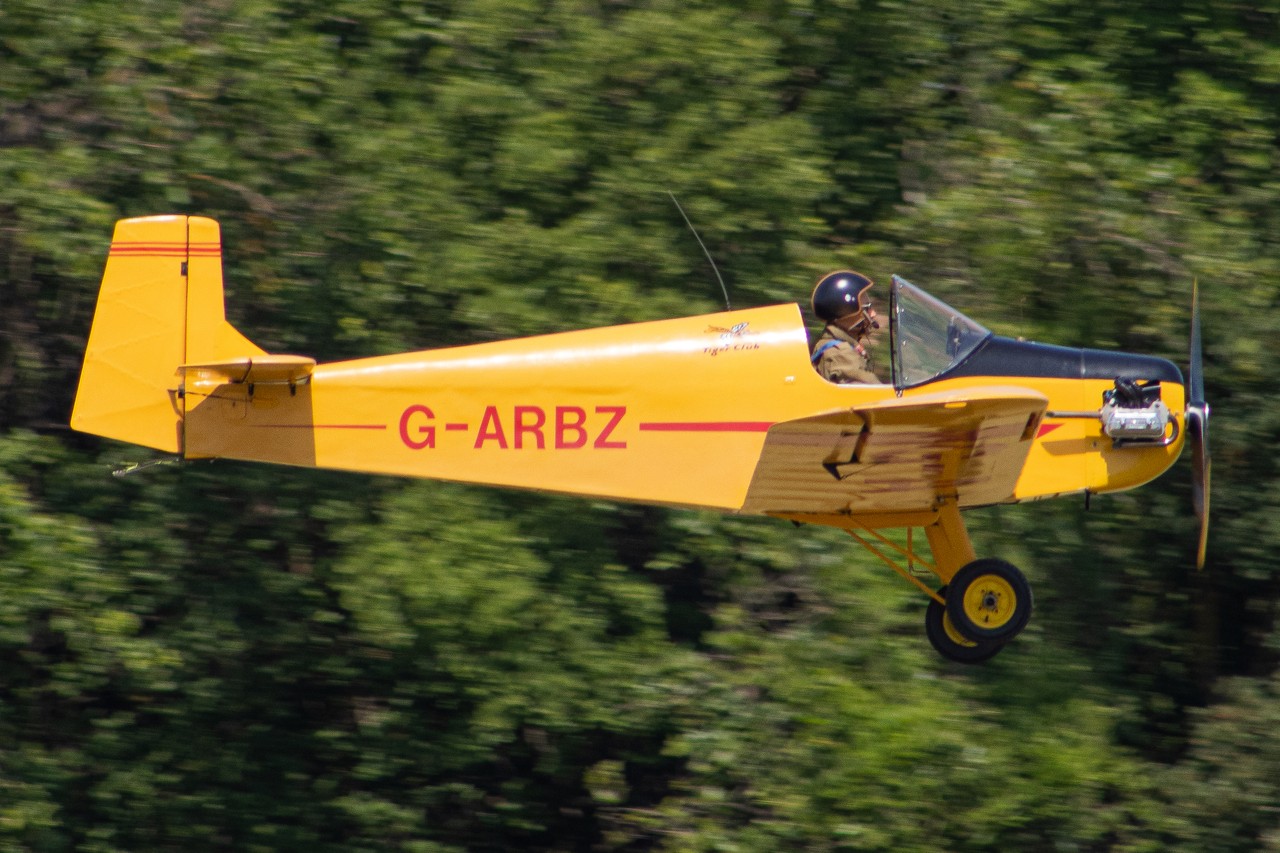
Revolutionary Amateur Aviation Design
Roger Druine transformed amateur aviation in 1950 when he created the D-31 Turbulent as his second post-war aircraft design. Born in 1921 in Pont-Sainte-Maxence, northern France, Druine had built his first aircraft at age 16 in 1938. His design philosophy centered on creating an ultra-simple, single-seat aircraft that amateur builders could construct using basic woodworking skills and readily available materials.
The Turbulent's innovative design featured a rectangular box fuselage constructed with four longerons and plywood-covered turtle deck, combined with cantilever low wings utilizing a two-spar configuration with a plywood D-nose torsion box. This wood-and-fabric construction method proved both lightweight and robust, enabling the aircraft to achieve structural certification while remaining accessible to amateur builders.
Factory Production and Global Distribution
Rollason Aircraft & Engines Limited acquired production rights from Druine around 1958, establishing manufacturing facilities in Croydon, Surrey. Between 1958 and 1984, Rollason produced 26 standard D-31 aircraft and 3 strengthened D-31A variants certified for full British Certificate of Airworthiness operations. The D-31A featured reinforced wing spars and could accommodate the more powerful 55-horsepower Rollason Ardem engine, achieving maximum speeds of 115 knots.
Simultaneously, Druine's plans proliferated globally through amateur building organizations. The Popular Flying Association (now Light Aircraft Association) in the United Kingdom approved the design as one of their earliest homebuilt projects. In Australia, the Department of Civil Aviation certified approximately 10 completed examples, while New Zealand builders constructed more than 20 aircraft through organizations like Aerocraft (NZ) Ltd. Additional construction occurred in France, Germany through Stark Flugzeugbau, and South Africa, though exact worldwide totals remain unknown.
Engine Development and Performance
The Turbulent's success stemmed partly from its adaptability to various powerplants, particularly modified Volkswagen automotive engines. Rollason Aircraft developed licensed versions of the French Ardem conversion, producing the 4C02 series engines. The standard Mk IV generated 45 horsepower, while the Mk V produced 55 horsepower for the D-31A variant. By February 1963, Rollason had manufactured 32 Ardem engine conversions.
These air-cooled, horizontally-opposed four-cylinder engines featured dual ignition systems and carburetion through Solex side-entry carburetors with preheated air intake. Engine production continued from 1958 through 1984, with variants ranging from 25 to 83 horsepower. The reliability of these automotive conversions proved crucial for amateur builders seeking affordable powerplants for their aircraft.
Flight Characteristics and Pilot Experience
Pilots found the Turbulent forgiving and predictable, with a maximum speed of 175 kilometers per hour and cruising speed of 161 kilometers per hour. The aircraft demonstrated a service ceiling of 2,740 meters and initial climb rate of 137 meters per minute. With a range of 400 kilometers, the Turbulent provided sufficient performance for local recreational flying while maintaining fuel economy.
The fixed tailwheel landing gear configuration simplified construction and maintenance while reducing weight. Empty weight of just 179 kilograms allowed a maximum gross weight of 281 kilograms for standard variants, with the D-31A certified up to 317 kilograms. This lightweight construction contributed to the aircraft's gentle handling characteristics and made it suitable for pilots transitioning from training aircraft.
Operational Legacy
The Tiger Club in the United Kingdom operates five Turbulents as of 2019, using them for formation displays and demonstration flights. Aircraft like G-APWP regularly participate in airshow performances, showcasing the type's continued airworthiness decades after initial construction. G-APNZ and other examples remain active on the British civil register.
In New Zealand, the first Turbulent was constructed by Syd Jensen and registered to Aviation Sales and Services Ltd in Palmerston North. Australian examples like VH-PWH continued flying through the 1980s, with several aircraft based at Mangalore, Victoria. South African builders also embraced the design, with aircraft like ZS-UFZ representing the type's global appeal.
Enduring Impact
The Druine D-31 Turbulent's significance extends beyond its production numbers. As one of the first aircraft specifically designed for amateur construction and approved by regulatory bodies worldwide, it established precedents for the modern homebuilt movement. The UK Light Aircraft Association continues holding plans rights, supporting ongoing construction projects.
The Turbulent proved that simple, traditional construction methods could produce safe, enjoyable aircraft accessible to amateur builders. This democratization of aircraft construction influenced subsequent ultralight and homebuilt designs, establishing wood-and-fabric construction as a viable alternative to complex metal fabrication for recreational aviation.