
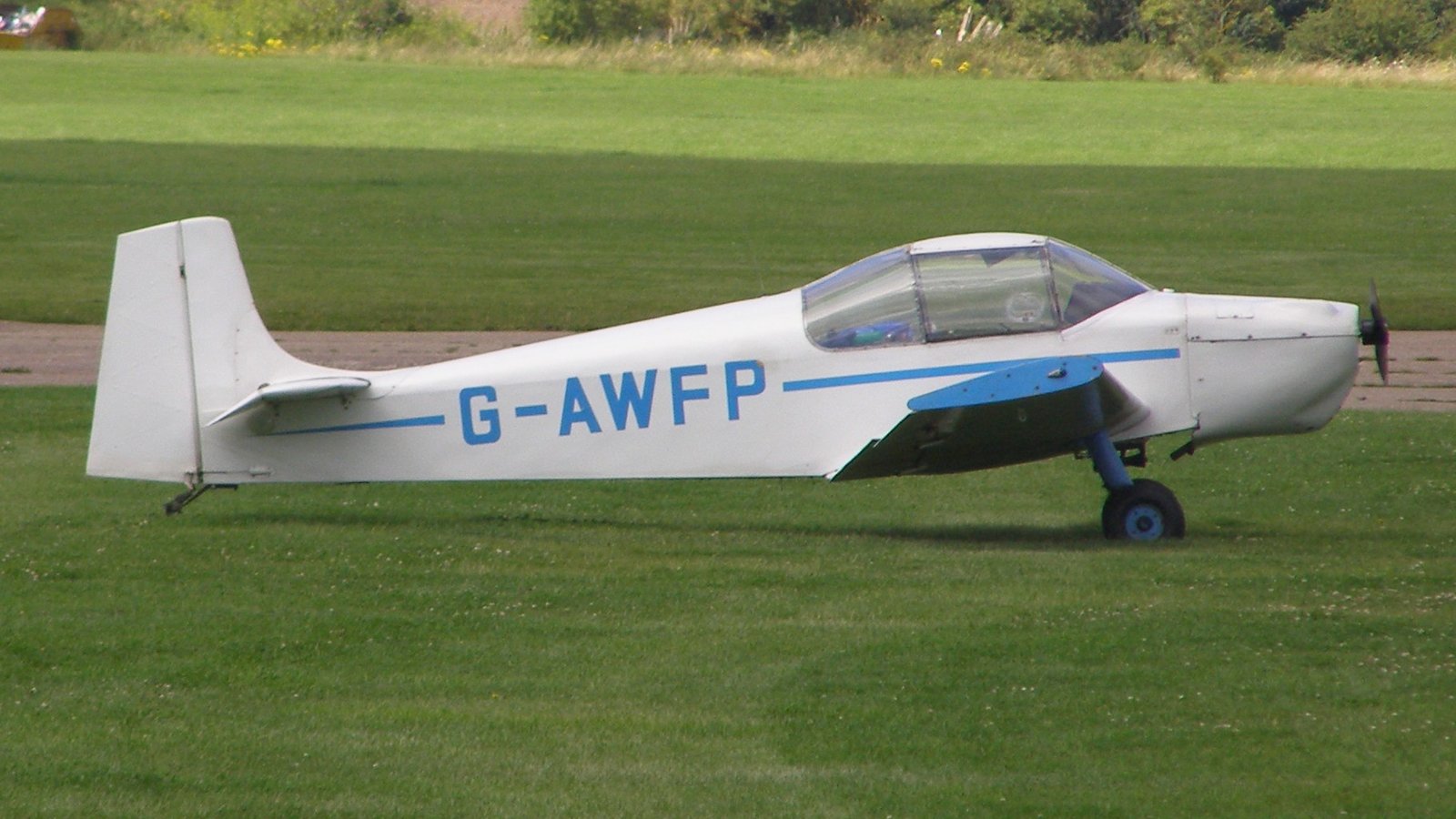
Service History in Amateur Aviation
The Druine D.60 Condor carved out a significant niche in European sport aviation, particularly within the amateur-built aircraft community. While initially conceived as a factory-built design, the Condor found its true calling when plans became available for home construction. Only Rollason Aircraft & Engines Ltd. of Croydon, Surrey produced a series of factory-built machines beginning around 1958, while countless amateur builders across France and the United Kingdom constructed their own examples from plans.
The aircraft's accessibility to amateur builders made it a popular choice for flying clubs and private owners throughout the 1950s and 1960s. The Aero Club Louis Breguet at Aerodrome Persan-Beaumont near Paris operated the second prototype, F-PHLL, which was delivered on September 14, 1956. This aircraft later passed to private owner Eugène Martin at Chelles near Paris on January 11, 1973, demonstrating the type's longevity in private hands.
The Designer and His Legacy
Roger Druine established himself as one of Europe's most innovative light aircraft designers before creating the Condor. Having built his first aircraft at age 17 in 1938, Druine had already gained recognition for his Turbulent and Turbi designs before developing the two-seat Condor concept. His untimely death in 1958 marked the end of an era, but his designs continued to influence amateur aviation for decades.
After Druine's death, Rollason Aircraft & Engines became the primary manufacturer of his designs in the British market, continuing operations until approximately 1984. The company's commitment to the Condor design resulted in multiple variants and sustained production that kept the type viable for sport aviation enthusiasts.
Engine Evolution and Technical Development
The Condor's development showcased the evolution of light aircraft powerplants during the 1950s. Both initial prototypes utilized 60-horsepower Italian CNA D4 engines, but the first aircraft was subsequently re-engined with a 65-horsepower Continental A65-8F, establishing a pattern of continuous improvement that would characterize the type throughout its production life.
The D.61 variant offered builders a choice between 65-horsepower Continental A65 or 75-horsepower Continental A75 engines, while the D.62 variant featured the more powerful 90-horsepower Continental C90. These Continental inline piston engines, manufactured by Continental Motors, provided reliable power that made the Condor suitable for cross-country flying and advanced training operations.
Variants and Performance Characteristics
The Condor family expanded beyond the original D.60 configuration to meet diverse operational requirements. The D.61 became the standard amateur-built version, offering builders proven Continental powerplants in the 65-75 horsepower range. Rollason produced the D.62 series in the United Kingdom, creating sub-variants designated D.62A, D.62B, and D.62C to accommodate different equipment standards and customer preferences.
The most ambitious development was André Merville's D.63 derivative, which first flew on March 23, 1962. This homebuilt variant featured nosewheel landing gear, a modified fin design, and a 105-horsepower French Potez 4E-20 engine. The tricycle gear configuration represented a significant departure from the conventional tailwheel arrangement of earlier Condors, offering improved ground handling characteristics for less experienced pilots.
Production Legacy and Continuing Operations
The Condor's production history reflects the dual nature of post-war European aviation, combining limited factory production with extensive amateur construction. While exact total production figures remain undocumented, the design's availability in plans form enabled numerous builders to complete their own aircraft over several decades.
The type's longevity is demonstrated by aircraft still registered well into the 21st century. The first prototype, F-BBIX, remained on the French amateur aircraft register under the ownership of Renaud Jean and Philippe Archambaud as of May 27, 2014, based at La Réole Floudes Airport approximately 30 miles southeast of Bordeaux. The third aircraft built, F-PBIZ, transitioned to the amateur register on February 24, 1965, and continued operating for decades thereafter.
Impact on European Sport Aviation
The Druine D.60 Condor represented a crucial stepping stone in the development of European amateur aviation. Its practical two-seat configuration filled a gap between single-seat sport aircraft and more complex touring machines, providing an accessible platform for pilots seeking cross-country capability without excessive complexity or cost.
The aircraft's influence extended beyond its immediate operators to inspire a generation of amateur builders and designers. Its combination of straightforward construction techniques, reliable powerplants, and adequate performance established benchmarks that influenced subsequent homebuilt aircraft development throughout Europe. Today, surviving examples serve as reminders of an era when individual craftsmen could still build complete aircraft in home workshops, contributing to aviation's grassroots development during the crucial post-war decades.