
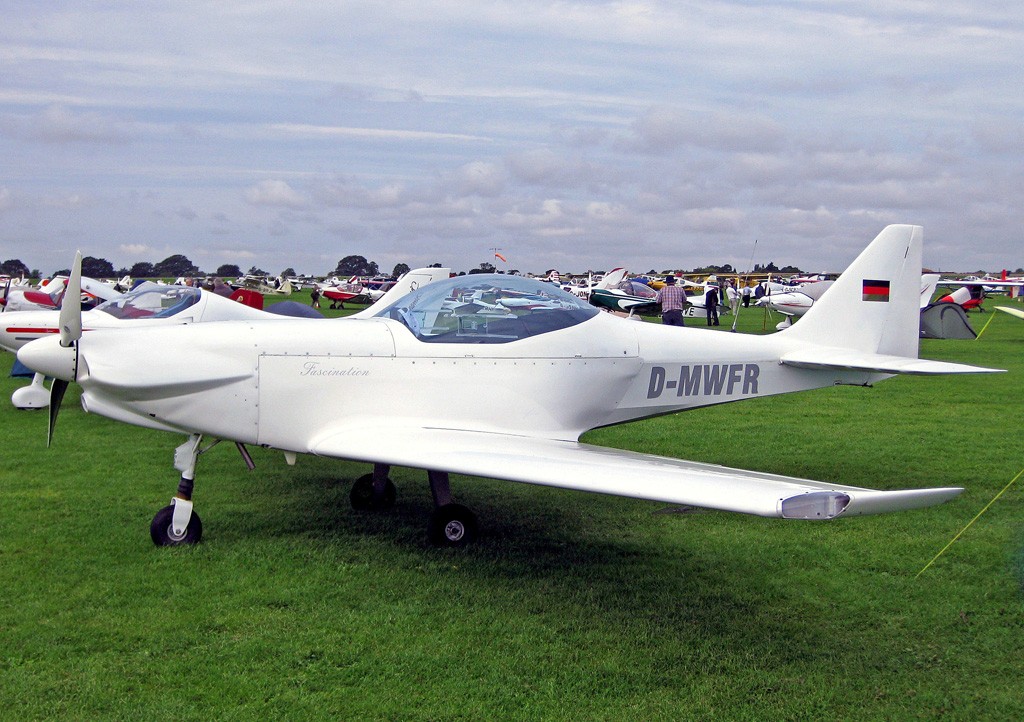
Revolutionary Design Philosophy
The D-4 Fascination emerged from Wolfgang Dallach's vision to create an ultralight aircraft with the sophistication and performance typically reserved for larger general aviation aircraft. Dallach, a celebrated German aerobatic champion and national team representative, sought to eliminate the compromises traditionally associated with ultralight design. The original 1996 prototype employed mixed construction techniques using tube, cloth, wood, composites, steel, and fabric, but this evolved dramatically by 1999 with the D4 BK variant's first flight, which featured full GRP sandwich composite construction.
Manufacturing Excellence
WD Flugzeugleichtbau GmbH operated a sophisticated two-facility production system that reflected German engineering precision. The completion and research facility near Heubach, Germany employed 15 people, while the main production plant operated in Kaplice, Czech Republic, employing 50 workers. This Czech facility, known as UL-Jih, was jointly owned by Wolfgang Dallach, Scherlinzky, and two Czech citizens, demonstrating the international nature of the operation.
By 2001, the company had delivered 90 fiberglass D-4s across Europe and Brazil, with the first United States delivery occurring on March 6th of an unspecified year. The aircraft was offered both as a kit requiring approximately 800 hours of construction time with pre-glued GFK shells, and as a factory-complete aircraft priced at approximately $100,000 in 2001.
Technical Innovation
The D-4 Fascination incorporated several groundbreaking features for its class. The aircraft featured a variable-pitch composite propeller that pilots could adjust in flight, composite wings with Dacron covering, and a Stratos Magnum 501 ballistic recovery parachute system. The half-shell engine cowling provided complete access to the powerplant, while electric starting eliminated the manual propeller swinging typical of ultralight aircraft.
Power came from Austrian-manufactured Rotax engines, specifically the 912 UL producing 80 horsepower or the 912 ULS generating 100 horsepower. These four-cylinder, liquid and air-cooled engines provided the reliability necessary for the aircraft's intended role, with the ULS variant featuring electronic fuel injection for improved efficiency. The engine variants led to corresponding aircraft designations: F80 for 912UL-powered aircraft and F100 for those equipped with the 912ULS.
Certification Achievements
The D-4 achieved significant regulatory milestones, earning microlight certification in Europe and Brazil beginning in 1995. More remarkably, it became CS-VLA certified in 2004, representing a significant achievement for an aircraft that began life as an ultralight design. This certification path demonstrated the aircraft's structural integrity and performance capabilities far exceeded typical ultralight standards.
An Evolution prototype emerged on March 6, 2001, featuring a carbon-fiber fuselage that provided increased cabin roominess while retaining the proven D-4 wings, ailerons, and rudder. This variant maintained the maximum speed limitation of 260 kilometers per hour imposed on the D4 BK model.
Corporate Turbulence
The D-4's production story became complicated by corporate instability. WD Flugzeugleichtbau GmbH filed for bankruptcy on May 6, 2005, effectively ending the original production run after more than 200 airframes had been completed, though specific production records show 51 aircraft built under the WDFL Dallach designation.
Following the bankruptcy, UL-Jih claimed rights to both the D-4 and D-5 designs, rebranding the aircraft as the UL-Jih F80/F100 Fascination. However, this venture never achieved series production. Swiss Light Aircraft (SLA) AG in Gümligen, Switzerland, subsequently acquired development rights around 2007, planning VLA and Mark 2 ultralight variants to be manufactured in the Czech Republic.
After eight years without successful production, SLA returned the rights to Wolfgang Dallach in 2014 following a landing incident with their sole VLA variant. Aircraft Design & Certification (AD&C) currently maintains the CS-VLA type certificate for ongoing maintenance support, while DG Flugzeugbau in Bruchsal supervised ultralight models from August 1, 2008, through 2014.
Legacy and Current Status
The D-4 Fascination's legacy was cut short by the tragic death of its creator. Wolfgang Dallach died on January 18, 2015, at age 63, from carbon monoxide poisoning during the crash of his Piper PA-24-260 (D-EERZ) near Rechberghausen. His death effectively ended hopes for renewed production of his innovative design.
Today, only three D-4 Fascination VLAs remain in flying condition. Notable examples include D-MBOZ (serial number 017, D4 BK variant), which was observed on January 7, 2018, at MLA airfield Dankern near Haren, Germany, and D-EHGG (serial number 018). The aircraft's safety record includes several documented accidents between 2000 and 2005, including incidents involving D-MSHO on June 16, 2000, and D-EYKL on July 8, 2005.
The D-4 Fascination represented a significant evolutionary step in ultralight aviation, demonstrating that aircraft in this category could achieve sophisticated engineering standards and certification levels previously thought impossible. While production revival remains desired by aviation enthusiasts, the complex web of intellectual property rights and the loss of its visionary creator make such prospects uncertain.