
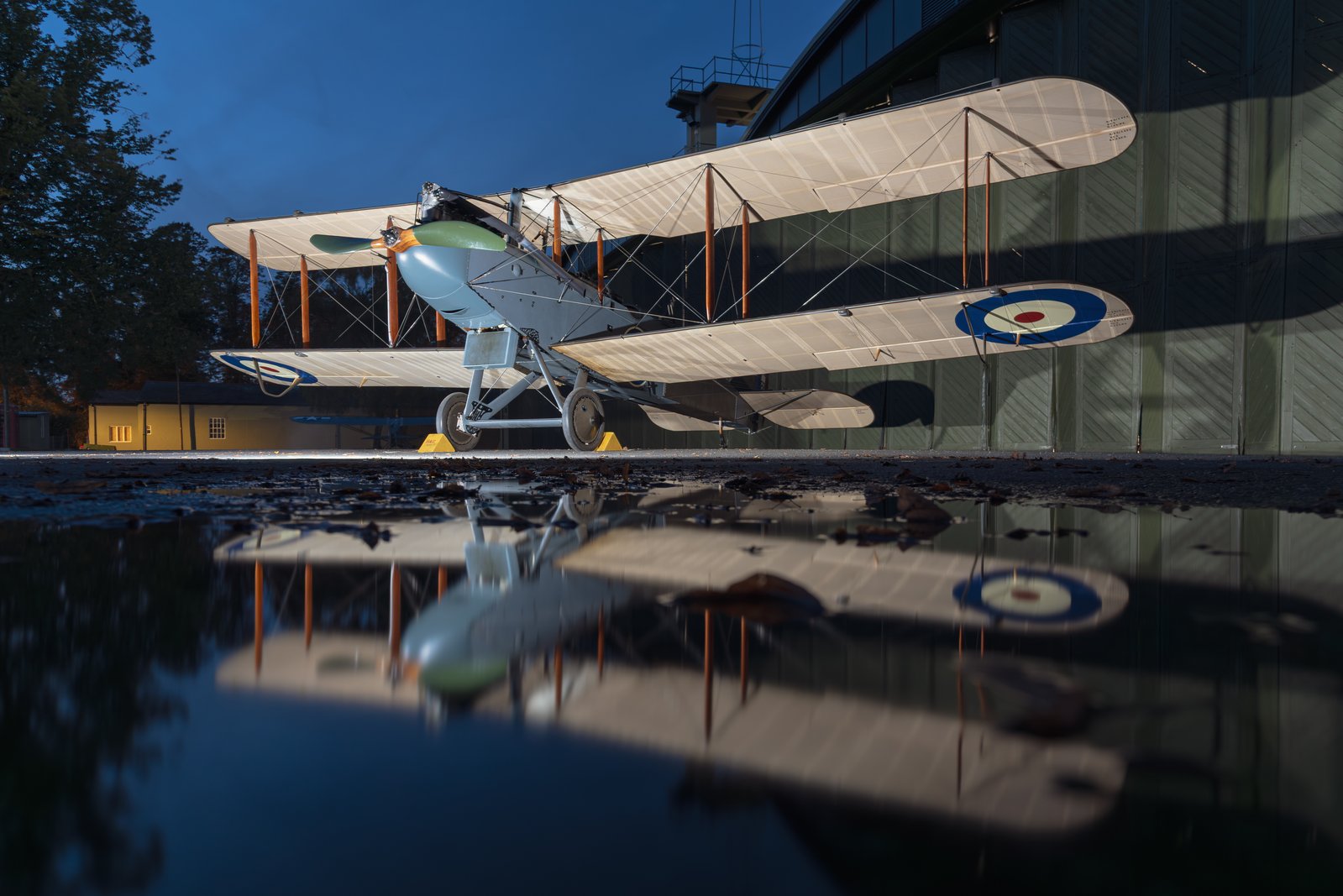
Design and Development
The Airco DH.9 was designed by Geoffrey de Havilland at the Aircraft Manufacturing Company (Airco) as an evolution of the successful DH.4 two-seat day bomber. Developed late in the First World War, the DH.9 aimed to improve crew communication and mutual support by repositioning the pilot closer to the observer and gunner. While the aircraft retained much of the DH.4's wings and airframe to facilitate rapid production, it featured a redesigned fuselage and center section to accommodate these changes and a new powerplant. The prototype first flew in 1917.
Production and Manufacturing
Ordered into production in 1917, the DH.9 was manufactured in very large numbers, with total production estimates exceeding 4,000 aircraft, and some sources citing figures between 4,091 and 4,200. While Airco served as the prime manufacturer at Hendon, production was farmed out to several other firms, including The British & Colonial Aeroplane Co. (Bristol Aeroplane Co.), Waring & Gillow Ltd, and G & J Weir Ltd in Scotland. Additionally, small numbers were produced in Australia by the Australian Aircraft & Engineering Co., and some assembly occurred in India. Production effectively ceased around 1919 following the cancellation of wartime contracts.
Technical Specifications and Performance
The DH.9 was powered by a water-cooled inline six-cylinder BHP/Galloway "Adriatic" engine, designed for approximately 230 hp. However, this engine proved unreliable and underpowered in operational service, often delivering less than its rated power. This technical failure meant the DH.9 frequently exhibited worse performance than the DH.4 it replaced. Typical specifications included a wingspan of approximately 42 ft 4 in, a maximum speed of 114–116 mph, and a service ceiling of roughly 15,500 ft. Its armament consisted of one synchronized .303 in Vickers machine gun for the pilot and one or two .303 in Lewis guns on a Scarff ring for the observer, with a bomb load capacity of approximately 460 lb.
Operational Service and Legacy
The DH.9 entered operational service in early 1918, with No. 103 Squadron deploying the type in February of that year. It served as the primary single-engine day bomber for the Royal Flying Corps and the subsequent Royal Air Force on the Western Front, targeting railways, airfields, and troop concentrations. Due to its poor climb rate and speed, it suffered significant losses to enemy fighters. Following the war, surplus aircraft were used for colonial policing in the Middle East and limited civil roles, such as air mail and light transport in the British Empire.
The shortcomings of the DH.9 led directly to the development of the more powerful DH.9A, which utilized the American Liberty engine. Today, very few examples survive, most notably a restored aircraft in the Royal Air Force Museum collection. The aircraft also marks a corporate transition; Airco was sold to the Birmingham Small Arms Company in 1920 and ceased operations shortly after, leading Geoffrey de Havilland to establish the de Havilland Aircraft Company on September 15, 1920.