
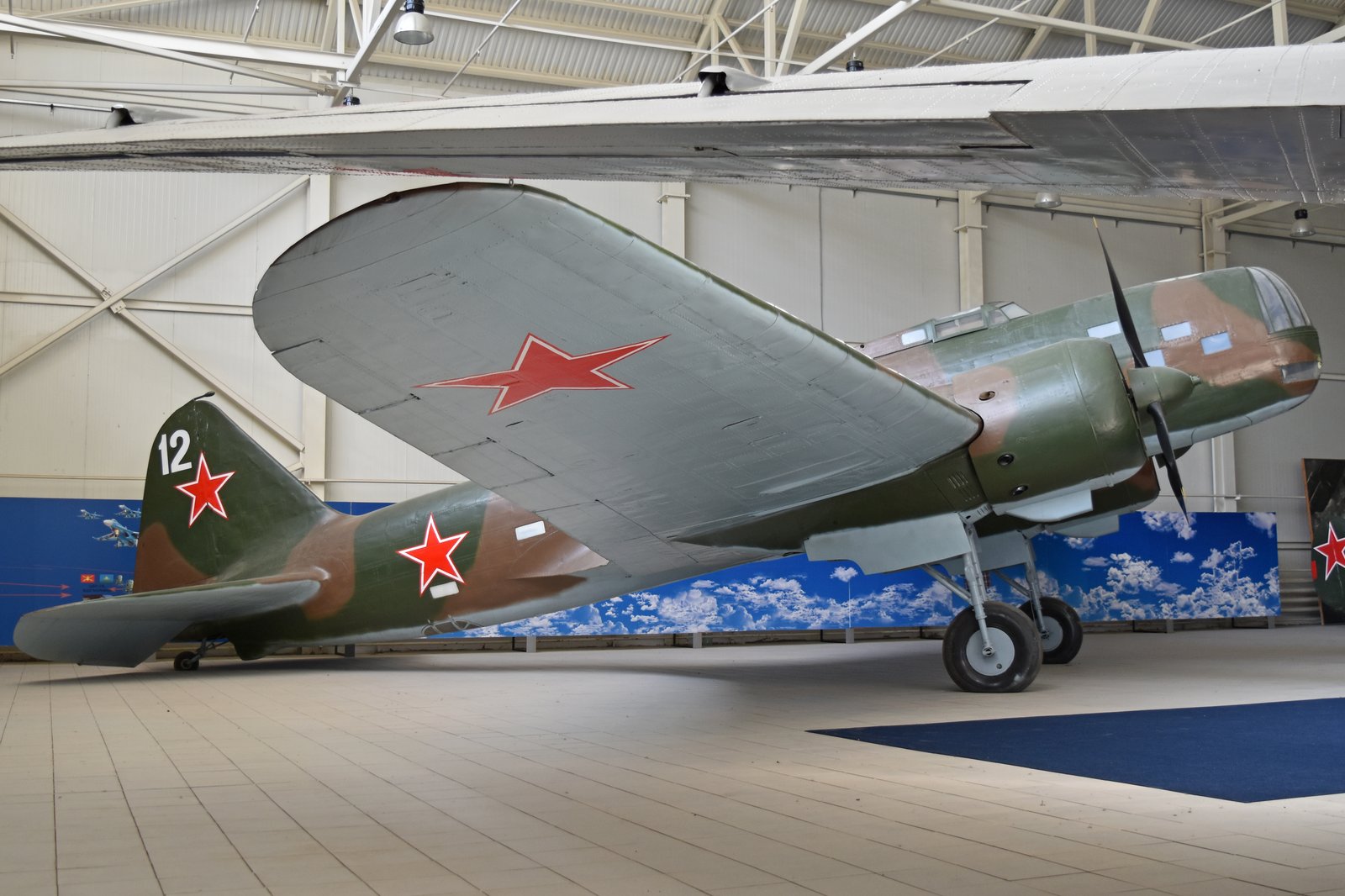
Designed by Sergei Vladimirovich Ilyushin and his design bureau (OKB Ilyushin), the DB-3 was developed in the mid-1930s to provide the Soviet Union with a high-speed, long-range strategic strike capability. The aircraft evolved from the TsKB-26 and TsKB-30 prototypes, with flight testing occurring between 1935 and 1936. As an all-metal twin-engine landplane, the DB-3 offered a combination of range and bomb load that surpassed previous Soviet designs, making it a cornerstone of the nation's aerial strategy leading into World War II.
Production was handled by several state factories under the People’s Commissariat for Aviation Industry. Key manufacturing sites included Moscow Aviation Plant № 39 (also known as Plant im. Menzhinskiy), the Voronezh aircraft plant (now VASO), and the Komsomolsk-on-Amur Aircraft Production Association. While exact plant-specific totals are not publicly available, it is estimated that over 1,500 DB-3 variants were produced before the design transitioned into the improved DB-3F and eventually the Ilyushin Il-4. In total, approximately 6,000 aircraft across the DB-3/DB-3F/Il-4 family were constructed between 1936 and 1940.
Technically, the DB-3 was powered by liquid-cooled V-12 piston engines from the Klimov family. Early models utilized the M-85 or M-86 engines, producing between 800 and 950 hp each. Later versions, including the DB-3F, employed the more powerful M-87 and M-88 engines, which provided roughly 1,000 to 1,100 hp per engine. These powerplants enabled a maximum speed of approximately 400–430 km/h and a service ceiling of 8,000 to 9,000 meters. The aircraft typically carried a crew of four and could deliver a bomb load ranging from 1,000 to 2,500 kg.
In military service, the DB-3 operated in several major conflicts. It was deployed during the Soviet-Japanese border conflicts in the late 1930s, such as the battles at Khalkhin Gol, and served as a long-range bomber during the Winter War (1939–1940). During World War II, the DB-3 and its Il-4 derivative were utilized by the Soviet Long-Range Aviation (ADD) and naval aviation, the latter using the aircraft as a torpedo-bomber. Notably, the DB-3F lineage was involved in some of the first Soviet bombing raids on Berlin in 1941. Small numbers of captured aircraft were also operated by the Finnish Air Force and the Luftwaffe.
Today, the legacy of the DB-3 persists through the continuing operations of the Ilyushin Aviation Complex (PJSC Ilyushin) within the United Aircraft Corporation. While very few airframes survive—with only a small number of Il-4/DB-3F examples in Russian museums—none are known to be in airworthy condition.