
Service History
The Super DC-3's commercial career proved disappointing despite its technical improvements. Capital Airlines initially ordered 23 aircraft to replace their aging DC-3 fleet but ultimately accepted delivery of only three units. Douglas Aircraft Company retained two examples for internal use, while Pilgrim Airlines briefly tested a turboprop variant designated N156WC equipped with experimental "Dart" engines before rejecting it due to licensing complications. The aircraft's failure to gain commercial traction stemmed from intense competition with newer designs and airlines' reluctance to invest in what they perceived as merely an updated version of an existing aircraft.
Military Adaptation
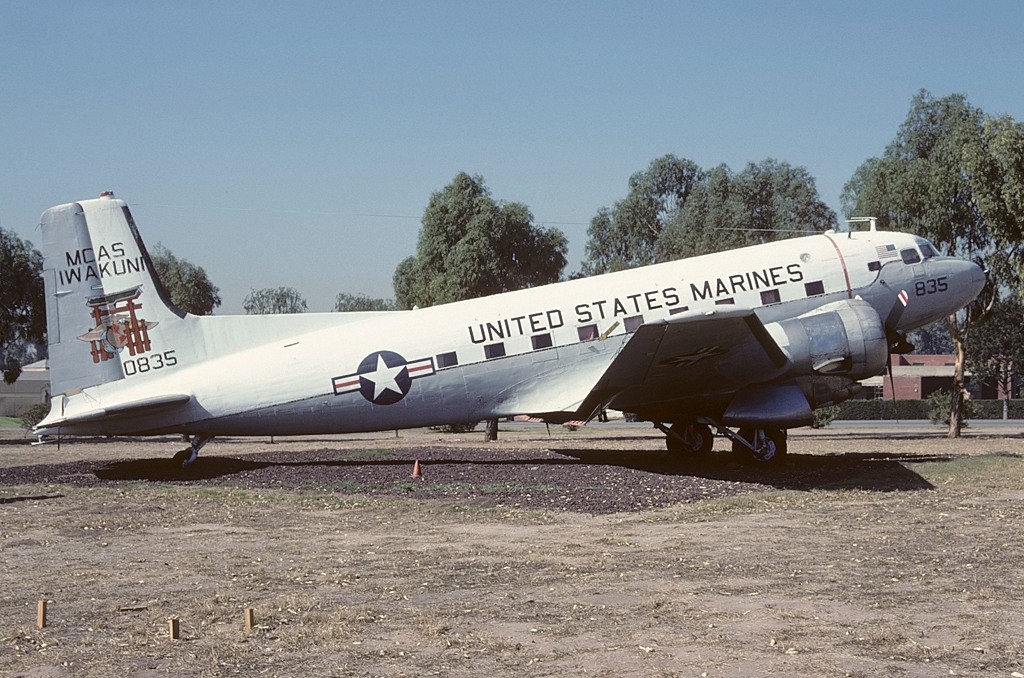
The U.S. Navy provided the Super DC-3's only significant operational success through their conversion program. Starting in the early 1950s, the Navy contracted Douglas to convert 100 existing R4D aircraft to R4D-8 standard (later redesignated C-117D), essentially creating military Super DC-3s at $300,000 per conversion. These aircraft received new constructor numbers and served primarily in transport roles, offering the increased range and 50% payload improvement that made them valuable for logistics operations. The U.S. Air Force also ordered a single YC-129 prototype in 1951 for evaluation, featuring modified tail and wing configurations, though this led to no production orders.
The Manufacturer
Douglas Aircraft Company, founded in 1920 by Donald Wills Douglas Sr., had established itself as America's premier transport aircraft manufacturer through the success of the original DC-3. By the late 1940s, the company was producing nearly 600 DC-3/C-47 aircraft per month at peak wartime rates and invested $3 million in Super DC-3 tooling, research, and development. The company operated independently until 1967, when it merged with McDonnell Aircraft to form McDonnell Douglas, which later became part of Boeing in 1997. Douglas's Santa Monica, California facilities served as the primary manufacturing location for both prototypes and the military conversion program.
Engine and Technical Innovation
Wright Aeronautical's R-1820 Cyclone 9 radial engines powered the Super DC-3, representing a significant upgrade from the original aircraft's powerplants. These air-cooled radial engines, manufactured by the Curtiss-Wright subsidiary, produced 1,475 horsepower each and incorporated supercharger enhancements for improved high-altitude performance. The engines drove four-blade propellers rather than the three-blade units of the original DC-3, contributing to the aircraft's maximum speed of 270 mph. Wright had produced over 50,000 R-1820 variants between 1925 and 1957, making them among the most reliable powerplants available for the Super DC-3's intended commercial service.
Design Revolution
Douglas engineers completely redesigned the aircraft to meet post-war FAR 4B Transport Category Requirements, which the original DC-3 could not satisfy. The 75% new design featured a stretched fuselage accommodating 38 passengers, larger squared-tail surfaces, new outer wing panels, and smoother engine nacelles that fully enclosed the retracted landing gear. The aircraft achieved a service ceiling of 25,000 feet and demonstrated its capabilities during a 10,000-mile demonstration tour in October 1949. Despite remaining unpressurized, the Super DC-3 offered significantly improved performance with a range of approximately 3,000 kilometers.
Production Legacy
The Super DC-3's production run of just two prototypes plus 100 military conversions stands in stark contrast to the original DC-3's massive success. Douglas effectively ended civilian production by 1952 due to lack of commercial orders, making the type one of aviation's notable commercial failures despite its technical merits. The military conversions proved the design's worth, but civilian airlines had moved beyond propeller-driven transports toward the emerging jet age. Today, fewer than 10 Super DC-3 or C-117D aircraft remain airworthy, a tiny fraction compared to the 400-1,000 original DC-3s still flying commercially worldwide.
Historical Significance
The Super DC-3 represents a fascinating "what if" in aviation history – a technically superior aircraft that arrived at the wrong moment. While the original DC-3 revolutionized air transport in the 1930s and 1940s, the Super DC-3's improvements came too late to capture the commercial market's imagination. The aircraft serves as a reminder that even excellent engineering cannot overcome poor market timing, and its limited production makes surviving examples particularly significant for aviation historians and enthusiasts studying the transition from propeller to jet-powered commercial aviation.