
Commercial Aviation Revolution
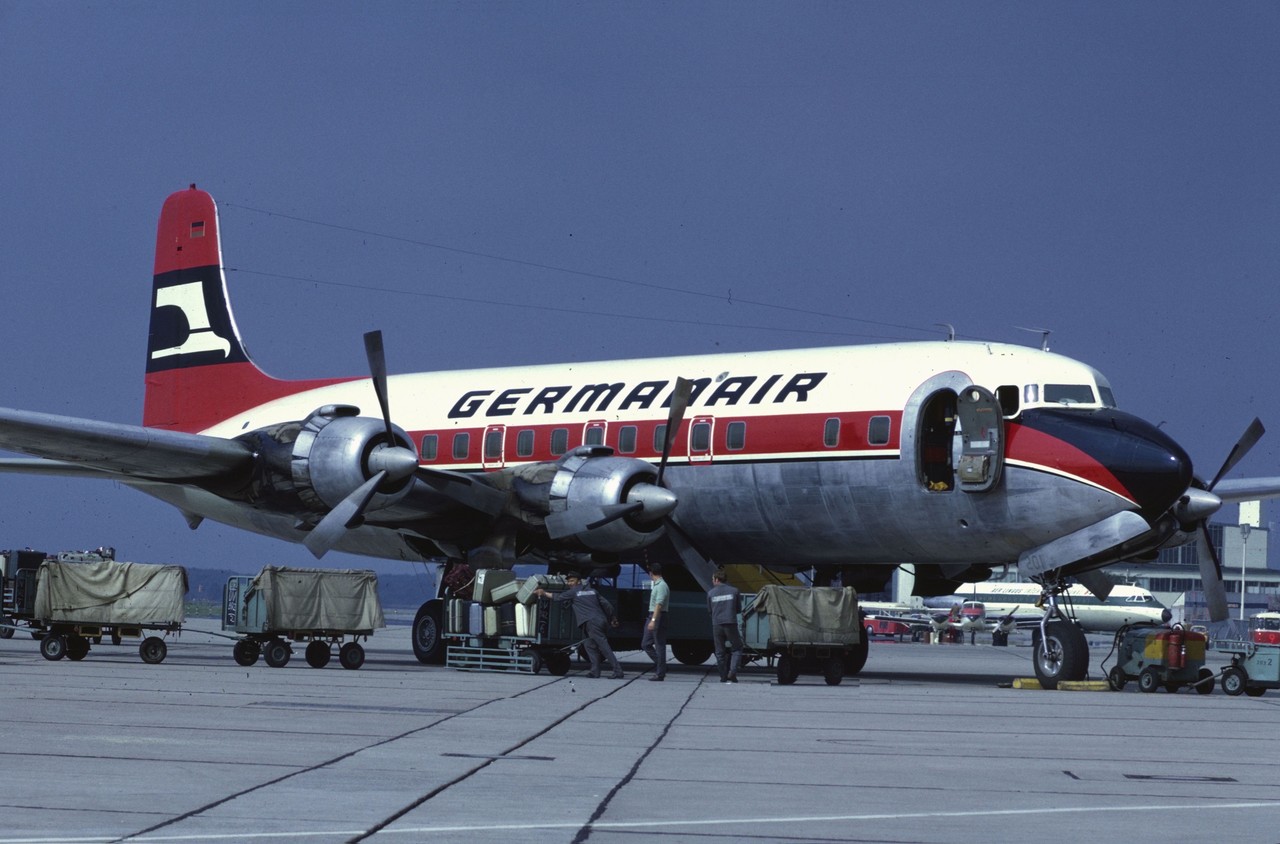
The DC-6 transformed post-war commercial aviation by offering unprecedented speed, comfort, and reliability. Launch customers American Airlines and United Airlines received their first aircraft on November 24, 1946, placing them into service in March 1947. The aircraft immediately demonstrated its capabilities when Douglas chief test pilot Larry Peyton flew between Dallas and Los Angeles in just over three hours during testing. By March 1948, DC-6s were completing the Chicago to New York route in approximately three hours, dramatically reducing transcontinental travel times.
Pan American Airways utilized the DC-6 to inaugurate tourist-class service across the North Atlantic, making international air travel accessible to a broader market. Delta Air Lines operated an extensive DC-6 fleet, promoting them with the slogan "None Faster, None Finer to and thru' the South." The aircraft's pressurized cabin could maintain an equivalent altitude of 5,000 feet while flying at 20,000 feet, allowing passengers to fly comfortably above turbulent weather.
Early Operational Challenges
The DC-6's promising start faced a serious setback in 1947 when multiple inflight fires, including the crash of United Airlines Flight 608, led to the grounding of the entire fleet. Investigation revealed a faulty fuel vent positioned adjacent to the cabin's cooling turbine as the cause. Douglas engineers quickly redesigned the fuel system, and after comprehensive modifications to all DC-6s, the aircraft returned to service within five months. United Airlines was among the first carriers to resume DC-6 operations, demonstrating confidence in the corrected design.
Presidential Service and Military Operations
President Harry Truman selected a DC-6 for official presidential transport, christening it "Independence" after his Missouri hometown. The 29th production DC-6 was specially modified as the VC-118 and delivered on July 1, 1947. This presidential aircraft featured enhanced communication equipment and executive accommodations.
The military adopted the DC-6 in various configurations following the Korean War outbreak in 1951. The U.S. Air Force designated it C-118A "Liftmaster" for personnel transport, while the Navy operated it as the R6D. Medical evacuation variants carried the MC-118A designation. These military versions proved invaluable for long-range transport operations during the Cold War era.
Douglas Aircraft Company Legacy
Douglas Aircraft Company, founded in 1921, reached its commercial aviation zenith with the DC-6. The company had previously revolutionized air transport with the DC-3 in the 1930s, and the DC-6 represented the culmination of piston-engine airliner development. Douglas operated independently until merging with McDonnell Aircraft Corporation in 1967 to form McDonnell Douglas. The combined company continued aircraft production until Boeing acquired it in 1997, ending the Douglas name as an independent manufacturer.
Engineering Excellence
Four Pratt & Whitney R-2800 Double Wasp engines powered the DC-6, each producing 2,400 horsepower from 18 air-cooled radial cylinders. These proven engines, designated R-2800-CA15 in civilian variants, provided the reliability necessary for commercial operations. The R-2800 had already demonstrated its capabilities in military aircraft during World War II, making it an ideal choice for the demanding commercial environment.
The DC-6 featured Douglas's first pressurized cabin system, thermal wing deicing, and comprehensive air conditioning. These innovations made it the most advanced piston airliner of its era and the first Douglas aircraft to exceed 300 mph cruise speed. Operating economics were exceptional, with the DC-6 achieving the lowest per-mile costs of any propeller airliner.
Variant Development
Douglas developed three main civilian variants to meet diverse market needs. The DC-6A, first flown on September 29, 1949, served as an all-cargo version with large freight doors and reinforced flooring. The DC-6B, which flew on February 10, 1951, accommodated up to 102 passengers with optimized cabin configuration. The convertible DC-6C combined passenger and cargo capabilities with removable seating and dual door arrangements.
Enduring Operations
Production concluded in 1958 after 704 aircraft, including 167 military versions. The DC-6 continued flying with airlines worldwide well into the jet age, with many examples still operating in 1998. Today, surviving DC-6s serve in specialized roles including cargo transport, military operations, and wildfire suppression. Several examples are preserved in aviation museums, representing the pinnacle of piston-engine airliner development.
The DC-6 stands as one of aviation's most successful transitional aircraft, combining wartime technological advances with peacetime commercial requirements. Its pressurized comfort, reliable operations, and economic efficiency established standards that influenced airliner design well into the jet age.