
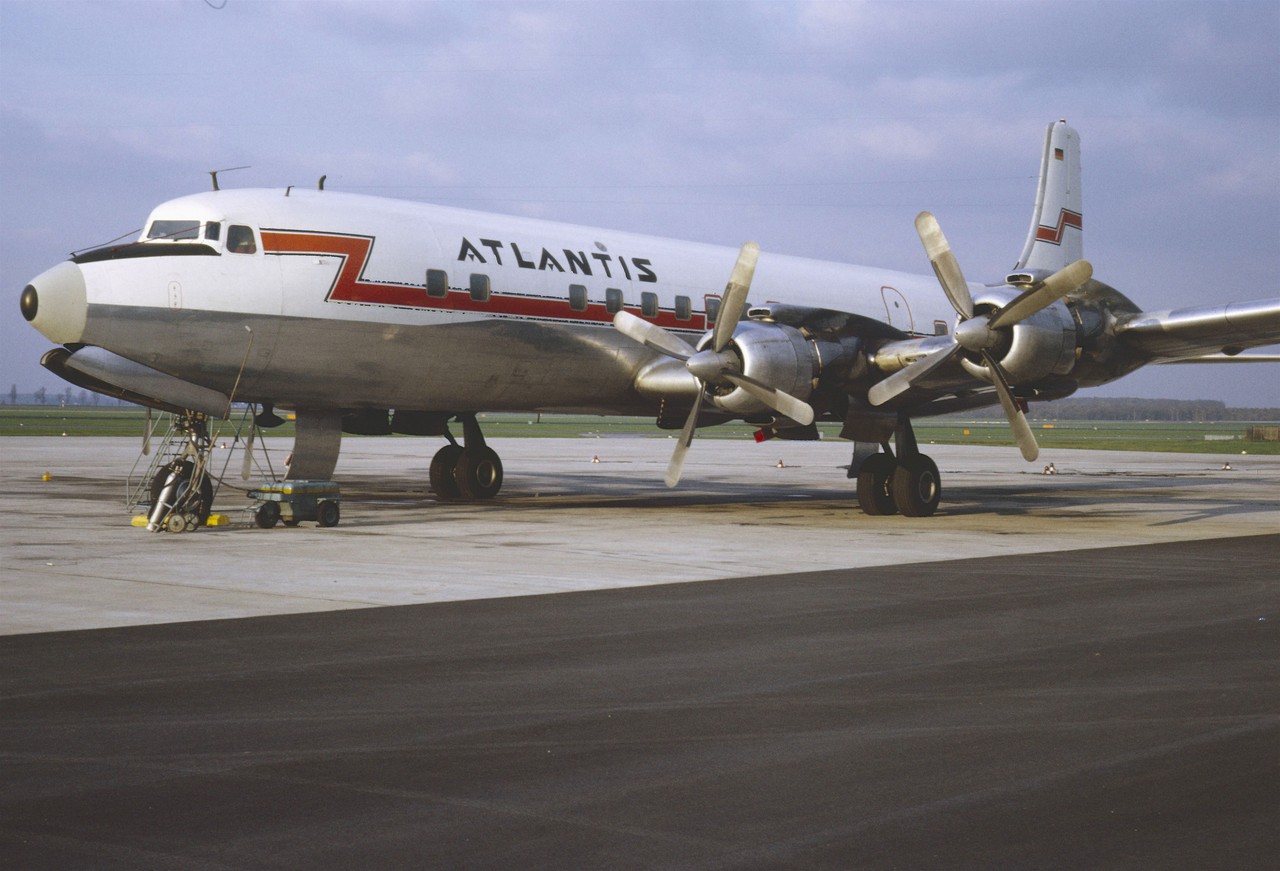
Service History
The DC-7 dominated transcontinental air travel in the United States during the brief twilight of the piston-engine era. American Airlines, the launch customer, ordered 25 aircraft for $40 million and introduced the type on the prestigious New York-Los Angeles route in November 1953. Within months, the DC-7 had revolutionized coast-to-coast travel by eliminating the mandatory fuel stops that had plagued earlier airliners. The aircraft's ability to complete the transcontinental journey in eight hours proved crucial, as federal regulations limited flight crews to eight hours of duty time within a 24-hour period.
A total of 18 airlines worldwide operated DC-7s, with major carriers including Pan American Airways, TWA, United Airlines, and Delta Air Lines joining the initial operator. Pan American inaugurated nonstop London-New York service with the improved DC-7B variant on June 13, 1955, while Scandinavian Airlines System used the long-range DC-7C to pioneer Europe-to-Far East routes over the North Pole. Delta Air Lines operated 21 DC-7 aircraft, including 10 of the enhanced 7B models, utilizing them on domestic trunk routes throughout the late 1950s.
The Manufacturer
Douglas Aircraft Company, founded by Donald Douglas Sr. in 1921, had established itself as America's premier airliner manufacturer by the 1950s. Based in Santa Monica, California, Douglas had already achieved legendary status with the DC-3 and maintained its market leadership through the DC-4 and DC-6 series. The company operated as an independent manufacturer until 1967, when it merged with McDonnell Aircraft Corporation to form McDonnell Douglas. Boeing acquired McDonnell Douglas in 1997, ending the Douglas nameplate after 76 years of aircraft production. During its heyday, Douglas competed directly with Lockheed's Constellation series and Boeing's early jetliners.
Engine & Technical Innovation
Four Wright R-3350 Turbo-Compound engines, each generating 3,250 horsepower, propelled the DC-7 to unprecedented performance levels for piston-powered aircraft. These sophisticated radial engines featured three exhaust-driven turbochargers that recovered waste energy from the exhaust gases, providing approximately 20 percent more power output than conventional engines. Wright Aeronautical Corporation had originally developed the R-3350 for military bombers during World War II, but the Turbo-Compound version represented a quantum leap in reliability and efficiency.
The DC-7's design incorporated a fuselage stretched 1.02 meters beyond the DC-6B, while the later DC-7C received an additional 1.02-meter extension to accommodate 105 passengers in high-density configurations. The aircraft's gross weight increased by 6,895 kilograms over its predecessor, necessitating strengthened landing gear and wing structures. Douglas engineers achieved their design objective of creating the fastest commercial transport in service, with the DC-7 cruising at 365 mph and reaching maximum speeds of 410 mph.
Production & Variants
Douglas manufactured 338 DC-7s between 1953 and 1958, comprising three distinct variants. The initial DC-7 accounted for 105 aircraft, followed by 112 examples of the DC-7B with improved engines and systems. The final 120 aircraft were built as DC-7Cs, featuring extended fuselage and range capabilities for intercontinental operations. Production ceased in 1958 as airlines rapidly transitioned to jet-powered aircraft like the Boeing 707 and Douglas's own DC-8.
A planned DC-7D variant, intended to feature four Rolls-Royce Tyne turboprop engines, never progressed beyond the design stage due to the jet age's arrival. This cancellation marked the end of Douglas's piston-engine airliner development, as the company redirected resources toward jet aircraft production.
Tragic Legacy
The DC-7's service record was marred by one of aviation's most significant disasters. On June 30, 1956, United Airlines Flight 718, a DC-7 named "Mainliner Vancouver," collided with a TWA Lockheed Super Constellation over the Grand Canyon at 21,000 feet. The collision destroyed the DC-7's left wing, sending the aircraft into an uncontrolled spin before crashing at Chuar Butte. All 128 passengers and crew aboard both aircraft perished, making it the deadliest aviation accident in history at that time. This tragedy led to major reforms in air traffic control and the creation of the Federal Aviation Agency.
Current Status
Fewer than a dozen DC-7s remain in existence today, with most serving as museum displays rather than operational aircraft. Epic Flight Academy's DC-7, the final passenger variant built in 1956, accumulated more than 33,000 flight hours before retirement in 2005. This aircraft now resides in the National Air and Space Museum in Washington, DC, serving as a monument to the golden age of piston-engine aviation. The DC-7's brief but significant career bridged the gap between the propeller era and the jet age, representing the ultimate expression of piston-powered commercial aviation technology.