
The Stretch Revolution
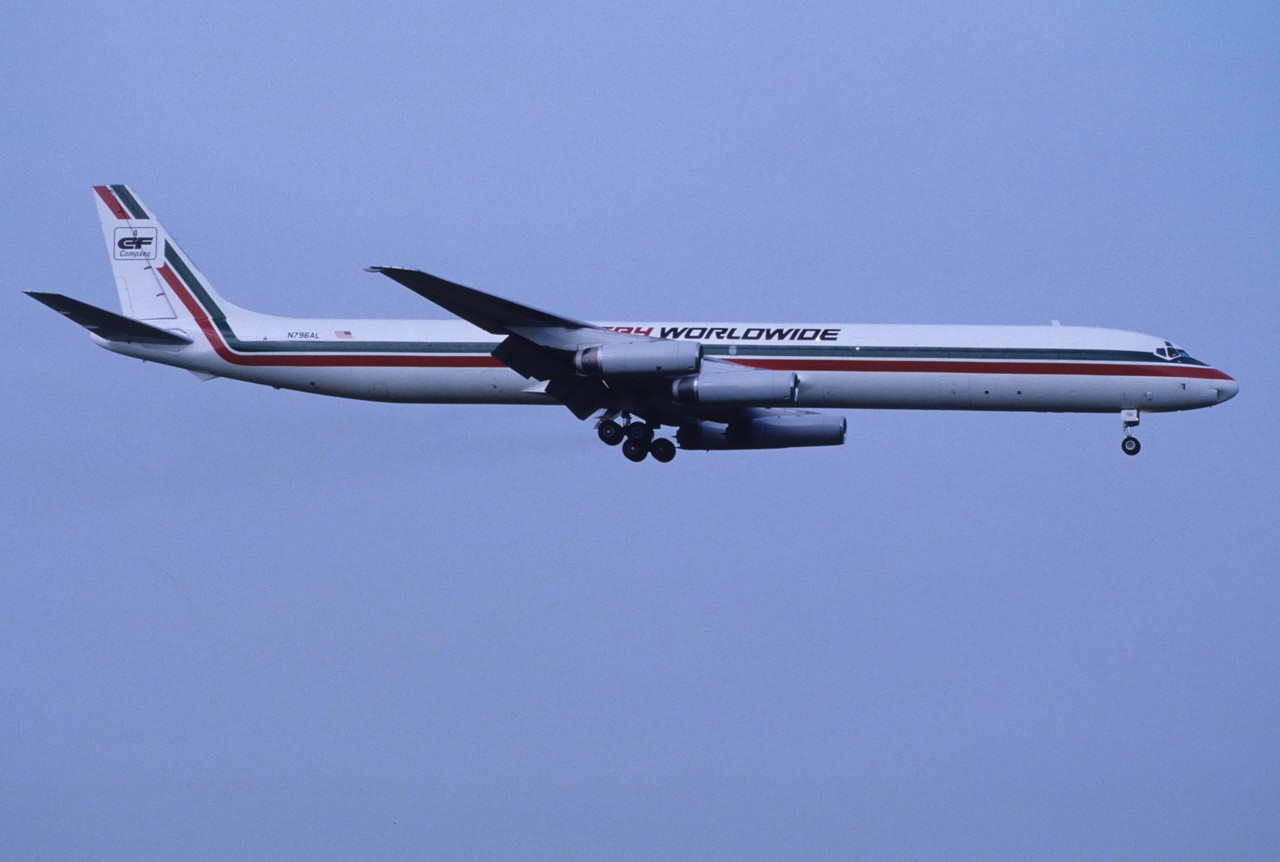
The DC-8-60 series emerged from McDonnell Douglas's bold decision to dramatically extend their proven jetliner design rather than develop an entirely new aircraft. Announced in April 1965, the Series 60 variants demonstrated that the original DC-8 structure possessed sufficient strength and ground clearance to accommodate a one-third increase in cabin size without requiring longer landing gear—a remarkable testament to the foundational design's robustness.
The DC-8-61 pioneered this stretched configuration when it first flew on March 14, 1966. The 36-foot fuselage extension transformed the aircraft from a medium-capacity jetliner into a high-density transport capable of competing with newer wide-body designs through sheer passenger volume rather than cabin width.
Commercial Dominance
United Airlines became the launch customer for the DC-8-61, placing the type into revenue service in February 1967 following certification on September 2, 1966. The stretched variants offered airlines unprecedented flexibility: the DC-8-61 maximized passenger capacity, the DC-8-62 optimized long-range performance with extended wingspan, and the DC-8-63 combined the -61's stretched fuselage with the -62's long-range wing design.
This versatility proved commercially successful as airlines could select configurations matching specific route requirements. The DC-8-62 achieved remarkable range performance of 5,500 nautical miles, enabling non-stop service on transcontinental and intercontinental routes that previously required fuel stops.
McDonnell Douglas Heritage
The DC-8-60 series entered production during a pivotal period for its manufacturer. Originally developed by Douglas Aircraft Company, the program transitioned under McDonnell Douglas Corporation following the 1967 merger between Douglas Aircraft and McDonnell Aircraft Corporation. This consolidation created one of America's premier aerospace contractors, combining Douglas's commercial aviation expertise with McDonnell's military aircraft specialization.
Production continued at the Long Beach Airport facility in California, where McDonnell Douglas maintained the manufacturing line through 1972. The company's engineering teams had successfully evolved the DC-8 from its origins as a competitor to Boeing's KC-135 tanker into a diverse family of commercial jetliners spanning short-haul through ultra-long-range applications.
Advanced Powerplant Technology
The Series 60 variants benefited from significant propulsion advances, particularly the adoption of Pratt & Whitney JT3D turbofan engines. These powerplants delivered 18,000 pounds of thrust on the DC-8-61 and DC-8-62, while the DC-8-63 employed 19,000-pound thrust variants. The turbofan technology provided substantial improvements in fuel efficiency compared to earlier turbojet engines, directly enabling the economic viability of stretched configurations.
Engineers designed the Series 60 for efficient cruise performance at Mach 0.82, balancing speed with fuel economy. Maximum takeoff weights reached 325,000 pounds for the DC-8-61, with the DC-8-62 and DC-8-63 handling 334,900 pounds and 350,000 pounds respectively, accommodating the additional fuel required for extended range operations.
Operational Excellence
From a pilot's perspective, the DC-8-60 series maintained the handling characteristics that made the original DC-8 popular among flight crews while adding the complexity of managing a significantly longer aircraft. The extended fuselage required modified ground handling procedures and enhanced rudder authority for crosswind operations, but the fundamental flight characteristics remained predictable and professional.
The cockpit retained the three-crew configuration standard for the era, with captain, first officer, and flight engineer managing the four-engine powerplant and complex fuel systems necessary for long-range operations. Pilots appreciated the aircraft's stability in turbulence and reliable performance across diverse operating conditions.
Production Legacy and Retrofit Programs
McDonnell Douglas produced the DC-8 family through 1972, achieving a total of 556 aircraft across all variants. While specific production numbers for Series 60 aircraft are not definitively recorded, these stretched variants represented a significant portion of later production as airlines gravitated toward higher-capacity configurations.
The type's operational life extended well beyond initial production through innovative retrofit programs. Beginning in 1975, McDonnell Douglas partnered with General Electric to offer Series 70 conversions, replacing original JT3D engines with modern CFM56 turbofans. This program converted 110 DC-8s by 1988, dramatically reducing noise levels and improving fuel efficiency to meet evolving environmental regulations.
Enduring Service
While the DC-8-60 series largely exited passenger service during the 1980s and 1990s as airlines transitioned to more modern designs, many aircraft found second careers as cargo haulers. The stretched fuselage configurations proved particularly valuable for freight operations, where the combination of volume and range remained commercially viable.
Today, the DC-8-60 series represents a crucial chapter in commercial aviation history—demonstrating how innovative engineering could extend an existing design's competitive life rather than requiring completely new development programs. The success of these stretched variants influenced subsequent airliner development, establishing fuselage extensions as a standard technique for adapting aircraft to evolving market demands.